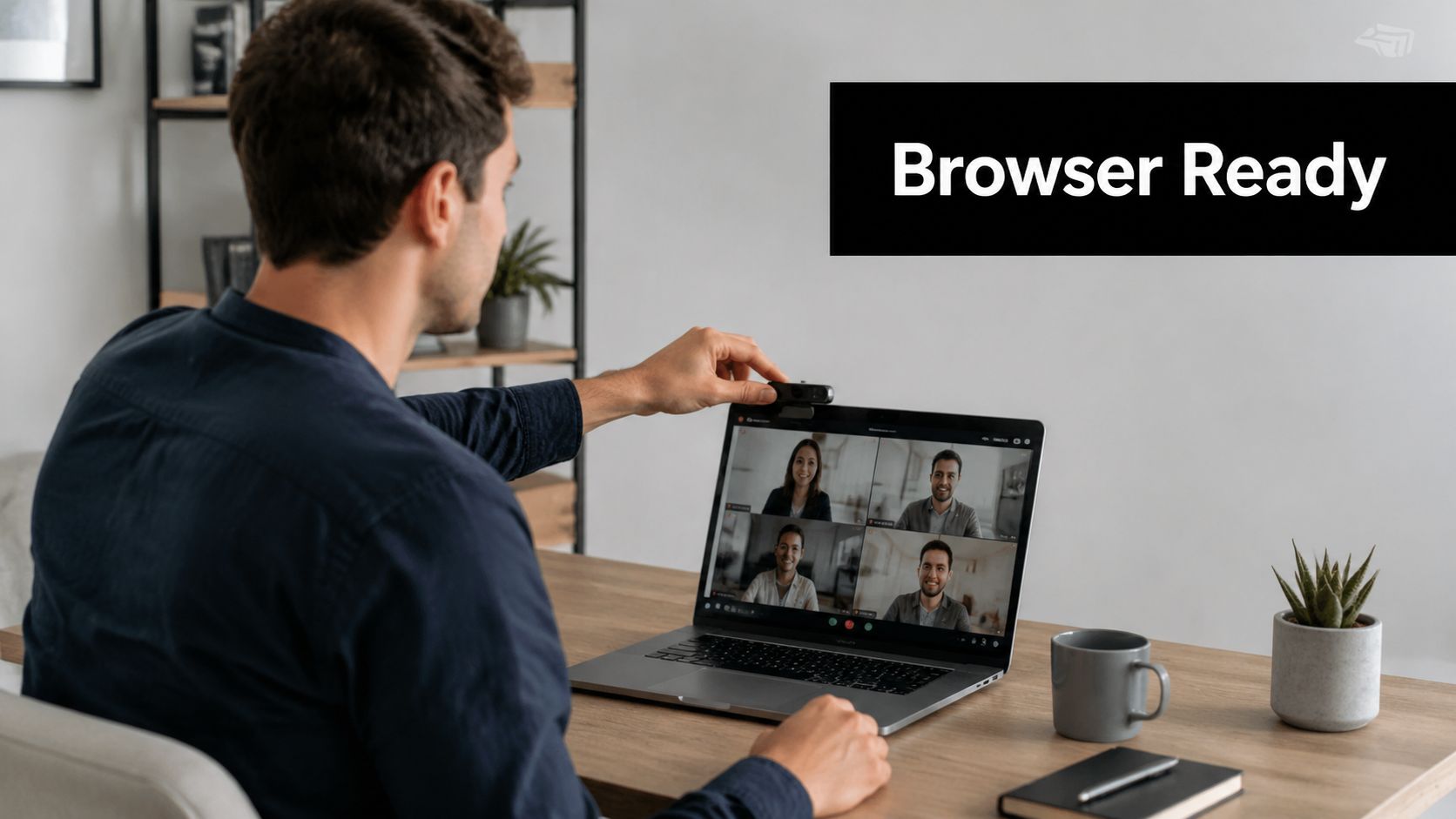
You're preparing for an important meeting. The agenda is solid, the attendees are on time, and the host sends a browser-based link so nobody has to install anything. Then the first message appears in chat: “I can hear everyone, but my camera is black.” A second person says screen sharing never starts on their laptop. Someone joining from an iPhone gets stuck after the microphone prompt.
That's browser compatibility in real life.
For technical project managers, this problem is frustrating because it often looks random. The application worked in QA. It worked on the host's machine. It even worked for most of the participants. But a browser-based meeting platform lives at the intersection of frontend rendering, media pipelines, operating system permissions, network conditions, and browser security rules. A small mismatch in any of those layers can break the experience for one user while everyone else connects normally.
The good news is that browser compatibility isn't guesswork if you approach it strategically. You don't need a giant spreadsheet of every browser version ever released. You need a way to understand where incompatibilities come from, which combinations matter most, and how to test based on your actual audience and business priorities.
Why Browser Compatibility Is Critical for Your Meetings
A failed checkout flow is bad. A failed meeting start is worse. Meetings are live, time-bound, and public. When video, audio, or screen sharing breaks in front of customers, partners, or executives, everyone notices immediately.
In a browser-based meeting environment, users assume the product will “just work.” That expectation is reasonable. If a platform promises no downloads and instant access, people don't think in terms of rendering engines, codec negotiation, or permission policies. They click Join. If anything goes wrong, they blame the meeting platform, not the browser.
Reliability is part of the product
A compatibility issue doesn't just create a technical defect. It changes how people judge reliability.
Consider a common scenario. A sales team launches a customer demo. The presenter is on a recent Chrome build, the buyer joins from Safari on a managed MacBook, and legal counsel joins from a locked-down corporate Firefox setup. The user interface may load fine for all three. Then the buyer's video degrades, and the counsel can't grant device access cleanly because of browser settings and enterprise controls. The meeting starts late, support gets pulled in, and the conversation begins with friction instead of confidence.
Practical rule: In meetings, the user doesn't separate “app quality” from “browser behavior.” They experience one product.
That's why browser compatibility belongs in platform planning, release management, and operational readiness. It's not a frontend detail to leave for the end of the sprint.
Small defects become visible fast
Video platforms expose incompatibilities faster than most web apps because they use more of the browser at once:
- Layout and rendering: Controls, panels, modals, and responsive views must display correctly.
- JavaScript execution: Joining, muting, chatting, and screen sharing depend on client-side logic.
- Hardware access: The browser has to negotiate camera, microphone, and speaker selection.
- Real-time media: Audio and video streams have to encode, transmit, decode, and adapt in real time.
A broken button frustrates one click. A broken meeting flow blocks a conversation.
That's why mature teams treat browser compatibility as part of service reliability. If the meeting has to start on time, compatibility work has to happen before users arrive.
Understanding Browser Rendering Engines
A meeting app can look stable in one browser and still fail in another, even when the code is the same. The reason often sits below the brand name. It sits in the rendering engine.
The rendering engine is the browser component that interprets HTML, CSS, JavaScript-related platform behavior, and many APIs the interface depends on. For a project manager, the practical takeaway is simple. Chrome, Edge, Safari, and Firefox are not four entirely separate testing targets, but they are not interchangeable either. Several browsers share the same engine, and that shared foundation explains why some bugs cluster together.

The engine layer is the real compatibility layer
A clearer way to frame browser support is to group browsers by the engine underneath them.
| Browser family | Rendering engine | Why it matters |
|---|---|---|
| Chrome and most Chromium-based browsers | Blink | Broad coverage across desktop and Android environments |
| Safari | WebKit | High importance on Apple devices, especially iPhone and iPad |
| Firefox | Gecko | Still relevant in enterprise, privacy-focused, and standards-conscious environments |
This model helps teams diagnose issues faster. If a control breaks in Chrome and Edge, the first suspect is usually Blink behavior or Chromium-specific implementation details. If the same workflow fails only in Safari, WebKit becomes the likely source of the difference.
That is more useful than treating every browser brand as a separate mystery.
Why this matters for AONMeetings
For AONMeetings, engine differences are not just about layout polish. They affect the path a user takes from clicking a meeting link to joining with working audio and video. A permissions prompt may appear differently. A device picker may expose cameras in a different order. A real-time media feature may be supported, partially supported, or handled through a different browser-specific path.
The result is a planning problem, not just a coding problem.
Teams that manage compatibility well do not ask, "Which browsers exist?" They ask, "Which engines do our users rely on, and which meeting flows matter most in each one?" That shift turns browser compatibility from a long generic checklist into a business decision based on real usage patterns. If your user base is heavy on managed Macs and iPhones, WebKit deserves early attention. If most attendees join from corporate Windows laptops, Blink coverage may deserve the first pass. Firefox may still matter less often, but it can matter a lot for regulated or locked-down environments.
Rendering is only part of the story
The term "rendering engine" can be misleading because it sounds visual, as if it only controls page appearance. In a meeting platform, the browser engine influences much more than what users see. It affects event timing, media-related APIs, permission handling, performance characteristics, and the way the app interacts with browser networking and security rules.
That is why a button can look correct while the join experience still fails.
Under the hood, live meetings also depend on signaling, device access, and media negotiation. Teams evaluating real-time behavior should understand how the browser interacts with WebRTC signaling and session setup, because compatibility problems often appear before the first video frame is ever rendered.
Why engineers talk about engines instead of browser names
Engine-level language shortens the path from bug report to fix. "Safari on iPhone fails to keep the selected microphone after permission approval" gives the team a stronger starting point than "mobile is broken." It points toward WebKit behavior on iOS, permission state handling, and device enumeration, instead of sending the team into a broad search.
This also helps with prioritization. A bug in a Blink-based path may affect Chrome, Edge, and several Chromium-based browsers at once. A WebKit-specific issue may affect nearly every iPhone user you serve. The business impact comes from audience concentration, not from the number of browser logos on a support matrix.
Why the same standards still produce different results
Standards reduce inconsistency, but they do not erase it. Browser vendors implement standards on different schedules, apply security restrictions differently, and make different product decisions around experimental or privacy-sensitive features. In practice, "supported" often means "supported with conditions."
That gap matters in meetings because users notice delays immediately. If joining takes an extra permission step in one browser, or if screen sharing behaves differently on one platform, the meeting feels less reliable even when the app code has not changed.
For project managers, the practical lesson is straightforward. Track compatibility by engine, map it to your audience, and prioritize the meeting journeys that affect revenue, onboarding, and executive communications first. That is how teams improve AONMeetings for the users who show up, instead of testing every browser combination as if each one matters equally.
Key Compatibility Hurdles for Video Conferencing
A normal business web app can get away with basic compatibility coverage for layout, forms, and API calls. Video conferencing can't. Real-time communication pushes the browser harder and exposes differences that simple page testing never catches.
The fastest way to understand this is to separate general browser behavior from RTC-specific behavior.

General compatibility is only the first layer
A meeting app still needs the usual web basics:
- Layout consistency: Buttons, participant tiles, and menus need to render in the right place.
- Interactive logic: Join flows, mute toggles, settings dialogs, and chat all depend on JavaScript executing correctly.
- Standard APIs: Device enumeration, storage behavior, and network requests all rely on browser APIs behaving as expected.
Many teams stop there. That's not enough for live media.
WebRTC is where differences become expensive
WebRTC is the browser technology that enables real-time audio, video, and peer or server-mediated communication. Think of it as the live transport system for your meeting. If HTML is the meeting room walls, WebRTC is the wiring, microphones, and video switcher.
The browser has to do several things at once: discover devices, request permission, negotiate media formats, establish network paths, and keep streams synchronized while conditions change. That means a defect may not appear as a “UI issue” at all. It may show up as frozen video, one-way audio, or poor adaptation under load.
If you need a grounding in how the signaling side fits into the call setup process, this overview of a WebRTC signaling server is useful context.
Codec support changes the actual meeting experience
A codec is the format used to compress and decompress media. The simple analogy is language. If one browser speaks one media language well and another speaks it poorly, they can still communicate, but not always efficiently.
According to Ant Media's WebRTC browser support guide, Chrome, Edge, and Firefox fully support VP8, VP9, and hardware-accelerated H.264, while Safari on macOS lacks VP9 support entirely and relies on software-decoded VP8, which is CPU-intensive.
That has direct implications:
- A call that looks smooth in Chrome may tax Safari more heavily.
- Higher-resolution video can require fallback behavior.
- Media servers often need transcoding strategies when Safari is a priority.
For PMs, this matters because “video quality issue” may actually mean “codec mismatch plus CPU load,” not “the internet is bad.”
Permissions, policies, and extensions cause hidden failures
Not every compatibility problem is a rendering or codec issue. Some are policy problems masquerading as bugs.
Three common culprits:
Device permissions
The browser may have blocked camera or microphone access, or the user may have denied it once and forgotten.Security restrictions
Enterprise browser settings, embedded contexts, or stricter browser security rules can limit media access or screen sharing behavior.Browser extensions
Privacy tools, script blockers, and audio-routing extensions can interfere with real-time media without obvious warning.
When a user says, “The site loaded, but the meeting didn't work,” these are often the first places experienced support teams check.
The Desktop Versus Mobile Compatibility Divide
A meeting experience that works on desktop may still fail on mobile for reasons that have nothing to do with your application code quality. Mobile browsers run in tighter environments. They have less thermal headroom, more aggressive power controls, and operating system rules that shape what the browser can do.
Desktop users also tend to tolerate complexity better. They're comfortable checking browser settings, selecting devices, or reopening a tab. Mobile users are moving faster. They expect a tap-to-join path with almost no recovery steps.
Why mobile is a different operating model
On desktop, users usually have a larger viewport, stable permissions UI, and more visible browser controls. On mobile, browser prompts can be easier to miss, device switching is less transparent, and interruptions from the operating system are more common. A phone call, battery optimization, or backgrounding event can affect media behavior quickly.
The biggest source of confusion is iOS. Many people assume switching from Safari to Chrome on iPhone means switching browser technology. It doesn't work that way. On iPhone and iPad, browsers use Apple's WebKit engine, so changing the app icon doesn't necessarily eliminate a WebKit-specific issue.
That's why mobile browser compatibility needs its own test path. It isn't just “desktop, but smaller.”
Accessibility and responsive behavior matter more on mobile
Meeting interfaces on mobile also have to balance compact layouts with permission flows, captions, controls, and touch targets. Accessibility and compatibility often intersect here. A control that technically renders may still be hard to operate, discover, or understand on a smaller device.
For teams working through mobile accessibility and responsive constraints, ADA Compliance Pros' 508 compliance challenges gives useful context on why mobile-friendly design decisions can become compliance problems if they're not tested carefully.
A practical example is the Chromebook edge case. Users may assume Chromebook behavior matches either desktop Chrome or a mobile device, but support patterns can differ depending on hardware, permissions, and school or enterprise management. This guide on using Zoom on Chromebook helps illustrate why browser and device combinations deserve specific validation, even when the browser brand looks familiar.
Mobile browser compatibility is less about visual polish and more about respecting platform rules that users never see.
Strategic Testing for a Flawless Meeting Experience
Most compatibility plans fail because they start with a list of browsers instead of a list of users. That sounds small, but it changes everything.
A long browser checklist feels thorough. It also wastes time if it isn't tied to real traffic, customer value, and the features people use. The stronger approach is to build a dynamic compatibility matrix from your own analytics and support evidence.

Build the matrix from user behavior
Virtooso QA's discussion of browser compatibility testing notes that most content overemphasizes version checklists and underexplains the value of a dynamic, traffic-driven compatibility matrix. It also points out that for many applications, covering one major Blink browser, Safari on iOS or macOS, and Firefox handles the engine layer, while the rest should be weighted by analytics.
That's the right mental model for a PM. Start with engine coverage, then prioritize based on who your users are and what they're trying to do.
A practical decision framework
Use a matrix with three dimensions:
User importance
Segment users by business significance, not just volume.
- Revenue-critical groups: Customers, buyers, partners, and regulated users get first priority.
- Internal power users: Hosts, moderators, trainers, and presenters need stronger coverage than passive attendees.
- Environment sensitivity: Healthcare, education, and enterprise IT environments often need extra compatibility validation because device controls and browser policies differ.
Feature criticality
Not every feature deserves the same test depth.
| Feature area | Priority logic |
|---|---|
| Join flow | Must work everywhere you officially support |
| Audio and video | Core meeting success criteria |
| Screen sharing | High priority for presenters and training sessions |
| Chat and reactions | Important, but secondary to media and join success |
| Advanced settings | Validate, but don't let them consume all test capacity |
Environment risk
This is where many teams under-test.
- Low-bandwidth conditions: A strong office network hides adaptation issues.
- Older or underpowered devices: Media decode and UI responsiveness can degrade together.
- Partial JavaScript failure: If script loading or execution degrades, key controls may disappear or stall.
The testing principle here aligns with guidance from TestGrid's browser compatibility discussion: strong compatibility work includes simulating degraded conditions, using transpilation in CI/CD, applying conditional polyfills, and validating dynamic UI elements in older or constrained environments. I'm referencing the idea qualitatively here because the core operational takeaway matters more than memorizing a checklist.
Blend automation with human validation
Automation is great for regression detection. It's weak at telling you what a real user feels during a live call. Use both.
A good mix looks like this:
- Automated checks for core joins, control visibility, and repeated regressions.
- Manual exploratory sessions for screen sharing, permission recovery, device switching, and reconnection behavior.
- Support feedback review every release cycle to see which browser and device combinations generate tickets.
If users report poor local performance, it's also worth having support content ready for browser-level tuning. Guidance such as how to turn on hardware accelerator can help recover performance in environments where decode and rendering are stressing the device.
Best Practices for AONMeetings Implementers
A meeting starts failing before anyone clicks Join. It starts when an attendee opens an invitation on a locked-down work laptop, or uses a browser your team never validated, or reaches the meeting with camera permissions still blocked. By the time support hears about it, the host is waiting and confidence is already slipping.
That is why strong browser compatibility work is not just a technical cleanup task. For AONMeetings implementers, it is an operational plan. The goal is not to support every possible browser equally. The goal is to focus effort where it protects the largest share of real users and keeps meetings running smoothly.
Set a browser support policy based on actual usage
Start with your own audience, not a generic compatibility chart.
If most attendees join from current Chrome and Safari versions, validate those first and document them clearly. If your customer base includes regulated enterprises with managed Windows devices, put more weight on Edge in hardened environments. If executives and field teams often join from mobile devices, include those combinations in your primary support matrix.
This works like capacity planning. You do not build for every theoretical peak. You build for the traffic patterns you have, then prepare a fallback plan for the edges. Browser compatibility should follow the same logic.
A simple support policy should define:
- Primary browsers: the combinations your team tests every release
- Supported fallback browsers: combinations expected to work for core meeting tasks
- Higher-risk environments: older browser versions, restrictive enterprise policies, and uncommon device setups that may need extra guidance
That gives product, support, and customer-facing teams one shared answer instead of case-by-case guessing.
Put guidance before the meeting, not after the incident
A short pre-meeting message prevents more meeting failures than a long help article sent after a problem starts.
Keep it practical. Tell attendees which browsers your organization has validated most thoroughly. Remind them to allow camera and microphone access. Ask them to close apps that may already be using those devices.
Users do not need a lecture on rendering engines or codecs at this stage. They need a short runway checklist, the same way passengers need boarding instructions before takeoff, not after the plane is delayed.
Use a preflight experience to catch the common failures early
A preflight or green room page is one of the best controls you can add to AONMeetings. It turns unknowns into visible checks before the live session begins.
A useful preflight flow should let attendees:
- test camera visibility
- test microphone pickup
- confirm speaker output
- review and grant permissions
- switch to the correct devices
For project managers, the value is simple. A preflight step shifts failure from a live meeting to a controlled setup moment. That reduces support pressure and protects the meeting itself.
Plan for enterprise restrictions as part of implementation
Corporate environments often change browser behavior in ways users cannot explain. VPNs, endpoint security tools, browser hardening policies, virtual desktop sessions, and firewall rules can all interfere with media setup or device access.
As noted earlier, browsers have a long history of inconsistent behavior across vendors and environments. That history still matters. In video meetings, small differences in permission handling, codec support, or screen sharing policies can produce very different user outcomes even when the interface looks the same.
Treat those environments as first-class implementation inputs. Ask customers and internal stakeholders early whether attendees will join from managed devices, restricted networks, or virtualized desktops. Then document the known limits and recovery paths before rollout.
Align support, product, and rollout decisions
Compatibility work improves fastest when support tickets, release testing, and browser policy are connected.
If support keeps seeing the same issue from one browser and device combination, that pattern should influence what the team tests before the next release. If a low-volume browser consumes a large share of triage time, decide whether to invest in full support, document a limitation, or guide those users to a better-tested option. This is the strategic part many teams skip.
For AONMeetings implementers, the practical standard is clear. Use real user data to decide where to test thoroughly, communicate browser expectations early, and build simple recovery steps into the meeting flow. That is how you turn browser compatibility from a recurring fire drill into a managed part of service delivery.
A Quick Troubleshooting Checklist for Users
When a meeting won't start properly, users don't want theory. They want the next step. The fastest support flows are symptom-based and short enough to scan while the clock is ticking.

If your camera or microphone isn't working
Try these in order:
Check browser permissions
Open the browser's site settings and confirm camera and microphone access is allowed.Select the correct devices
Many users have multiple microphones, webcams, or audio outputs connected. Make sure the meeting app is using the intended ones.Close other apps
Another browser tab, video app, or recording tool may already be using the device.
If the meeting page loads but media is unstable
Use this quick reset sequence:
- Refresh the meeting tab
- Close unnecessary tabs and background apps
- Try a private or incognito window to rule out extension conflicts
- Update the browser if it's outdated
- Restart the device if nothing else clears the issue
If screen sharing or controls behave strangely
The likely causes are browser restrictions, extension interference, or a stale browser session.
A practical rule of thumb:
- First attempt: Refresh and retry
- Second attempt: Use a private window
- Third attempt: Switch to a recommended browser on the same device
- Last resort: Restart and rejoin
If you're supporting end users, put this checklist in every meeting invitation and on the join page. Many individuals can fix common browser compatibility issues in a minute if the steps are obvious.
A reliable meeting experience starts long before the first participant joins. If you need a browser-based platform built for secure, enterprise-ready collaboration without downloads, explore AONMeetings to see how modern web conferencing can stay simple for users while meeting the demands of real-world IT environments.