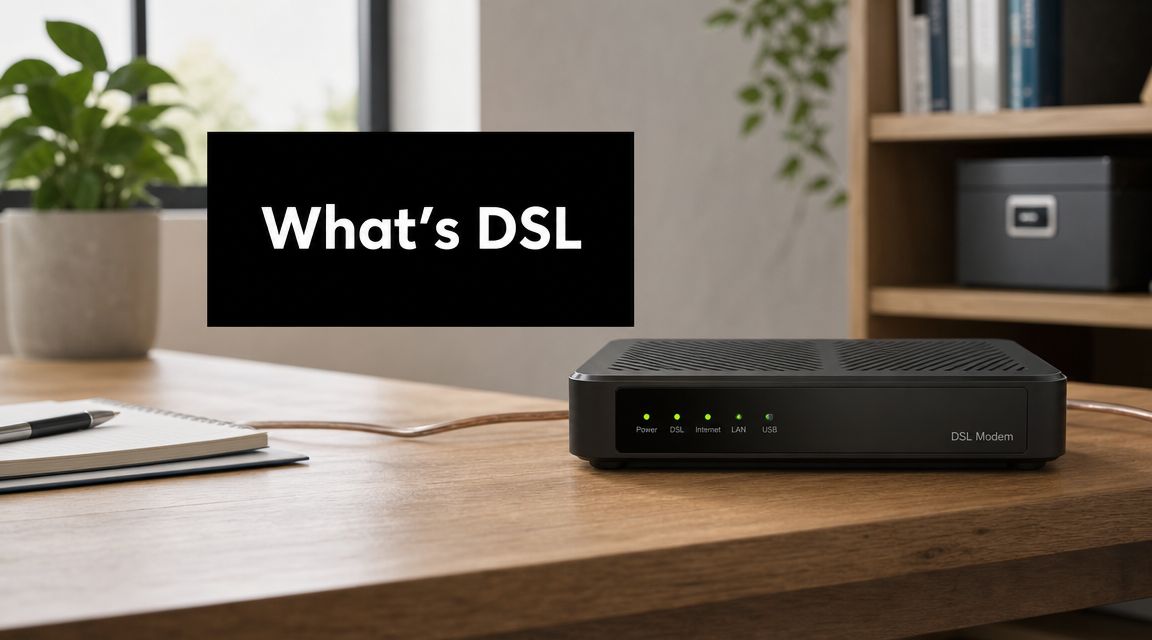
DSL usually means Digital Subscriber Line, a type of internet service that uses existing telephone lines and lets internet data travel without interrupting voice calls. Depending on the variant and line conditions, DSL can range from about 5 Mbps to 100 Mbps in typical residential use, with examples such as ADSL up to 20 Mbps down and 1.4 Mbps up, VDSL up to 52 Mbps down and 16 Mbps up, and VDSL2 up to 100 Mbps both ways, or even about 200 Mbps down and 100 Mbps up in favorable conditions.
If you're looking at an internet bill, shopping for a small office connection, or trying to figure out why video meetings feel choppy, that's probably why you're asking what DSL means. The term sounds technical, but the idea is simpler than it looks once you connect it to how your office works day to day.
Decoding Your Internet Service
Internet providers love abbreviations. DSL, cable, fiber, modem, router, throughput. If you're a small business owner, you're often expected to make a buying decision based on terms that nobody explained in plain English.
DSL is one of those terms that shows up everywhere, especially in older plans, rural areas, and small offices that still use legacy telecom infrastructure. In practical terms, it means your internet is riding over the same copper phone lines that were already in place for landline service.
That matters because it explains both DSL's biggest strength and its biggest limitation. The strength is convenience. Providers could offer broadband without installing a completely new network. The limitation is that older copper lines have performance boundaries that show up fast when your team starts doing cloud backups, file uploads, and video conferencing.
A lot of confusion also comes from people mixing up speed with usable performance. Your plan might sound fine on paper, but video calls depend on more than the advertised number. If you want a plain-English explanation of that difference, this guide to throughput in computer networks is worth reading.
Why business owners still run into DSL
DSL isn't just a relic. Many offices still use it because:
- The building already supports it and setup is straightforward.
- It may be the only wired option in some areas besides slower legacy services.
- Basic business tasks work well enough when usage is light and expectations are realistic.
Practical rule: If your business mostly browses the web, sends email, and runs a few cloud apps, DSL can be workable. If several people need stable video calls at the same time, the upload side becomes the real test.
When people ask "Whats DSL mean," what they usually want to know is not the acronym itself. They want to know whether their current connection is the reason meetings freeze, files upload slowly, or remote staff complain that calls sound robotic.
How DSL Internet Actually Works
DSL most commonly means Digital Subscriber Line, a broadband technology that uses ordinary copper telephone lines to transmit internet data while leaving voice service uninterrupted, and the term originally came from digital subscriber loop according to the Cambridge definition of DSL.

One wire, two jobs
The easiest way to understand DSL is to picture a road with separate lanes. The physical road is the copper telephone line. One lane carries voice traffic. Another lane carries internet data. Because the traffic is separated by frequency, you can talk on the phone and use the internet at the same time.
That was a major shift from dial-up. Dial-up tied up the line. DSL didn't. For households and small businesses, that made broadband feel practical for daily work instead of something you connected to only when needed.
The modem and the filter
In a DSL setup, the DSL modem acts like a translator. Your computer and office devices speak digital networking language. The phone line carries signals in a form suited to the copper circuit. The modem converts between the two.
You may also hear about microfilters or a splitter. Their job is simple. They keep voice signals and data signals from interfering with each other. Without that separation, you can end up with noise on phone calls or an unstable connection.
A separate question many owners ask is whether the equipment in the office affects performance too. It can. If your internal network is weak, even a decent line will feel slow. This article on whether routers affect internet speed gives a practical breakdown.
What happens on the provider side
At your provider's end, the DSL signal connects into telephone company equipment that aggregates many subscriber lines and routes data into the wider internet. You don't need to memorize the hardware names to make a smart decision. The useful takeaway is this: DSL works by stretching broadband over a phone system that was never originally built for modern video-heavy business traffic.
DSL was a smart reuse of existing infrastructure. That's why it spread widely and became a mainstream alternative to dial-up.
For a small business, that history matters because it explains why DSL often remains available where fiber still isn't, but also why its performance ceiling is lower.
ADSL vs VDSL Understanding DSL Variants
Not all DSL plans behave the same. This variance often trips people up. They hear "DSL" and assume it's one fixed kind of service, but it's really a family of technologies.
Published examples show the spread clearly in RingCentral's explanation of DSL variants: ADSL has been described with download speeds of up to 20 Mbps and upload speeds up to 1.4 Mbps, VDSL up to 52 Mbps down and 16 Mbps up, and VDSL2 up to 100 Mbps for both upload and download in some deployments, as outlined in this RingCentral DSL overview.
Why ADSL feels fine until you start talking on video
The "A" in ADSL stands for asymmetric. That means downloads are faster than uploads. For older internet habits, that made sense. People mostly downloaded web pages, music, and videos.
For modern work, upload matters much more than it used to. Every time you join a video meeting, send a large attachment, sync files to the cloud, or share your screen, you're uploading. ADSL can feel acceptable for browsing and still struggle during a client call because the upstream side is the bottleneck.
Where VDSL and VDSL2 fit
VDSL and VDSL2 are faster DSL variants. In plain language, they offer a better shot at handling today's workloads, especially if your business depends on remote collaboration.
A simple way to understand it:
| Variant | Best fit |
|---|---|
| ADSL | Web browsing, email, light cloud use |
| VDSL | Small offices with mixed use and occasional video calls |
| VDSL2 | Heavier daily use, more frequent calls, better upload demands |
If your team says "downloads are okay, but calls break up when we present," that's a classic sign to look beyond basic ADSL.
If you're checking your provider portal and trying to understand whats DSL mean for your office, the specific variant matters almost as much as the word DSL itself.
DSL vs Cable and Fiber Internet Compared
For most businesses, the question isn't what DSL stands for. It's whether DSL is the right fit compared with cable or fiber.

The biggest difference is consistency
DSL is distance-sensitive. Signal quality drops as the line gets farther from the provider's central office, so real-world performance can vary a lot by address. Ringy notes typical residential DSL speeds ranging from 5 Mbps to 100 Mbps, with VDSL2 reaching about 200 Mbps down / 100 Mbps up in favorable conditions, and explains that loop length affects throughput in this Ringy guide to DSL performance.
That distance issue is why two businesses on the same provider can have very different experiences. One office may report acceptable service. Another may deal with unstable speeds and poor call quality.
Side by side in business terms
| Connection type | What it uses | Main strength | Main weakness | Business impact |
|---|---|---|---|---|
| DSL | Phone lines | Often widely available | Performance varies with distance | Good for lighter workloads |
| Cable | TV coaxial lines | Faster than many DSL plans | Shared neighborhood capacity can affect performance | Usually a stronger middle-ground choice |
| Fiber | Optical fiber | Fastest and most consistent | Not available everywhere | Best for teams that live on video and cloud apps |
Cable often gives small businesses a practical step up from DSL, especially when several employees are online at once. If you're evaluating equipment options too, this resource to compare modem router combos for RVs is built for mobile setups, but it can still help you understand how modem and router choices affect different internet types.
Which one makes sense for remote work
Choose based on work patterns, not marketing labels.
- DSL makes sense when availability is limited, the team is small, and internet use is moderate.
- Cable makes sense when you need better performance but fiber isn't available.
- Fiber makes the most sense when calls, uploads, cloud systems, and reliability all matter every day.
A small accounting office that mostly uses email and browser-based software can often live with DSL. A distributed sales team running back-to-back video calls usually can't.
If your office is on DSL and struggling, the issue may not be that DSL is "bad." It may be that your business has outgrown what that line can comfortably support.
Optimizing Video Conferencing on a DSL Connection
A DSL connection doesn't automatically mean poor meetings. It means you need to manage the connection carefully, especially if upload capacity is limited.

Fix the easy problems first
Start with what you control inside the office.
- Use Ethernet for important calls. A wired connection removes a layer of Wi-Fi instability.
- Pause large uploads during meetings. Cloud backup, file sync, and software updates can crowd out your call.
- Limit simultaneous heavy use. If one employee is presenting to a client, that isn't the best moment for another workstation to upload a large media file.
- Lower video quality when needed. Audio stability matters more than perfect image sharpness.
If Wi-Fi is part of the problem, this expert guide to stronger smart home WiFi gives useful placement and signal tips that also apply to small offices.
Focus on upload, not just download
Business owners often test download speed and stop there. For video conferencing, upload deserves equal attention. Your camera feed, screen share, and audio all have to travel out from your office cleanly.
A practical way to think about it is this:
- One unstable caller can disrupt the whole meeting.
- Uploads get crowded first on many DSL connections.
- Screen sharing plus video is harder on the line than listening only.
For a better sense of how meeting features change demand, review these video conferencing bandwidth requirements.
Keep your camera on when relationship-building matters. Turn off HD or stop other uploads when connection stability matters more.
Small adjustments that help immediately
Move nonessential connected devices off the network during critical meetings. Reboot aging networking hardware if calls have grown less reliable over time. Position your router away from interference sources if you must stay on Wi-Fi. And if your team spends most of the day in browser-based tools, keep unnecessary background tabs and streaming services closed during meetings.
These aren't glamorous fixes. They work because DSL leaves less room for waste.
Beyond Internet What Else DSL Can Mean
In most everyday business conversations, DSL means internet service. But if you've seen the term in software or engineering discussions, it can mean something else: Domain-Specific Language.

The programming meaning
A Domain-Specific Language is a language built for a specific task instead of general-purpose computing. Think of it as a tool designed for one kind of work.
Examples include:
- SQL, which is made for querying and managing databases.
- HTML, which structures web pages.
- Build and configuration languages used in software tools.
That meaning comes up mostly in developer circles. If you're choosing office internet, troubleshooting a modem, or asking why remote calls stutter, you almost certainly mean Digital Subscriber Line.
The practical takeaway
If someone asks whats DSL mean in a telecom context, the short answer is straightforward. It's internet over copper phone lines, usually available in places where newer infrastructure may be limited. It can still serve a small business, but its usefulness depends heavily on line quality, distance, the DSL variant, and how much your team relies on uploads and live video.
That last point is what matters most now. Old internet categories were built around browsing and downloading. Modern businesses run on meetings, cloud apps, file sync, and shared screens. DSL can support some of that. It just needs honest expectations and smart setup choices.
If your team is relying on video meetings every day, the platform matters as much as the connection. AONMeetings gives businesses a browser-based video conferencing option that works without software installs, which can simplify access for clients, remote staff, and regulated teams that need secure, dependable communication.