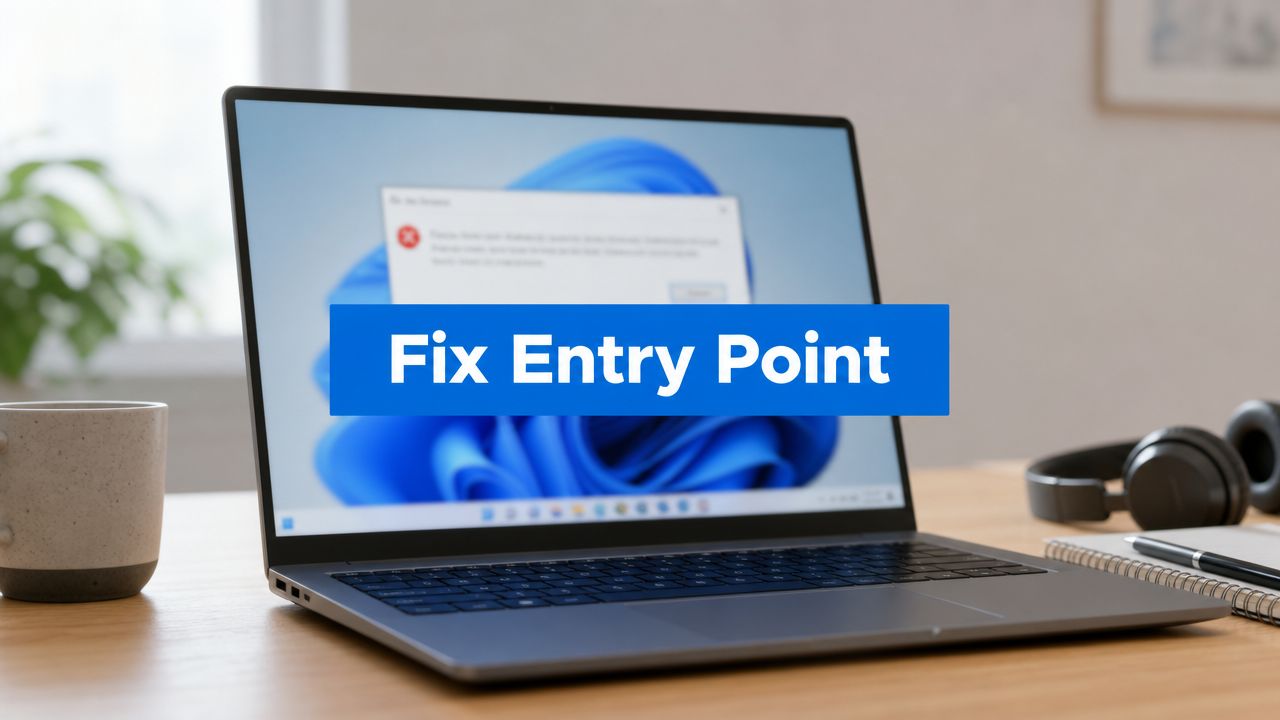
You open a program you use all the time. Instead of the app starting, Windows throws a box that says The procedure entry point could not be located. The message usually names a DLL file and a function you've never heard of. It looks obscure, but the pattern is familiar.
This error is one of those Windows problems that gets worse when you guess. People reinstall random runtimes, download DLLs from sketchy sites, or keep retrying the same launch until nothing changes. A better approach is to narrow the failure first, then fix the specific layer that's broken. That's how support teams save time, and it's how you avoid turning one DLL issue into several.
What This Entry Point Error Actually Means
Windows programs don't ship with every function built into one giant file. They rely on dynamic-link libraries, or DLLs, which act like shared building blocks. When a program starts, it asks Windows to load the DLLs it needs and then calls specific functions inside them.
When you see The procedure entry point could not be located, the application is trying to call a function that isn't present in the DLL that got loaded. That usually means a DLL mismatch. The program expected one version, but Windows loaded another, or the file is corrupted. Support guidance commonly treats this as a compatibility failure that can affect many applications when multiple library versions exist on the same system, and repairing or reinstalling the affected runtime or app is often the practical fix, as summarized in this explanation of entry point and DLL mismatch behavior.
A simple way to think about it
Treat the program like a manual that says, “Go to page 84 for the next step.” If someone handed you a different edition of the book, page 84 might contain something else, or not exist at all. The program isn't necessarily broken. It may just be reading the wrong edition of the library.
That's why this error often shows up after:
- An update changed a shared file
- A program installed its own copy of a DLL
- A runtime package became damaged
- You moved software folders manually
- The app was built for a Windows function your machine doesn't have
Practical rule: Don't treat every entry point error as “reinstall the app and hope.” The right fix depends on which DLL Windows loaded, where it came from, and whether the missing function should exist on your version of Windows at all.
What usually doesn't work
A few responses create more trouble than they solve:
| Common reaction | Why it often fails |
|---|---|
| Downloading a random DLL file | You may replace the wrong file with the wrong version |
| Rebooting repeatedly | Useful after repairs, not as a diagnosis |
| Installing every redistributable you can find | It can help in some cases, but it won't fix path conflicts or OS API mismatches |
| Copying DLLs between computers | Different app builds and Windows versions matter |
The fastest path is a diagnostic funnel. Start with what failed, identify the DLL involved, classify the problem, then apply the repair that matches that class of failure.
How to Diagnose the Root Cause of the Error
Most bad troubleshooting starts with a fix before there's a diagnosis. For this error, that's backwards. You need to learn which class of failure you're dealing with.

Authoritative guidance around this error points to three distinct root-cause classes: a wrong-version library being loaded from the system path, a missing or damaged Microsoft Visual C++ runtime, or a true Windows API and OS compatibility mismatch where the requested function does not exist on the target machine. That distinction matters because reinstalling the app or the VC++ package won't solve every case. Sometimes the appropriate fix is changing load order, removing a conflicting DLL, or rebuilding against an older Windows SDK, as noted in MathWorks' discussion of entry point failures and their root-cause classes.
Start with Event Viewer
Event Viewer won't always hand you the answer, but it often tells you where to look.
- Press Start and search for Event Viewer.
- Open Windows Logs.
- Check Application first.
- Reproduce the error if needed.
- Look for entries created at the same time.
- Read the details for the app name, faulting module, or related DLL.
If the popup says one DLL and Event Viewer points to another module loading just before the failure, trust the broader pattern, not only the popup text. The named DLL in the dialog is useful, but the surrounding modules often expose the underlying conflict.
Classify the failure before you repair it
Use what you found to sort the error into one of these buckets:
- Wrong DLL version loaded: The app is pulling a library from the wrong folder, often from its own program directory or another software package.
- Runtime damage: Microsoft Visual C++ runtime files are missing, damaged, or mismatched.
- OS compatibility mismatch: The app expects a Windows API that your system doesn't provide.
If the same product worked before an update and fails now, suspect a version mismatch first. If multiple unrelated apps fail, suspect shared runtimes or system files.
Use Dependency Walker or similar tools carefully
If Event Viewer doesn't give enough detail, inspect the executable or related DLL with Dependency Walker or a modern dependency inspection tool. The point isn't to stare at every warning. The point is to answer two practical questions:
- Which DLL is the application expecting?
- Which function import can't be resolved?
That tells you whether the program is missing a standard runtime export, loading the wrong vendor DLL, or asking Windows for an API your version can't provide.
Check whether the problem is isolated
This quick matrix helps:
| What you observe | Most likely direction |
|---|---|
| Only one app fails | App repair, local DLL conflict, app-specific runtime issue |
| Several apps fail after an update | Shared runtime or system file issue |
| Older machine, newer app build | OS API mismatch |
| Error appears only when a plugin loads | Add-in or bundled DLL conflict |
If you're used to troubleshooting live meeting apps, the same logic applies. Isolate the layer first. That's the same mindset used in targeted checks for screen sharing problems in browser-based meeting tools. You don't swap hardware before checking permissions, browser behavior, and app scope.
Quick Fixes and Application-Level Repairs
If your diagnosis points to one application, stay at the application layer first. Don't start replacing system files when the problem is local to a single program install.

Use Windows Repair before uninstalling
In Settings > Apps > Installed apps, find the program and open its advanced options if Windows offers them. Some apps expose Repair and Reset.
They aren't the same:
- Repair keeps your data and tries to restore the installed application files.
- Reset is more disruptive. It returns the app closer to a fresh state and may remove local settings or cached data.
For Microsoft Store apps, this is often the cleanest first move. For traditional desktop programs, the vendor's installer may provide a repair option through Apps and Features or Programs and Features.
When a clean reinstall is the right call
If repair doesn't help, reinstall the application properly. That means more than clicking Uninstall and immediately running the same installer again.
Use this workflow:
- Uninstall the application
- Restart Windows
- Delete leftover app folders in Program Files, ProgramData, and your user profile if the vendor documents them
- Remove old plugins or add-ins tied to that app
- Download a fresh installer from the official vendor source
- Reinstall and test before restoring optional add-ons
A clean reinstall helps when an update left behind the wrong local DLL, a plugin dropped a conflicting file into the app folder, or the installer partially rolled back.
Don't overlook bundled dependencies
Some programs ship with their own runtime files beside the executable. That can be helpful, but it can also cause version conflicts if an older bundled DLL wins the load order.
Look inside the application folder for clues:
- Vendor-named DLLs suggest a product-specific file issue
- Standard runtime DLLs may point to bundled dependency conflicts
- Plugin folders often explain why the base app launches on one machine but fails on another
If the app has hardware integration, camera access, or communication modules, test the simplest path after reinstalling. For example, when a laptop app interacts with media components, basic permission and device checks matter too. A practical companion check is this guide on enabling the camera on a Lenovo laptop, because media-related app failures sometimes get misread as program corruption when the issue is local configuration.
What to avoid during app-level repair
- Don't copy DLLs from another PC
- Don't mix old and new installer files
- Don't restore plugins immediately after reinstalling
- Don't test five variables at once
Change one thing, retest, and write down what changed. That discipline matters more than any single trick.
Repairing Corrupted System Files and Runtimes
If multiple applications are failing, or your earlier checks point to shared Windows components, move to system integrity. At this stage, many entry point problems either get fixed cleanly or become much easier to classify.

Run System File Checker the right way
Microsoft's supported first-line remediation for this error is System File Checker. Microsoft states that sfc /scannow scans protected system files and replaces incorrect versions with correct Microsoft versions. That's why it belongs early in the process, before deeper repair steps such as reinstalling shared runtime components or the application itself. The critical detail is that it must be run from an admin Command Prompt, because skipping administrator rights can prevent access to protected files and make the repair appear ineffective, as described in Microsoft's guidance on using SFC for this error.
Use this sequence:
- Open Start
- Search for Command Prompt
- Choose Run as administrator
- Enter
sfc /scannow - Wait for the scan to complete
- Restart and retest the affected app
Here's how to interpret the result in practical terms:
| SFC result | What it suggests |
|---|---|
| Found and repaired files | Retest first. The DLL boundary may already be fixed |
| Found issues but couldn't repair all | The Windows image may need deeper repair |
| Found no integrity violations | Focus on runtimes, app folders, or compatibility |
Field note: If SFC changes anything at all, don't skip the reboot and don't jump straight to manual DLL replacement. Test the original problem first.
Use DISM when SFC can't finish the job
If SFC reports that it couldn't repair everything, use DISM from an administrator Command Prompt to repair the Windows image, then run SFC again.
Common support flow:
- Run DISM image repair
- Restart if prompted
- Run SFC again
- Retest the application
DISM matters because SFC relies on the integrity of the Windows component store. If that store is damaged, SFC may not have a clean source from which to restore protected files.
Repair Microsoft Visual C++ runtimes
A large share of these errors involve Microsoft Visual C++ Redistributables. The application may depend on a runtime that is damaged, missing, or out of sync with what the executable expects.
Focus on repair before brute-force replacement:
- Open Installed apps or Programs and Features
- Find each Microsoft Visual C++ Redistributable
- Use the Modify option if available
- Choose Repair
- Restart and retest
If repair isn't available or doesn't help, uninstalling and reinstalling the relevant package from Microsoft's official distribution channel is a reasonable next step. Keep the process controlled. Remove the suspect runtime, restart, install the correct package, and test.
Check Windows Update and related components
After system file repair and runtime repair, install pending Windows updates. This matters most when the failing function is tied to a Windows component that changed during a partial update or rollback.
For apps that depend on media, browser, or collaboration components, verify associated tools too. For example, browser-based platforms such as AONMeetings let users test camera, microphone, and screen sharing directly in the browser, which can help separate a Windows component problem from an app-specific problem during troubleshooting.
Advanced Manual Fixes for Persistent Errors
If standard repairs didn't resolve the problem, you're in advanced territory. At this stage, you should have a specific DLL name, a reproducible trigger, and a working theory about load order or compatibility.

Check the PATH environment variable
Windows uses search paths to locate files. If an old software directory appears earlier in the search order, an application may load the wrong DLL even when the correct one exists elsewhere.
Inspect the PATH environment variable in System Properties and look for:
- Old software directories from removed applications
- Duplicate paths
- Development tool folders on production machines
- Vendor folders that contain common DLL names
This kind of conflict is common on systems that have accumulated older software, SDKs, plugins, and tools over time. Clean up only what you recognize. If a path belongs to active software, document it before changing anything.
Search for duplicate DLLs
Use File Explorer search on the local drive for the DLL named in the error. You're looking for extra copies in places they shouldn't be.
Good questions to ask:
- Is the DLL sitting in both the app folder and another vendor folder?
- Does the timestamp look out of place compared with nearby files?
- Is there an old copy in a plugin directory that loads first?
One of the most useful clues is finding the same DLL name in several unrelated folders. That often explains why random reinstalls never fixed the actual conflict.
Manual DLL replacement needs discipline
Manual replacement can work, but it's the last surgical option before restore or rebuild. It's easy to make things worse.
Use these rules:
- Replace only the exact file you identified
- Match architecture correctly, such as the app's bitness and the intended runtime family
- Get the file from the software vendor or Microsoft, not a random DLL repository
- Back up the original file first
- Retest immediately after the change
Some DLLs are private to an application and can safely live in the app folder. Others are part of protected Windows components and shouldn't be replaced by hand. If you're not sure which kind you're dealing with, stop and verify before touching it.
Registration isn't a universal fix
People often reach for DLL registration tools automatically. That's only relevant for certain kinds of components. Many modern DLLs do not need manual registration, and forcing registration on the wrong file wastes time.
If the issue involves audio or communication peripherals after software changes, validate the simple device path too. Before you chase registration ghosts, it can help to run a direct hardware test like this guide on testing a computer microphone. That won't solve a DLL mismatch, but it can rule out a parallel hardware or permission problem that muddies the diagnosis.
Frequently Asked Questions and Last Resorts
Can malware cause this error
Yes, it can. Malware can replace, inject into, or damage DLLs. So can aggressive cleanup tools. If the error appeared suddenly alongside other strange behavior, run a full scan with your security tools before doing deeper manual repair.
What if it only happens in one game after a patch
Treat that like an application-specific update problem first. Remove mods, overlays, and third-party injectors. Verify game files through the official launcher if the platform supports it. If the game worked before the patch and now fails at launch, the patch may have changed a bundled DLL or increased the minimum OS requirement.
I repaired the app and runtime, but the error still won't go away
Go back to your evidence. Recheck Event Viewer. Confirm the exact DLL name and whether the same module appears every time. If the named function doesn't exist on your Windows version, you may be facing a real compatibility limit rather than corruption.
Should I use System Restore
If the problem started recently and you have a restore point from before the error began, System Restore is a sensible next move. It's often safer than hand-editing registry entries or swapping shared files manually.
When is a full Windows reinstall justified
Use that option when several core applications fail, system repairs don't complete cleanly, and the machine has accumulated too many conflicting variables to trust. A reinstall is also reasonable when the system has a long history of partial upgrades, software remnants, or suspected file damage that keeps resurfacing.
If you've reached the point where every fix changes the symptoms but not the outcome, stop layering more fixes on top. Preserve your data, decide whether restore or reinstall is cleaner, and reset the machine in a controlled way.
If your team runs into Windows issues while preparing for meetings, training sessions, or client calls, AONMeetings is a browser-based option that reduces local software dependencies by letting users join through Google Chrome, with built-in tools for testing audio, video, and screen sharing before the session starts.