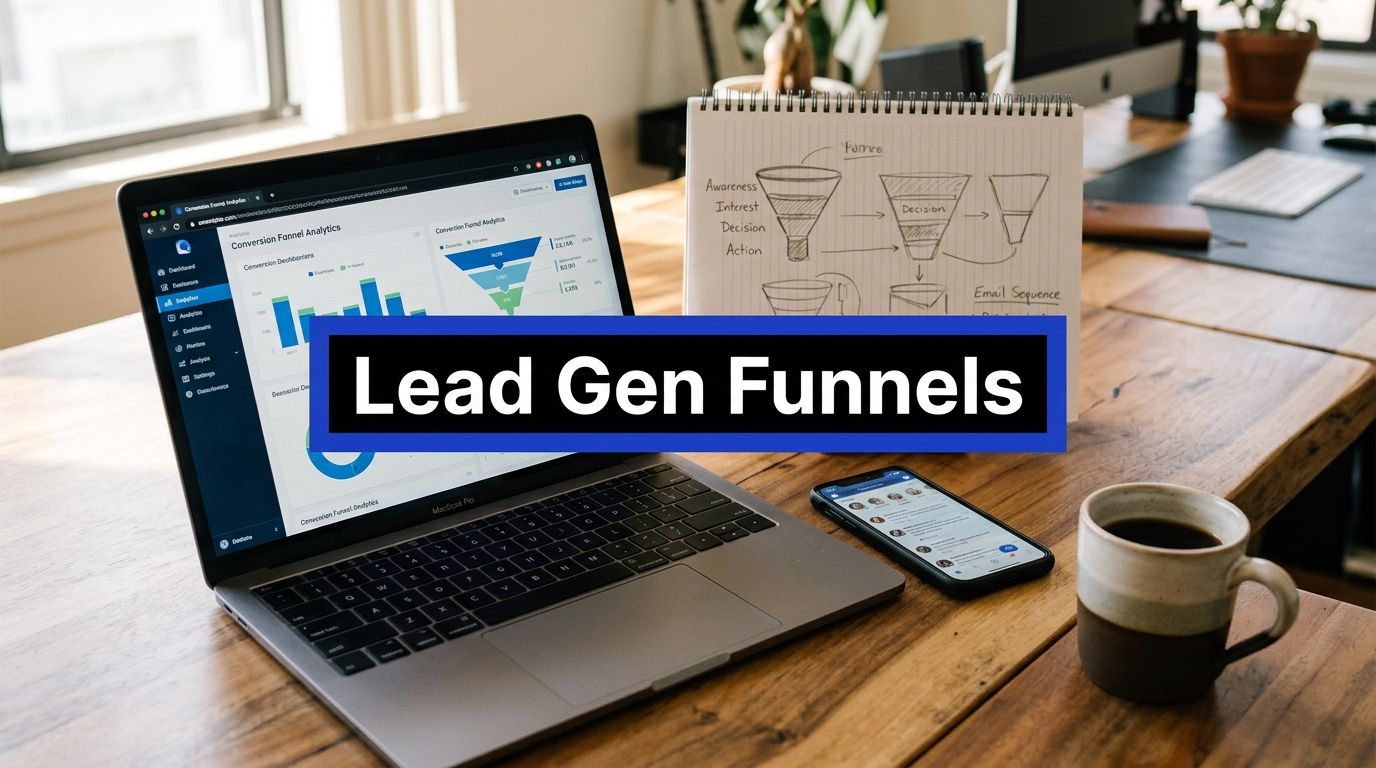
Lead gen funnels aren't a side tactic anymore. They sit inside a market projected to grow from $5.59 billion in 2024 to $32.1 billion by 2035, at a 17.2% CAGR, according to Roots Analysis on the lead generation market. That changes the conversation. A funnel isn't just a campaign setup. It's revenue infrastructure.
Most businesses still treat funnels like a straight pipe. Traffic comes in, a form gets filled out, a few emails go out, and sales waits for meetings to appear. That model misses how people purchase. Prospects hesitate, compare options, skip steps, revisit old content, and respond to the moments that feel relevant.
That's why so many funnels feel “leaky.” The issue usually isn't just top-of-funnel traffic. It's that the experience doesn't adjust once a real person starts showing real buying behavior.
A better way to think about lead gen funnels is this. They're less like a conveyor belt and more like an adaptive conversation. If someone watches a webinar, asks a detailed question, or revisits a pricing page, your funnel should respond differently than it would for someone who only downloaded a checklist.
Why Lead Gen Funnels Are Your Engine for Growth
A strong funnel does two jobs at once. It creates demand and it organizes that demand so your team can act on it. Without that system, leads pile up in a CRM, sales follows up inconsistently, and marketing can't tell which efforts are attracting serious buyers.
For smaller companies, that creates waste. For larger companies, it creates drift. Teams get busy, but pipeline quality stays uneven.
The funnel is the operating system, not the campaign
The best lead gen funnels coordinate content, offers, handoffs, follow-up, and qualification. They give your team a shared map of what should happen after interest appears. If you want a practical companion piece for smaller organizations, Rebus' lead generation guide gives helpful context on turning early attention into structured demand.
A lot of confusion starts with the word “funnel.” Leaders hear it and imagine a fixed sequence. In practice, a useful funnel has rules, not rails. It guides prospects forward, but it also changes the next step based on what they do.
Practical rule: If two prospects show different levels of intent, they shouldn't get the same follow-up.
That's where interactive formats become valuable. A webinar, workshop, or live Q&A gives your team behavior signals you can use. Someone who attends live and asks implementation questions is telling you far more than someone who opens a newsletter. Businesses that want to build those richer touchpoints often start with a webinar-first approach, like the one outlined in this guide to marketing with webinars.
Demystifying the Lead Generation Funnel Stages
The simplest way to understand a funnel is to treat it like a business conversation. You wouldn't walk into a room, meet someone for the first time, and immediately ask for a contract signature. You'd start with relevance, build trust, answer questions, and only then move toward a decision.
That's what the classic funnel stages do.

Top of funnel
At the top of funnel, people are problem-aware, not vendor-ready. They're trying to name the issue, understand the cost of ignoring it, or learn what good solutions even look like.
Your job here is education. Blog posts, short guides, industry explainers, and broad webinars work well because they reduce confusion without asking for too much commitment.
In B2B, the average conversion rate from a website visit to a lead is 2% to 5%, based on Little Bird Marketing's lead funnel benchmarks. That's a useful reminder that most visitors aren't ready yet. They need a reason to stay engaged.
Middle of funnel
The middle of funnel is where a lead starts evaluating approaches. They're no longer asking, “Do I have a problem?” They're asking, “What kind of solution fits my situation?”
In such cases, generic nurture sequences often break down. A prospect who spent time in a technical webinar needs different follow-up than one who downloaded a beginner's guide. Dynamic lead gen funnels work better here because they respond to behavior.
The same benchmark source notes that 20% to 30% of leads become Marketing Qualified Leads, and 25% to 30% of MQLs become Sales Qualified Leads. That progression tells you qualification matters. The handoff improves when marketing stops treating all captured leads as equal.
Good middle-funnel content doesn't just persuade. It helps the buyer sort, compare, and self-qualify.
Useful formats at this stage include:
- Webinars and workshops: Better for prospects who want to learn in context
- Case studies and comparison pages: Better for prospects validating fit
- Interactive Q&A sessions: Better for uncovering objections early
If you want another perspective on how businesses structure this process, MakeAutomation's lead generation insights offer a clear primer on the broader lead generation workflow.
Bottom of funnel
At the bottom of funnel, the conversation changes again. Now the buyer wants confidence. They need fewer ideas and more proof.
That's where demos, consultations, implementation conversations, pricing reviews, and security discussions matter. The prospect isn't asking for more content. They're asking whether your team is the safest choice.
A common mistake is sending all bottom-funnel prospects into the same meeting flow. A behavior-driven model works better. Someone who asked integration questions should get a technical walkthrough. Someone focused on outcomes may need a business case call instead.
The Anatomy of a High-Converting Funnel
Analysts at GrowthList found that landing pages convert at an average of 9.7%, yet only 20% of new leads become sales. That gap between capture and progress highlights the job of a funnel. Getting the form fill is only the first win.

A high-converting funnel works less like a straight pipe and more like an airport. People arrive with different destinations, different urgency, and different questions. If every traveler gets sent down the same hallway, many end up in the wrong place or stop walking altogether.
The four parts that have to work together
The first part is the lead magnet. This is the initial exchange of value. You are asking for time, attention, or contact information, so the offer has to solve a real problem quickly. For a B2B buyer, that could be a workshop, a planning template, a benchmark checklist, or access to an on-demand session that answers a pressing question.
Next comes the landing page. Its job is clarity. One audience. One promise. One action. A page that tries to speak to everyone usually convinces no one, and a form that asks for a phone number before trust is built often creates avoidable friction.
Then comes the thank-you page. A common mistake is to treat it as a dead end. The better approach is to use it as a routing point. You can invite the lead to book time, choose a topic of interest, watch a short follow-up video, or join a live session. That single choice gives you a behavioral signal, which is far more useful than a generic “new lead” tag.
The fourth part is the nurture sequence. During this stage, the funnel either adapts or stalls.
Static nurture treats every lead the same. Behavior-driven nurture responds to what the prospect does. If someone watches a product webinar, visits your pricing page, and asks a technical question, they should not receive the same follow-up as someone who downloaded an early-stage checklist and never returned. One person is asking for evaluation help. The other may still be defining the problem.
Why nurture is where the funnel is won
Many teams put energy into getting the conversion and far less into guiding the next decision. That creates a familiar pattern. Leads come in, interest fades, sales follows up too early or too late, and the funnel gets blamed when the underlying issue is weak choreography between stages.
A strong nurture system usually includes:
- A clear first follow-up: Confirm what the prospect requested and set the expectation for what comes next
- Behavior-based branching: Change the path based on attendance, page visits, repeat engagement, or questions submitted
- A human checkpoint: Define the exact signals that should trigger outreach from sales or customer success
- An interactive touchpoint: Offer a live Q&A, office hours session, or short video meeting for leads who want to engage in real time
That last point is where adaptive funnels often outperform email-only sequences. Email is useful for reminders and education, but it is a limited format for handling nuance. A short live conversation can surface objections, priorities, and buying roles much faster than a string of automated messages. For many B2B offers, that is the difference between nurturing and guessing.
The thank-you page should answer one silent question: “What should I do next if I'm interested right now?”
On-demand content helps here because it gives prospects a way to keep moving at their own pace. A library such as webinars on demand can support this middle stage by giving buyers deeper material to explore before they commit to a sales conversation.
Driving Traffic with Powerful Channel Tactics
About half of B2B traffic from any channel will never become pipeline if the offer and the visitor's intent do not match. That is why channel strategy works less like buying more megaphones and more like placing the right signpost at the right fork in the road.
The useful question is not which channel is best. The useful question is which channel attracts a prospect who is ready for this specific next step.
A search visitor reading educational content behaves differently from a paid ad click responding to a time-sensitive offer. A webinar registrant behaves differently again, because registration signals willingness to spend time, not just curiosity. If you send all three people into the same path, the funnel becomes rigid. If you route them based on behavior and context, the funnel starts adapting the way a good sales team would.
How to match the channel to buyer intent
SEO and content marketing work well for early discovery. They attract buyers who are still naming the problem, comparing approaches, or trying to understand risk. That makes search a strong entry point for educational funnel assets such as guides, checklists, and category-level webinars.
Paid ads work well when you need precision. They let you put one offer in front of one audience with one clear call to action. This channel is often strongest when the audience is already defined by role, industry, or urgency.
Webinars serve a different job. They create a two-way moment. Instead of guessing interest from a click, you can observe attendance, questions, poll responses, and follow-up actions. For middle-funnel leads, that is far more useful than a generic nurture sequence because it gives your team real signals to work with.
Lead generation channel comparison
| Channel Tactic | Typical Lead Quality | Average Cost Per Lead (CPL) | Primary Funnel Stage |
|---|---|---|---|
| SEO and content marketing | Broad to moderate, depends on topic intent | Qualitative, varies by production and distribution model | Top of funnel |
| Paid ads | Mixed, depends on targeting and offer match | Qualitative, varies by platform and audience | Top and bottom of funnel |
| Webinars | Often higher intent, especially for evaluation-stage buyers | Qualitative, varies by format, audience fit, and promotion model | Middle of funnel |
A practical mix that works
A strong traffic system usually combines channels in sequence, because each one solves a different problem.
- Use SEO content to attract problem-aware buyers and give them a useful first conversion.
- Use paid promotion to put a focused asset, event, or workshop in front of a narrow audience.
- Use webinars to sort passive interest from active evaluation through live engagement.
- Use post-event signals to decide who should get more education, who should get an invite to a live discussion, and who is ready for direct outreach.
This approach works like airport routing. Search helps people enter the terminal. Paid ads direct them to the right gate. Webinars act like the security checkpoint where intent becomes visible.
That last part matters for adaptive funnels. Static channels can bring people in, but interactive channels help you decide what happens next. A prospect who attends a webinar and asks about implementation is not asking for the same follow-up as someone who bounced from a blog post after 20 seconds.
If webinars are part of your traffic plan, registration quality matters as much as traffic volume. This practical guide on how to increase webinar registration focuses on attracting the right attendees, not just collecting more names.
You can also turn calls into content by using recurring sales or discovery conversations to shape future webinar topics, ad angles, and search content. That creates a feedback loop. Traffic channels bring in prospects, live interactions reveal what they care about, and your next campaign gets sharper because it reflects real buyer questions.
AONMeetings in Action A Practical Funnel Integration
A dynamic funnel works best when each interaction creates useful signals. Video meetings and webinars are valuable here because they reveal intent in ways static content can't. Attendance, drop-off points, poll responses, chat questions, and follow-up requests all help your team decide what should happen next.
Consider a simple journey.
A prospect finds an educational webinar through a search result or LinkedIn post. The topic is broad enough for top-of-funnel interest, such as compliance trends, buyer mistakes, or planning frameworks. Registration captures the basics, but the richer data comes later, during the session itself.

From attendance to segmentation
One attendee watches most of the session, answers a poll, and asks a question about rollout timing. Another registers but doesn't attend. A third attends briefly, then leaves before the product example.
Those are not the same leads.
A behavior-driven funnel treats them differently:
- Highly engaged attendee: Invite them to a focused workshop or consultation
- No-show registrant: Send the recording with a narrower follow-up prompt
- Lightly engaged attendee: Offer a related educational asset before any sales outreach
Meeting records become useful in this process. According to Martal's lead generation statistics, companies using AI for lead generation report a 50% increase in sales-ready leads. Automated transcripts and meeting summaries can support that process by helping teams identify which questions, objections, and themes signal real buying intent.
Turning live conversations into reusable assets
A second advantage of interactive sessions is content reuse. A webinar can become clips for follow-up emails, FAQ documents for sales, or short insights for social distribution. Meeting transcripts make that easier, especially when teams want to turn calls into content without manually rebuilding every conversation from notes.
A dynamic funnel doesn't ask, “Did this lead convert today?” It asks, “What did this lead just tell us about the next best step?”
The final stage is a one-to-one conversation. Once a lead shows clear intent through repeated engagement, specific questions, or workshop participation, the next touchpoint should be more personal and more relevant. That might mean a customized demo, a security review, or a planning call with the right stakeholder in the room.
Funnel Playbooks for High-Stakes Industries
In high-stakes industries, the funnel can't rely on hype, pressure, or vague promises. Buyers in healthcare, legal, financial services, and enterprise technology need trust before they need urgency. They also need a process that respects privacy, internal review, and professional risk.
That changes what “high-performing” looks like.

Healthcare playbook
A healthcare organization usually does better with education-first entry points than aggressive form-first pages.
A practical flow looks like this:
- Awareness asset. A patient education webinar or clinical explainer focused on a specific condition or treatment path.
- Interest capture. A simple registration form that collects only what's necessary.
- Appraisal step. Follow-up resources that explain process, expectations, and common concerns.
- Conversion step. A secure scheduling request or consultation handoff.
The key difference is restraint. You don't need louder calls to action. You need more clarity about what happens next and why the next action is safe.
Legal playbook
For law firms, trust is built through expertise and precision. A broad “contact us” funnel rarely carries enough weight on its own.
A stronger pattern is:
- Lead magnet: A webinar or briefing on a specific regulatory, litigation, or contract issue
- Middle step: A narrower session, checklist, or consultation guide tied to that topic
- Bottom step: A consultation invitation framed around risk review, not hard selling
Legal buyers often need internal consensus before they act. That means your funnel should help them explain the issue to others inside the organization. Good legal funnel content helps the buyer justify the next conversation.
Enterprise SaaS playbook
Complex software sales need behavior-driven routing more than almost any other category. A technical evaluator, an economic buyer, and an operational stakeholder won't respond to the same content.
A practical enterprise flow often includes:
- Top of funnel: Educational webinar on a market problem or workflow challenge
- Middle of funnel: Role-specific workshop, implementation discussion, or integration overview
- Bottom of funnel: Relevant demo with the right technical and business stakeholders present
According to Campaign Creators' analysis of leaking lead funnels, many funnels fail because they don't adapt to real-time behavior and audience segmentation. The same source notes that 68% of leads never convert when funnels fail to adjust to buyer behavior. That's why a rigid “same nurture for everyone” model underperforms in high-consideration markets.
Trust-heavy buyers don't want more pressure. They want better routing.
Your Toughest Lead Gen Funnel Questions Answered
How do you measure funnel performance in regulated industries without creating privacy risk
Use a privacy-first funneling approach. Track stage progression through aggregated event data instead of storing more personally identifiable information than you need. In practice, that means logging actions like registration completed, webinar attended, resource viewed, consultation requested, and proposal sent, while limiting unnecessary personal fields and keeping audit trails for who accessed what.
This matters more now because 42% of marketers in regulated industries are abandoning traditional funnel analytics tools due to privacy risks, according to First Page Sage's analysis of lead generation funnels. The lesson isn't to stop measuring. It's to measure with tighter data minimization, clearer consent, and systems designed around compliant workflows.
What's the simplest improvement most teams can make
Stop treating all leads the same after capture. Route follow-up based on behavior, not just source. A prospect who significantly engaged with a live session has earned a different next step than someone who only downloaded a basic asset.
Should every funnel be nonlinear
Not completely. The stages still matter. What changes is the path between them. Buyers need structure, but they also need relevance.
If you want a browser-based platform for webinars, demos, and secure meetings that can support modern lead gen funnels without adding software friction, take a look at AONMeetings. It's built for organizations that need scalable collaboration, webinar functionality, and enterprise-grade security in one place.