
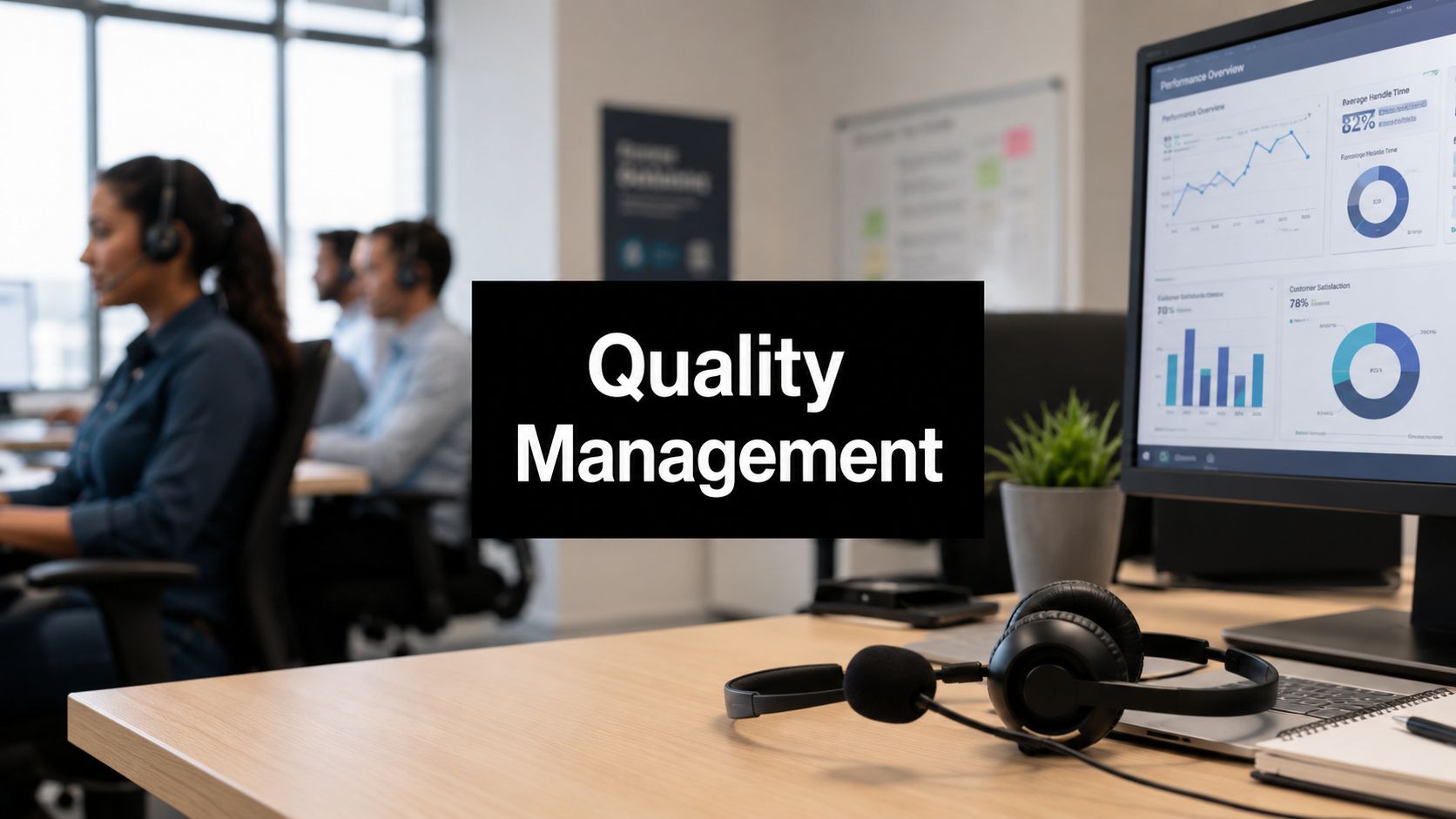
You're probably looking at a familiar and maddening picture. Customer complaints are rising, supervisors are spending more time reviewing interactions, and yet internal scorecards still look respectable. Agents appear to be following process. The numbers inside the center say things are under control. The numbers outside the center say customers disagree.
That disconnect is where most organizations first realize they don't have a scoring problem. They have a quality management problem.
In many contact centers, quality started as a narrow inspection exercise. Someone listened to a sample of calls, checked whether the script was followed, noted a few errors, and filed a score. That approach still exists, but it no longer matches how modern service operations work. Today, customer experience is shaped across voice, chat, email, social messaging, and sometimes video. Quality has to connect what agents do, what customers feel, and what the business needs.
Beyond Scripts and Scores an Introduction to QM
A contact center can look healthy on paper while frustrating customers in practice. That's why high internal quality scores can be misleading when they measure only procedural adherence. ICMI's warning is blunt: a 99% quality score is not meaningful if CSAT is only 79%, a point highlighted in Observe.AI's discussion of modern contact center quality management.
That statement changes the whole conversation. It tells leaders that contact center quality management isn't just about whether an agent said the right words in the right order. It's about whether the interaction produced the right outcome for the customer and the business.
Why old-style QA stops short
Traditional QA often behaves like an inspection checklist:
- Script adherence: Did the agent say the required phrases?
- Process completion: Were the mandatory steps followed?
- Error detection: Did the reviewer spot any obvious failures?
Those checks still matter. Compliance matters. Accuracy matters. But they don't tell you whether the customer felt understood, whether the issue was resolved properly, or whether the interaction strengthened trust.
Modern QM is broader. Observe.AI describes quality management as an umbrella made up of quality assurance, compliance, and coaching. That's a useful framing because it turns quality into a management system rather than a policing mechanism.
Practical rule: If your scorecard rewards box-checking but your customers reward resolution and empathy, your quality program is measuring the wrong thing.
What leaders are really managing
In operational terms, quality management connects three layers:
| Layer | What it looks at | Why it matters |
|---|---|---|
| Standards | Required behaviors, policies, compliance rules | Protects the business and creates consistency |
| Performance | How agents communicate, solve problems, and handle complexity | Improves execution at the front line |
| Outcomes | Customer satisfaction, resolution quality, repeat contact patterns | Shows whether the service model is working |
That's why strong QM programs don't stop at “Did the agent comply?” They also ask, “Did the interaction help the customer?” and “Can we coach this behavior at scale?”
When leaders understand that shift, quality stops being a back-office scorekeeping activity. It becomes the operating system for customer conversations.
What Is Contact Center Quality Management
The clearest way to think about contact center quality management is as a continuous improvement discipline for customer interactions. It captures conversations, evaluates them against a standard, turns findings into coaching, and uses those lessons to improve future performance.
That's very different from the old image of a supervisor listening for mistakes.
A better analogy
Think of QM less like an inspection line and more like a health program. An inspection tells you whether something failed at a specific moment. A health program looks for patterns, diagnoses causes, recommends treatment, and checks whether the treatment worked.
That's how modern quality management should function in a contact center. It should review voice, chat, email, and other channels not to punish agents, but to understand what good service looks like, where it breaks down, and how to improve it repeatedly.
What separates QM from basic call monitoring
Basic monitoring asks a narrow question: “Was this interaction acceptable?”
Quality management asks broader operational questions:
- Consistency: Are customers getting the same standard of service across teams and channels?
- Capability: Which agent skills need reinforcement?
- Risk: Where are compliance or process failures showing up?
- Experience: Which behaviors correlate with stronger customer outcomes?
- Improvement: Are coaching and process changes effective?
A narrow monitoring mindset often creates fear. Agents feel watched. Supervisors become auditors. Reports pile up without changing behavior.
A real QM program changes the purpose of review. It identifies excellence worth replicating. It flags coaching needs early. It highlights broken workflows that no amount of agent effort can fix.
Good QM doesn't ask, “Who failed this call?” It asks, “What can this interaction teach us about performance, training, and process design?”
Why it matters strategically
Contact centers sit at the intersection of revenue protection, customer retention, compliance, and brand trust. That means the quality of conversations isn't a soft issue. It's an operational issue with business consequences.
A mature QM program helps leaders answer questions like these:
- Are agents resolving issues in a way customers value?
- Are evaluators applying standards consistently?
- Are coaches focusing on the behaviors that move outcomes?
- Are recurring failures caused by individuals, training gaps, or broken processes?
When those questions are answered consistently, quality management becomes strategic. It helps the organization reduce avoidable friction, strengthen customer confidence, and make better decisions about staffing, workflows, and technology.
That's also why modern teams increasingly treat QM as a cross-functional discipline. Operations, training, compliance, customer experience, and platform teams all have a stake in what the reviews reveal. The best insights rarely stay inside the QA department.
The Five Core Components of a QM Program
A QM program works like a control system in manufacturing. One sensor can detect a defect, but the plant improves only when detection, diagnosis, correction, and follow-up all connect. Contact center quality management follows the same logic. It captures interactions, evaluates them against a standard, turns findings into coaching, checks evaluator consistency, and feeds patterns back into operational decisions.
That closed loop is what makes QM more than a compliance exercise. With AI, speech analytics, desktop capture, and video support now part of many service environments, each component can operate with more speed and more context than manual review alone.
Monitoring
Monitoring is the input stage. It determines what the organization can see.
A narrow monitoring setup produces narrow conclusions. If reviewers hear only call audio, they may miss the moment an agent got stuck in a slow workflow. If they sample only a few voice calls, they may overlook failures happening in chat, email, or video-based support. Modern QM starts by capturing enough of the interaction to make diagnosis possible.
That includes channel coverage, but also sequence. The customer's experience often stretches across multiple contacts and systems. A good monitoring design helps teams trace what happened before, during, and after the interaction, which makes it easier to connect quality findings to the broader voice of the customer program.
Scoring
Scoring converts raw interactions into a shared standard. The scorecard is the operating model in miniature. It tells evaluators what matters, how much it matters, and which failures carry the highest business risk.
Strong scorecards separate categories that often get blurred together. Compliance steps, resolution behaviors, communication quality, and process accuracy should not all be treated as if they have the same weight. Missing a required disclosure has a different implication than using weak transitional language. If the scorecard does not reflect that difference, leaders get tidy numbers with very little managerial value.
Good scoring also avoids the trap of false precision. A long checklist can create the appearance of rigor while hiding the core question: did the interaction produce the right customer and business outcome, and was the path there repeatable?
Coaching
Coaching is the conversion point where measurement becomes performance improvement.
The difference between weak and effective coaching usually comes down to specificity. General advice rarely changes behavior. Observed examples do. An agent can act on, “After the customer explained the issue, summarize it in one sentence before proposing a solution.” That is concrete, observable, and easy to practice.
Coaching also tests whether the issue belongs to the agent at all. Repeated quality failures in the same part of the journey often signal a broken process, poor knowledge design, or an interface problem. In that sense, coaching works like diagnosis in medicine. The symptom shows up in the interaction, but the underlying cause may sit elsewhere in the operation.
Calibration
Calibration keeps the scoring system stable. Without it, the same interaction can receive different scores depending on who reviewed it, which undermines trust in coaching, reporting, and incentives.
A practical calibration process is straightforward. Evaluators score the same set of interactions independently, compare results, discuss where interpretations diverged, and document the agreed standard. Industry guidance from SQM Group describes calibration as a necessary discipline for reducing evaluator inconsistency and keeping quality scores credible across teams.
Here is the operational effect of poor calibration:
| If calibration is weak | What happens |
|---|---|
| Agents see inconsistent judgments | They question fairness and resist coaching |
| Team leaders interpret standards differently | Behaviors drift across teams and locations |
| Trend reports rest on uneven scoring | Leaders act on distorted signals |
One point often gets missed. Calibration is not only about fairness. It is about data integrity. If evaluators are inconsistent, AI models trained on those labels will also be inconsistent, and automation will scale the problem instead of fixing it.
Reporting
Reporting closes the loop. It turns individual reviews into patterns that operations leaders can use.
Useful reporting does more than display average quality scores. It should show where failures cluster, whether coaching is being completed, how evaluator agreement is trending, and which quality issues connect to business outcomes such as repeat contact, escalation, complaints, or conversion. That is how QM becomes a management system rather than an archive of scored interactions.
At the executive level, reporting should answer practical questions. Which problems come from agent behavior? Which come from workflow design? Which are concentrated in one channel, one team, or one customer journey? Modern platforms make that analysis faster by combining manual evaluations with AI-driven pattern detection across voice, chat, screen activity, and video. When those signals are connected, QM starts doing what mature operations need it to do. It helps the business improve performance on purpose, not just inspect it after the fact.
Key KPIs for Measuring Quality Management Success
At 9:00 a.m., the dashboard looks excellent. Average handle time is down, service levels are stable, and leaders assume the quality program is working. By Thursday, repeat contacts rise, supervisors hear more escalations, and customer comments show the underlying problem. Agents got faster, but not better.
That gap explains why KPI selection matters so much in contact center quality management. A QM program works like a control system. It measures performance, feeds findings back into coaching and process changes, and checks whether those changes improved the customer outcome. If the wrong metrics dominate, the system corrects in the wrong direction.
The operational trio
Three metrics usually carry the most weight in day-to-day operations: First Call Resolution (FCR), Customer Satisfaction (CSAT), and Average Handle Time (AHT). As noted earlier in the article, industry guidance often treats these as the core operating measures because together they capture the central tradeoff in service delivery.
Each metric answers a different management question.
- AHT asks whether work is being done efficiently.
- FCR asks whether the customer's issue was resolved.
- CSAT asks whether the customer experienced the interaction as helpful and competent.
Read together, they show whether the center is creating efficiency or merely compressing time. For a useful overview of how teams track these measures in practice, see Phone Staffer's KPI insights.
Why one metric can send you in the wrong direction
AHT causes the most confusion because it looks precise. Shorter calls seem better. Lower averages suggest improvement. But time is a proxy, not an outcome.
A shorter interaction can reflect skill. It can also reflect rushed discovery, weak explanation, or premature closure. If FCR falls after AHT improves, the center may be exporting work into repeat contacts. If CSAT drops at the same time, the business is also paying a customer experience cost. The metric moved, but performance did not improve.
That is why QM should interpret KPI shifts as operating signals, not trophies. Leaders need to ask what behavior changed, what process changed, and whether the customer journey got easier or harder.
Process KPIs show whether the QM engine can be trusted
Outcome measures tell you what happened. Process measures tell you whether your quality system can diagnose causes accurately.
Four process KPIs deserve close attention:
- Calibration variance: Shows whether evaluators are applying the scorecard consistently.
- Coaching completion: Shows whether evaluation findings are reaching agents in time to change behavior.
- Behavior trend scores: Show whether targeted skills such as verification, probing, ownership, or next-step clarity are improving over time.
- Compliance performance: Shows whether required steps are being completed reliably.
These measures matter because QM is only useful if it forms a closed loop. Review creates findings. Findings lead to coaching, workflow fixes, or policy changes. The next round of measurement confirms whether the intervention worked. Modern platforms strengthen that loop by combining sampled evaluations with AI analysis across calls, chat, screen activity, and video interactions, so leaders can spot patterns sooner and act before isolated defects become systemic problems.
A balanced scorecard view
| KPI | What it tells you | Common misuse |
|---|---|---|
| FCR | Whether the customer's issue was resolved without repeat contact | Treating it as an agent-only issue when the root cause may sit in policy, training, or process design |
| CSAT | How the customer judged the interaction | Reading the score without reviewing the context behind the experience |
| AHT | How long interactions take | Pressuring agents to shorten calls even when the issue requires explanation or reassurance |
| Calibration variance | Whether evaluators score consistently | Assuming QA scores are objective when reviewers are not aligned |
| Coaching completion | Whether quality findings turn into action | Counting evaluations while failing to confirm that feedback changed performance |
Many teams improve this scorecard by pairing internal QA results with direct customer evidence. A structured voice of customer approach helps leaders test whether internal standards match what customers value, not just what the scorecard happens to measure.
A useful KPI points to a decision. A useful QM system connects that decision to action, then measures the result.
Best Practices for Your QM Framework
The difference between a weak quality program and a strong one usually isn't enthusiasm. It's design discipline. Teams often review interactions diligently, hold meetings, and produce scores, yet still fail to improve performance because the framework sends mixed signals.
Build the scorecard around outcomes
Industry guidance consistently recommends aligning QA scorecards to core KPIs such as AHT, FCR, and CSAT, and stresses that a balanced scorecard must combine efficiency, resolution quality, and conversational compliance, as discussed in Onsoft's overview of call center quality management. Scorecards profoundly shape agent behavior. If the rubric over-rewards speed, agents rush. If it over-rewards rigid script use, agents sound robotic.
A stronger scorecard separates categories clearly:
| Scorecard area | What belongs there |
|---|---|
| Compliance items | Required disclosures, verification, policy adherence |
| Resolution quality | Accuracy, ownership, next-step clarity, problem solving |
| Conversation quality | Listening, empathy, tone, confidence, structure |
This structure helps leaders avoid a common trap. Not every point on the form should carry the same business weight.
Separate hard fails from coaching traits
Some failures are binary. Either the agent completed a required compliance step or didn't. These belong in a hard-fail category.
Other qualities are developmental. Tone, pacing, probing, de-escalation, and empathy often improve through repeated coaching. If leaders lump these together with hard compliance failures, they distort the score and confuse the coaching message.
That distinction also makes feedback more credible. Agents can accept that a missed required disclosure is a mandatory requirement, while still seeing conversational refinement as a professional growth issue rather than punishment.
Make coaching concrete and routine
A review without practical feedback changes nothing. Strong coaching has three traits:
- It uses evidence: Replay the exact interaction moment.
- It names the behavior: Don't say “be better with customers.” Identify the missed skill.
- It gives an alternative: Show what the agent could say or do next time.
This is also where operational details matter. For example, transfer handling often affects both customer experience and resolution quality. A practical workflow reference like AONMeetings' guide to call transfers can help teams think more carefully about how transitions should sound and what information should move with the customer.
Run calibration like a management ritual
Calibration shouldn't be occasional cleanup. It should be built into the operating rhythm of the program.
When evaluators compare their scoring against an agreed standard, they're doing more than aligning numbers. They're refining the organization's shared definition of quality. That's vital in multi-team environments where local habits can drift.
Leadership cue: If supervisors can't explain why an interaction earned a score, the rubric is too vague or calibration is too weak.
Use external KPI frameworks carefully
Many operations leaders also compare their internal scorecards against broader KPI libraries to make sure they aren't overlooking important measures. One practical example is Phone Staffer's KPI insights, which can be useful as a reference point when reviewing whether your framework covers the right operational dimensions. The key is to adapt such frameworks to your own customer journey rather than copying a template blindly.
The best practice is simple: standardize where consistency matters, and customize where customer expectations differ.
The Role of Technology and Integrations
Technology changes the economics of quality management. In a manual environment, leaders review only a thin slice of interactions. They depend on small samples, delayed feedback, and a lot of reviewer labor. In a technology-enabled environment, quality becomes broader, faster, and more actionable.
From sampling to full-population visibility
Salesforce describes modern QM as a cyclical Monitor → Evaluate → Score → Coach → Improve workflow, and notes that advanced programs can evaluate 100% of voice, chat, email, and social conversations through interaction analytics in Salesforce's quality management overview. That shift is fundamental.
When teams can assess the full interaction population rather than a narrow sample, they stop relying on anecdotal impressions. Rare but important failures become visible. Patterns emerge earlier. Coaching can be driven by actual behavior frequency rather than a handful of reviewed calls.
Why video and AI matter
Voice alone doesn't always tell the whole story. In many service environments, quality depends on screen navigation, document review, co-browsing, visual demonstrations, or face-to-face remote interactions. That's especially true in healthcare, legal services, education, and complex business support.
A more mature stack may include:
- Recording across channels: Captures what happened, not just what someone remembers happened.
- Transcription: Makes conversations searchable and reviewable at scale.
- Screen capture or visual context: Helps identify process friction, not just language issues.
- Automated analysis: Flags patterns in compliance language, customer sentiment, escalation behavior, or repeated issues.
- Workflow integrations: Connects quality findings with ticketing, CRM, workforce, and coaching systems.
AI becomes useful, not magical. It doesn't replace managerial judgment. It helps teams surface interactions worth reviewing, identify recurring defects, and speed up the path from detection to coaching.
The strategic gain from AI isn't that it “scores calls.” It's that managers can spend less time searching for issues and more time fixing them.
Integrations make QM operational
Quality software creates more value when it isn't isolated. If the QM platform can connect with telephony, CRM, scheduling, ticketing, and collaboration systems, leaders can trace quality issues back to root causes faster.
For organizations comparing service stack options, a technical reference such as this guide to VoIP service provider comparisons can help frame what infrastructure choices may affect recording, routing, and analysis capabilities downstream.
The larger point is this: technology turns contact center quality management into a closed-loop control system. It captures interactions, evaluates them against standards, routes findings into coaching and process correction, then checks whether performance improves in the next cycle.
A Phased Rollout Plan for Your Organization
The cleanest way to launch a QM program is to treat it like an operating model rollout, not a one-time project. Most organizations get better results when they phase the work and protect quality from becoming an administrative burden too early.
Phase one foundation
Start by defining what the business needs the contact center to achieve. That may include stronger consistency, better resolution quality, lower compliance risk, or more effective coaching.
Then build the first scorecard. Keep it disciplined. Focus on a manageable set of standards that reflect the customer journey and business priorities. At this stage, leaders should also choose the evaluation and recording technology they'll rely on, because the data model will shape what the team can review later.
Phase two implementation
Train evaluators before you scale reviews. If the people scoring interactions don't apply the rubric consistently, the program will lose credibility quickly.
Run calibration sessions early and often. Launch with a pilot group rather than the entire operation. That gives supervisors time to practice feedback delivery, refine scoring language, and confirm whether the scorecard produces useful coaching conversations instead of confusion.
A practical implementation checklist often includes:
- Evaluator training: Align reviewers on standards and scoring logic.
- Pilot reviews: Test the scorecard on real interactions from a limited group.
- Coaching rhythm: Establish how feedback will be delivered and tracked.
- Manager review: Confirm that quality findings lead to action, not just documentation.
Phase three optimization
After the pilot stabilizes, expand coverage, tighten reporting, and use trend analysis to refine the program. At this point, leaders begin asking better questions. Which behaviors consistently predict stronger outcomes? Which issues are training problems, and which are workflow defects?
Industry-specific refinement matters here. A healthcare organization may put stronger emphasis on HIPAA-sensitive handling and privacy controls. A legal practice may care more about chain of custody, confidentiality, and precision in client communication. An education provider may prioritize clarity, accessibility, and documentation of student support conversations.
The rollout succeeds when quality becomes part of daily management. Reviews inform coaching. Coaching informs performance. Performance insights shape process improvement. At that point, the program is no longer a QA side function. It's part of how the organization runs service.
If your organization is building a more modern quality operation, AONMeetings is worth a close look. Its browser-based platform supports HD video meetings, recording, AI-generated transcripts, webinars, and secure collaboration without software installation, which makes it useful for teams that need richer interaction context across healthcare, legal, education, and business environments. For contact centers and service teams moving toward closed-loop quality management, that combination of video, recording, transcription, and controlled access can support a more complete view of customer conversations.