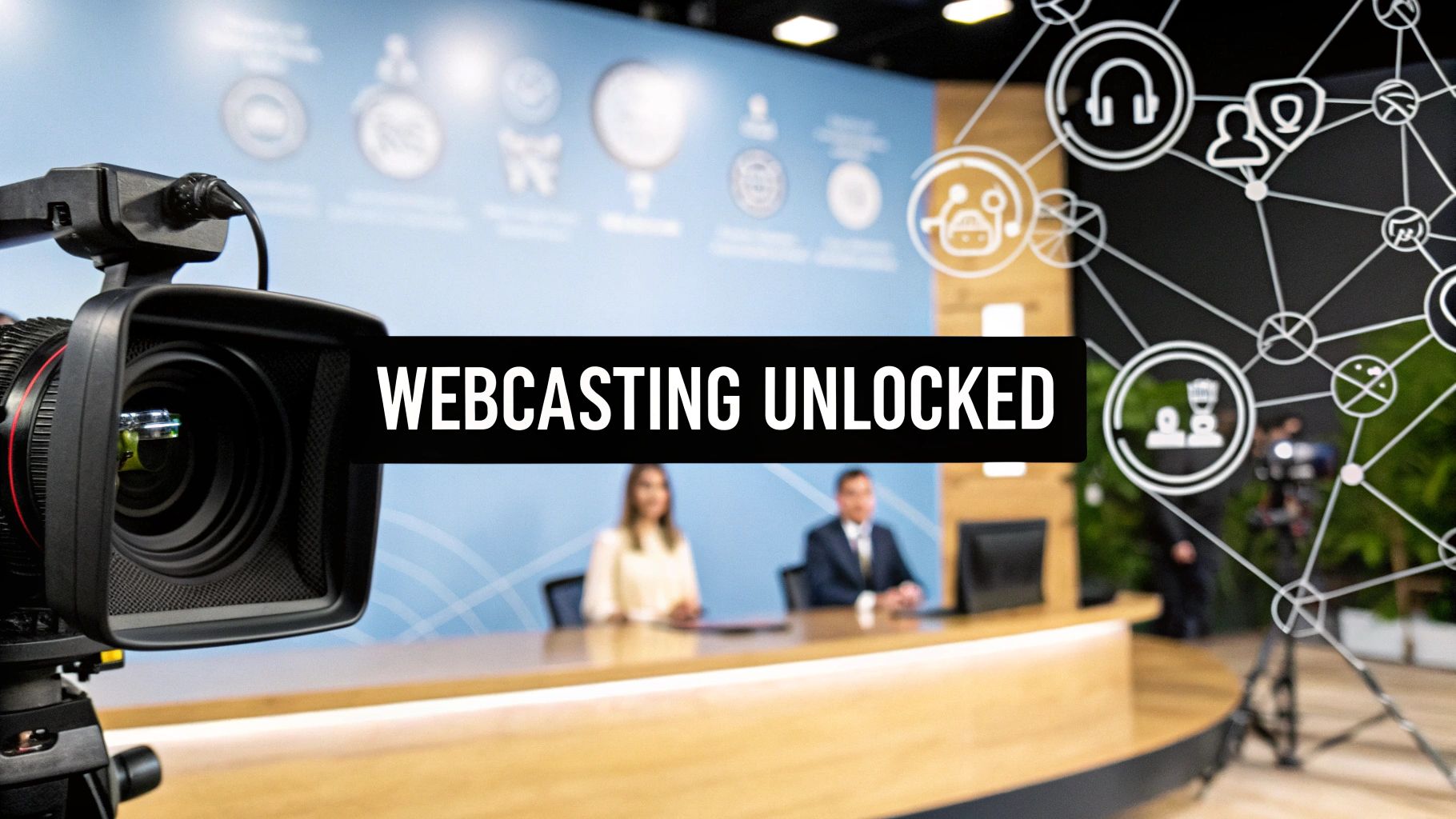
Picture a live TV broadcast, but instead of sending signals over the airwaves, you’re using the internet to reach people all over the world. That’s the easiest way to think about webcasting. It’s fundamentally a one-to-many communication model, making it the perfect tool for delivering a single, powerful message to a massive, spread-out audience.
Understanding the Core Concept of Webcasting

At its heart, a webcast is the digital version of a classic television or radio show. It’s all about streaming live or pre-recorded content from one source to countless viewers at the same time. This one-way flow of information is what really defines a webcast and separates it from other, more interactive forms of online communication.
Think of it like a keynote speech at a huge conference. You have one person on stage, and the message is flowing out to hundreds or even thousands of listeners. While the audience might clap or react, the spotlight is squarely on the presenter and their message.
Webcasting Versus Interactive Meetings
This "one-to-many" delivery is the total opposite of a typical video conference, which operates on a "many-to-many" model. A video meeting is more like a small roundtable discussion, where everyone has a seat at the table and can speak, share their screen, and contribute equally. A webcast, on the other hand, is built for scale, prioritizing broadcast quality and massive reach over two-way conversation.
A webcast is built for presentation, while a video conference is built for collaboration. Understanding this distinction is key to choosing the right tool for your communication goals.
The lines can sometimes blur, especially when you bring interactive formats like webinars into the mix. While they share some DNA, there are crucial differences. For a complete side-by-side comparison, check out our guide on the distinction between a webcast vs. webinar. It’ll make it crystal clear why one is perfect for a big product launch and the other is better for a small team brainstorm.
To help you get a quick handle on these core ideas, here’s a simple breakdown of what makes webcasting unique.
Webcasting at a Glance
This table breaks down the essential characteristics of webcasting, offering a quick and clear summary for easy reference.
| Core Characteristic | What It Means for Your Event |
|---|---|
| One-Way Broadcast | The focus is entirely on the presenter's content, ensuring a controlled and polished message. |
| Large Audience Scale | Built to reach thousands of viewers simultaneously without sacrificing stream quality. |
| Presenter-Focused | The format is designed to amplify the speaker's voice, ideal for keynotes or announcements. |
| Limited Interactivity | Audience interaction is usually passive (e.g., Q&A, polls) rather than open conversation. |
In short, when you need to deliver a polished, high-impact message to the largest possible audience, webcasting is the tool for the job.
From Niche to Mainstream: The Webcasting Story
Webcasting wasn’t born overnight. Its story begins back in the dial-up days of the 1990s, a time when the internet was a slow, clunky place and the very idea of sending live video across it felt like science fiction. But a handful of tech pioneers saw the potential. They were the trailblazers who pushed the limits of what was possible, wrestling with immense technical hurdles like sluggish bandwidth and weak processing power. Their early experiments laid the essential groundwork for the streaming world we take for granted today.
Those first few broadcasts were nothing short of monumental. One of the earliest documented live streams took place on June 24, 1993, when a garage band called Severe Tire Damage played a show online using the experimental MBone network. It was a groundbreaking feat that reportedly ate up about half of the internet’s available bandwidth at the time—a perfect snapshot of both the promise and the problems of early webcasting. If you're curious about the origins of live streaming, castr.com offers a deeper dive.
The Broadband Boom Changed Everything
The real game-changer came in the 2000s with the rise of broadband internet. Suddenly, the choppy, pixelated streams of the past gave way to faster, more reliable connections. This was the turning point that opened the floodgates for new platforms to emerge, transforming webcasting from a niche hobby for tech geeks into a powerful communication tool for millions.
This new era of high-speed internet sparked a wave of innovation. Platforms started rolling out more advanced tools, better video quality, and user-friendly interfaces, catching the eye of businesses, educators, and creators everywhere.
What started as a daring experiment among a few tech enthusiasts quickly grew into a global phenomenon, completely changing how we share information, host events, and connect with people all over the world.
The path from those early, glitchy broadcasts to the seamless HD streams we enjoy now is a testament to relentless innovation. Every modern webcast is built on the shoulders of decades of technological progress, from the first dial-up experiments to the powerful platforms that connect us across the globe today.
How a Live Webcast Actually Works
Ever wondered what magic happens behind the scenes to get a live video from a camera onto a viewer's screen across the world? It's a fascinating dance of technology that turns your live feed into a global broadcast. The best way to think about it is like a professional TV studio, where several key pieces have to work together perfectly to get the show on the air.
It all starts with your camera and microphone. These are the "talent" of the operation, capturing the raw sights and sounds you want to share. But that raw video and audio data is massive—far too bulky to send over a typical internet connection.
This is where the encoder steps in. Think of the encoder as the "translator" in our studio. It takes those huge files from your camera and mic and cleverly compresses them into a much lighter, streamable format. This compression is absolutely essential for giving your audience a smooth, buffer-free viewing experience. If you want to get into the technical weeds, this process uses protocols like RTMP or RTSP to package the data for its journey.
From Your Computer to the World
Once your content is compressed and ready to travel, it’s sent to a webcasting platform like AONMeetings. This platform is your "broadcast tower." It takes that single, tidy stream from your computer and gets it ready to be duplicated and sent out to hundreds or even thousands of viewers all at once.
The ability to do this has come a long way. We've moved from the slow, clunky dial-up days to today's lightning-fast global fiber networks, which made this whole process possible.

But there's one last piece to the puzzle. To make sure everyone, everywhere, gets a rock-solid signal, the platform relies on a Content Delivery Network (CDN).
A CDN is a massive, globe-spanning network of servers. You can think of them as "signal boosters." They take your broadcast from the main tower and distribute it locally, making sure a viewer in Tokyo gets the stream just as quickly and clearly as someone watching in New York.
This global delivery system became a necessity by the mid-2010s, as giants like Twitch—which hit 15 million daily active users back in 2019—and YouTube Live turned streaming into a daily habit for billions. It’s this intricate, behind-the-scenes system that powers every flawless, high-quality webcast you watch.
Why Businesses Are Embracing Webcasting
It’s easy to get caught up in the technology, but the real reason businesses are flocking to webcasting comes down to powerful, tangible results. This isn't just another way to broadcast a message; it’s a strategic tool that solves fundamental challenges around scale, cost, and overall impact.
One of the biggest wins is its unparalleled global reach. With a single webcast, geographical boundaries simply melt away. Imagine hosting a major product launch or an all-hands meeting and instantly connecting with thousands of employees, customers, or investors across different continents. The logistical nightmare of trying to coordinate dozens of in-person events is gone.
Maximizing Budgets and Content Value
Webcasting is also incredibly cost-effective. Just think about the budget for a traditional conference: venue rentals, travel, hotels, and catering costs pile up fast. A webcast slashes these expenses to a fraction of the cost, often while reaching an even bigger audience. That kind of ROI is hard to ignore, no matter the size of your business.
By removing the need for physical attendance, webcasting democratizes access to information, allowing organizations to engage a wider, more inclusive audience without escalating costs.
And here’s the thing: a live webcast is never a one-time event. It’s the starting point for a long-term content strategy. The moment your session ends, the recording becomes a valuable asset you can use again and again. This on-demand content can be:
- Repurposed for marketing campaigns: Slice up clips for social media, drop them in email newsletters, or feature them on your website.
- Used for internal training: Build a library of expert sessions for new employee onboarding or ongoing professional development.
- Shared with those who missed the live event: Your message keeps working for you long after the broadcast is over, extending its life and impact indefinitely.
Finally, modern webcasting platforms deliver detailed audience analytics. You can see exactly who attended, how long they tuned in, which parts of the content they engaged with most, and what resources they downloaded. This isn't just interesting data—it's deep insight into audience behavior that helps you measure engagement, prove your event's ROI, and sharpen your strategy for the next broadcast. This is how webcasting evolves from a simple communication channel into a measurable, strategic business tool.
Real-World Webcasting Examples
Okay, enough with the theory. The best way to really get what webcasting is all about is to see how it works in the real world. This isn't just some abstract tech—it’s a versatile tool that solves real problems for all sorts of organizations, all built around a focused, one-to-many broadcast model. Whether it's bringing a global team together or making a huge splash in the market, webcasting is the go-to for high-impact communication.
Let's look at a few ways different businesses are using it, turning a simple concept into concrete results. Each example tackles a specific challenge and shows just how powerful a webcast can be as a solution.
Corporate and Enterprise Communications
Think about a massive corporation with thousands of employees scattered across different continents. How does the leadership team share big news, celebrate wins, or just reinforce the company culture in a way that feels personal and immediate? An email just isn't going to cut it.
This is where the corporate town hall webcast shines. A CEO can stand up and talk to every single employee at the same time, making sure everyone gets the exact same message straight from the source. A live broadcast like this builds a level of transparency and trust that a company-wide email could never achieve. It's also the perfect format for critical investor relations meetings, where financial updates need to be delivered clearly and professionally to stakeholders, no matter where they are.
Webcasting allows organizations to transform scattered teams into a connected community, ensuring key messages are delivered with consistency and authority.
Marketing and Education Initiatives
But webcasting isn't just for internal chats. It's become a cornerstone for modern marketing and educational programs, especially in these high-stakes scenarios:
- Major Product Launches: Imagine a tech company dropping its next big thing. They can build incredible buzz by webcasting the launch event live. This creates a shared, real-time experience for customers, partners, and the media, giving it the same energy as a major keynote speech.
- Continuing Education: Professional organizations and universities use webcasting to deliver accredited courses and certifications to a massive audience. An expert can teach thousands of people at once, offering top-tier training without anyone needing to book a flight.
- Large-Scale Virtual Conferences: When a physical event is off the table, a virtual conference powered by webcasting can bring an entire industry together. You can broadcast multiple keynotes and breakout sessions to a global audience, complete with sponsorships and digital networking opportunities.
In every one of these cases, webcasting delivers the scale and control needed to send a polished, professional message to a huge and diverse group of people.
Choosing a Platform for Professional Webcasts
Knowing what a webcast is and pulling one off professionally are two completely different things. Your choice of platform is the bridge that connects your idea to reality, especially since not all streaming solutions are built to handle high-stakes events. This is where a dedicated service becomes less of a tool and more of a strategic partner.
For instance, a platform like AONMeetings gives you the kind of enterprise-grade features you need for a polished, secure broadcast. We're talking about broadcast-quality HD video that makes your brand look its best, strong security protocols for any sensitive content, and the ability to scale up for huge audiences without a single glitch. For professional webcasting, these capabilities aren't just nice to have—they're crucial.

The interface is built to manage complex broadcasts while still being straightforward enough for the presenter. Finding that balance is the secret to delivering a smooth experience for both your team and your audience.
Transforming Viewers into Participants
Beyond just broadcasting a feed, the right platform can turn passive viewing into active engagement. AONMeetings makes this happen with a whole suite of interactive tools designed to connect you directly with your audience.
A professional webcast isn't just about sending a message; it's about creating an experience. The goal is to make a large-scale event feel personal and interactive, which requires a platform built for engagement.
You can take advantage of features like:
- Moderated Q&As: Keep discussions focused, on-topic, and productive.
- Live Polls: Get real-time feedback from your audience and keep their attention locked in.
- Breakout Rooms: Create smaller, more intimate group discussions within a large event.
When you start comparing your options, you’ll find a huge variety of webinar hosting platforms out there, each with its own set of strengths. As you weigh your choices, consider specialized webcasting platforms like Forthcast, which may offer specific solutions for different professional needs. Ultimately, choosing a platform like AONMeetings ensures your virtual events truly reflect your brand’s commitment to quality and impact.
Common Questions About Webcasting
Alright, let's wrap this up by hitting a few of the most common questions that pop up around webcasting. Think of this as a quick-fire round to solidify everything we've talked about.
Webcast Versus Webinar
What's the real difference between a webcast and a webinar? It's a question we hear all the time. The easiest way to think about it is this: a webcast is a lot like a TV broadcast. It's designed to reach a massive audience with one-way communication and limited interaction from viewers. On the other hand, a webinar is more like an interactive workshop or a classroom. It's built for smaller, more engaged groups where two-way communication and collaboration are the main goals.
Equipment Requirements
Do I need a Hollywood-level studio to pull off a webcast? Not necessarily. For a simple broadcast, you can absolutely get by with a good quality webcam and a solid microphone. But if you're aiming for that polished, professional look that builds trust with your audience, most businesses step it up. That usually means investing in dedicated cameras, external audio gear, and specialized encoding software to make sure the stream is crystal clear and totally reliable.
Can I record my webcast for later?
Absolutely. Most professional webcasting platforms, including AONMeetings, automatically record your live session. This creates a valuable on-demand asset you can share with attendees who missed the live event or repurpose for your marketing and training initiatives.
Ready to deliver professional, high-impact virtual events? AONMeetings provides the secure, scalable, and browser-based platform you need to connect with your audience. Start webcasting with AONMeetings today.