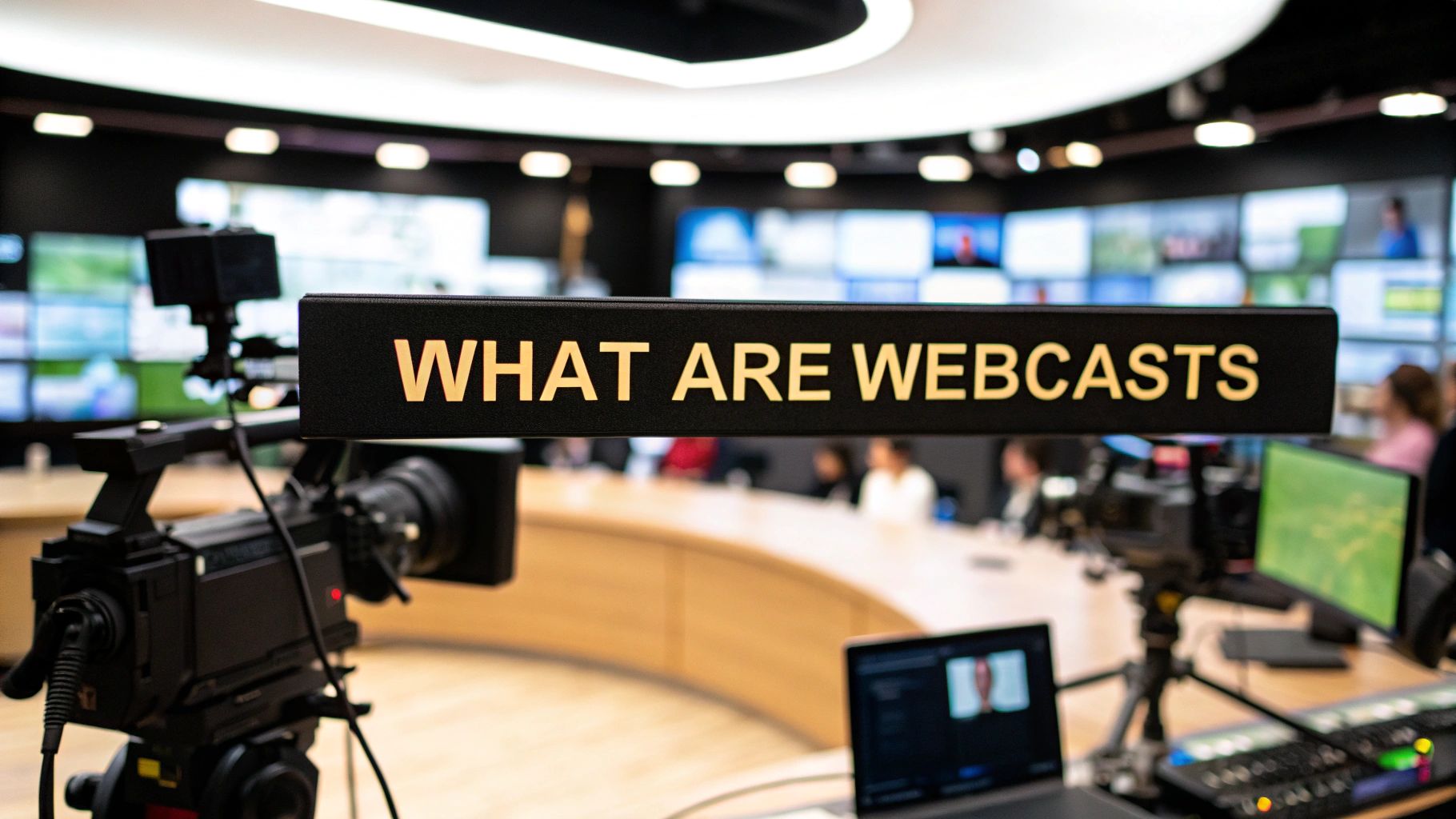
So, what exactly is a webcast?
At its heart, a webcast is a live broadcast, much like a television program, streamed over the internet. It's a powerful one-to-many communication tool, built to deliver a single, polished message to a massive and geographically diverse audience simultaneously.
Understanding the Core of Webcasting
Imagine a keynote speech delivered in a sprawling digital auditorium. A single presenter or a small group takes the stage, addressing a large audience that is primarily there to watch and listen. Unlike a collaborative meeting, the information flows in one direction: from the host to the viewers. This dynamic makes webcasting the perfect format for events where reach and message control are top priorities.
The real magic of a webcast is its incredible accessibility. People can join from anywhere on the planet with just a web browser—no travel, no physical venues, no hassle. This makes it an extremely cost-effective way to run large-scale events like corporate town halls, product launches, or university lectures.
To give you a clearer picture, let's break down the essential elements that define a webcast.
Key Characteristics of a Webcast
The following table provides a quick overview of the core features that set webcasts apart from other digital formats.
| Characteristic | Description |
|---|---|
| Massive Scalability | Built to handle thousands, even tens of thousands, of viewers without a drop in quality. |
| One-Way Communication | The focus is squarely on the presenter's delivery, with limited audience interaction. |
| Live and On-Demand | Broadcasted live but can be recorded and shared, extending the event's lifespan. |
These characteristics make webcasts a powerful tool for large-scale communication and a major reason for their explosive growth.
This broadcast model has taken off in recent years. The global market for webcasting was valued at a staggering $5.43 billion in 2024. Projections show it expanding at an annual growth rate of 12.6%, expected to hit around $20 billion by 2035. This isn't just a trend; it's a fundamental shift driven by remote work and digital-first communication strategies. For a deeper dive into the numbers, you can check out this comprehensive webcast market analysis report.
Webcasts vs. Webinars vs. Live Streams
It’s easy to get these terms mixed up. People often use webcast, webinar, and live stream interchangeably, but they're actually quite different tools for different jobs. Getting the distinction right is the first step to making sure your message lands perfectly with your audience.
The core difference really comes down to two things: how big your audience is and how much you want them to talk back.
Think of it like this: a webcast is a formal keynote address delivered in a massive digital auditorium. It’s a polished, one-to-many broadcast built for maximum reach and tight message control, perfect when you're speaking to thousands of people. A webinar, on the other hand, is more like an interactive classroom or a hands-on workshop. Here, two-way communication isn't just a feature; it's the whole point. Think live Q&A, polls, and active participation.
And then you have the live stream. This is the most informal of the bunch—almost like a casual public gathering or a behind-the-scenes look you’d broadcast on social media. It feels spontaneous and thrives on real-time engagement like comments and reactions.
Choosing Your Broadcast Format
So, how do you pick? It often starts with one simple question: how many people are you trying to reach? This little decision tree can help you make that first crucial choice.

As you can see, when your main goal is broadcasting to the largest audience possible, the webcast is the clear winner. Its underlying technology is specifically designed to handle that kind of scale without a hitch.
A Side-by-Side Comparison
While audience size is a great starting point, other factors like the level of interaction and what you’re trying to achieve are just as important.
A webcast is designed for presentation, a webinar is built for collaboration, and a live stream thrives on interaction. Choosing the right one aligns the technology with your communication goals.
Let's put these formats head-to-head to really clarify the differences. For an even deeper dive, check out our complete guide on the webcast vs webinar distinction.
Comparing Digital Broadcast Formats
The table below breaks down the key features of each format, helping you see at a glance which one is the best fit for your specific needs.
| Feature | Webcast | Webinar | Live Stream |
|---|---|---|---|
| Primary Goal | Broadcasting a polished message to a large, passive audience. | Educating and training a smaller, interactive group. | Engaging a community in a casual, real-time setting. |
| Audience Size | High (1,000 to 100,000+ attendees). | Moderate (50 to 1,000 attendees). | Varies widely, from small to very large. |
| Interactivity | Low (Moderated Q&A, polls). | High (Live Q&A, chat, breakout rooms, screen sharing). | Very High (Live comments, reactions, social sharing). |
| Common Uses | Corporate town halls, investor meetings, product launches. | Employee training, marketing demos, educational courses. | Social media events, influencer broadcasts, Q&A sessions. |
Ultimately, picking the right format is all about matching the tech to your intent. For a high-stakes corporate announcement to the entire company, the controlled environment of a webcast is perfect. But if you’re trying to teach a team a complex new skill, you’ll need the collaborative tools that only a webinar can offer.
How Webcasting Became a Communication Staple
Webcasts certainly didn’t just pop up out of nowhere. Their journey from a niche bit of tech to an absolute must-have business tool is really a story about the internet growing up and how our work habits have changed right along with it. In the early days, they were basically the online version of TV and radio broadcasts, a way to send audio and video to a new, growing audience on the web.
The initial idea was simple: one-way broadcasting. But the real game-changer was when platforms started adding interactive features like moderated Q&A sessions and live polls. This transformed passive watching into an active, engaging experience, suddenly making webcasts a perfect fit for things like corporate town halls or major announcements where getting a feel for the audience's reaction was crucial.
The Catalyst for Mainstream Adoption
If you want to pinpoint a starting line, webcasts really got their legs with the spread of broadband internet in the early 2000s, acting as a live-streaming alternative to traditional broadcasting. The massive global shift to remote work during the COVID-19 pandemic, however, was like pouring gasoline on the fire. Companies and schools had to go virtual almost overnight, which pushed webcasting technology—and its adoption—forward at a dizzying speed.
The need to connect a scattered workforce turned webcasting from a "nice-to-have" marketing gimmick into a critical piece of operational infrastructure.
This sudden, widespread demand forced the platforms to mature, and fast. They had to get better, more reliable, and more secure. What was once a specialized tool for tech companies became a mainstream solution for organizations of every size. The power to connect with thousands of employees, investors, or customers at once, without anyone having to travel, proved to be indispensable.
From Niche Tech to Business Essential
The modern webcast is a direct product of this whole journey. Its growth story is tied to the bigger narrative of how digital communication has reshaped our world over the last couple of decades. In fact, understanding the evolution of video conferencing technology gives you great context for how webcasts carved out their own unique and powerful place.
Here are a few key milestones that really cemented webcasting's role:
- Improved Accessibility: No more clunky software downloads. Browser-based platforms made joining a webcast as simple as clicking a link.
- Enhanced Analytics: Suddenly, you could track who was watching, how engaged they were, and where they were from. This gave businesses a clear picture of their return on investment.
- Integration with Business Tools: Linking webcasts to CRMs and marketing automation platforms turned them into powerful machines for generating leads and nurturing customer relationships.
Today, webcasting is a mature, reliable, and fundamental part of how modern businesses operate. It’s essential for everything from internal all-hands meetings to global product launches.
Powerful Webcast Examples in Action

It’s one thing to know the definition of a webcast, but seeing how they’re used in the real world is where their power really clicks. These one-to-many broadcasts are so much more than online presentations; they are strategic tools that businesses, schools, and organizations of all stripes use to connect, inform, and inspire on a massive scale.
Think about the logistical puzzle a multinational corporation faces for its quarterly all-hands meeting. With a webcast, the CEO can address thousands of employees across different continents in a single, unified session. Everyone gets the same message, straight from leadership, which is huge for building a cohesive culture. Not to mention, it saves a fortune in travel expenses.
Driving Growth and Authority in Marketing
In the marketing world, webcasts are absolute gold for generating excitement and cementing a brand as a leader. Imagine a tech company gearing up to launch its next flagship product. Instead of a physical event capped by the size of the venue, they can broadcast to a limitless global audience of customers, journalists, and industry analysts, creating an incredible amount of buzz.
But it’s not just about big launches. Webcasts are perfect for thought leadership events. By hosting a broadcast with industry experts discussing key trends, a company instantly positions itself as an authority. This does more than just build brand credibility—it becomes a powerful engine for generating high-quality leads.
By transforming a single live event into a valuable, reusable asset, webcasts extend the ROI far beyond the initial broadcast date. The on-demand recording continues to attract viewers and generate leads for months.
The numbers back this up. Webcasts are now a cornerstone of modern business communication, with 95% of marketers viewing them as a vital part of their strategy. Even more telling, 73% of B2B marketers point to webcasts as their top source for high-quality leads. You can dig deeper into how webcasts drive success in this report on webinar statistics.
Revolutionizing Education and Outreach
Educational institutions have also come to rely heavily on webcasting. A university can broadcast a graduation ceremony, allowing the families of international students to be part of the celebration from anywhere in the world. They can also host huge virtual lectures with guest speakers from across the globe, giving students access to expertise that would otherwise be completely out of reach.
Here’s a quick look at how different sectors are using them:
- Corporate: Global town halls, investor relations calls, and company-wide training sessions.
- Marketing: High-impact product reveals, expert panel discussions, and major customer announcements.
- Education: University-wide announcements, virtual open days for prospective students, and specialized academic conferences.
In every one of these scenarios, the advantages are crystal clear: incredible scalability, massive cost savings over physical events, and the creation of valuable on-demand content that lives on. This blend of reach, efficiency, and lasting value is exactly why getting a handle on what are webcasts is a must for any modern organization.
How to Plan and Run a Flawless Webcast
Pulling off a webcast that looks professional and actually holds your audience's attention takes serious preparation. A great event doesn't just fall into place; it's the product of a smart strategy that covers everything from your initial goals all the way to your post-event follow-up. Think of this as your playbook for producing a polished broadcast.
The real work starts long before you ever hit the "Go Live" button. The first, and most important, step is to nail down your objectives. What, exactly, are you trying to accomplish with this webcast? Is the goal to generate new sales leads, get your employees up to speed on new training, or maybe announce a major company update? Your goals will steer every other decision you make down the line.
Once you have clear objectives, you can define your key performance indicators (KPIs). For a marketing webcast, that might be the number of qualified leads. For an internal all-hands, it could be the percentage of employees who showed up live.
Setting the Stage for Success
With your strategy locked in, it’s time to get into the nuts and bolts of production. This phase really comes down to three core components: your content, your tech, and your promotion. Each one is a critical piece of the puzzle.
- Prepare Compelling Content: Your presentation is the main event. Make sure your content flows logically with a clear beginning, middle, and end. Use high-quality visuals and, please, avoid jamming your slides with giant walls of text. The idea is to inform and engage, not put your audience to sleep.
- Manage the Technical Setup: You have to get the gear right. A good external camera and a dedicated microphone can make a massive difference in quality. Test your internet connection—a wired ethernet connection is always going to be more reliable than Wi-Fi—and get comfortable with your webcasting platform’s features well ahead of time.
- Promote Your Event: You could have the most amazing content in the world, but it won't do much good if nobody is there to see it. Get the word out about your webcast across the channels that make sense, like email, social media, and your company blog. Set up a simple registration page that clearly spells out the value attendees will get for their time.
Executing and Maximizing Your Impact
On the day of the event, it's all about execution. Having a dedicated moderator is a game-changer for managing the flow, fielding audience questions, and jumping on any technical glitches that pop up. This frees your main speaker to focus entirely on delivering their message. For more tips on keeping your delivery clear and engaging, check out these insights on what makes a good presentation.
The work isn't over when the live broadcast ends. The post-event phase is where you can extract long-term value from your efforts and solidify your relationship with the audience.
After the webcast wraps, your focus should shift to getting as much mileage as possible out of it. Send a follow-up email to everyone who registered, and be sure to include a link to the on-demand recording. This simple step is a great service to both the people who made it and those who couldn't, and it dramatically extends the life of your content. By circling back to your KPIs, you can measure your success and pick up valuable insights to make your next webcast even better.
Choosing a Secure Webcasting Platform

The success of a high-stakes webcast often boils down to the technology powering it. Choosing the right platform isn’t just about streaming a video feed; it’s about making sure your broadcast is secure, reliable, and professional from start to finish. When you’re running an investor call or a confidential internal meeting, security is everything.
This is where a dedicated platform like AONMeetings makes all the difference. It’s built with end-to-end encryption to shield sensitive information, so you can discuss proprietary data without looking over your shoulder. For any serious corporate communication, that level of security is simply non-negotiable. If you want to dig deeper, you can explore more about what makes a platform truly secure in this guide to essential features in a secure video conferencing platform.
Beyond Security to Quality and Scale
But security is just one piece of the puzzle. For a polished product launch or a major announcement, you also need flawless high-definition video and an infrastructure that can handle a massive audience without breaking a sweat. A professional platform ensures your brand is represented with the quality it deserves, steering clear of the technical glitches that can completely undermine your message.
A great webcasting platform does more than just broadcast your event; it protects your data, upholds your brand’s image, and provides the tools to measure your success.
Finally, the value of a webcast lives on long after the broadcast ends. As you evaluate different platforms, it’s critical to understand how they handle attendee data. Advanced analytics can offer incredible insights into audience engagement, while features like managing webcast attendee data with CRM integration allow you to seamlessly funnel leads into your sales pipeline and prove the event’s ROI. AONMeetings pulls all these elements together, offering the security, quality, and analytics you need for a truly flawless webcast.
Your Top Webcast Questions, Answered
As you start exploring the world of webcasting, you'll probably run into a few common questions. Let's tackle them head-on to clear things up and give you the confidence to plan your next big broadcast.
What Kind of Gear Do I Need for a Professional-Grade Webcast?
Technically, you could run a webcast from your laptop. But if you want to look professional and make a real impact, a few upgrades will make a world of difference.
A high-quality external camera, like a DSLR, will give you that crisp, polished video that a built-in webcam just can't match. For audio, a dedicated USB or XLR microphone is non-negotiable; it delivers that rich, clear sound that keeps your audience tuned in. And of course, good lighting is the secret ingredient to looking your best on screen.
But here’s the real pro tip: beyond the camera and mic, the most critical piece of your setup is a stable, high-speed wired internet connection. It’s the absolute foundation for a smooth, glitch-free broadcast.
Once you have the hardware, a professional platform like AONMeetings ties it all together. It gives you the software you need to manage the stream, engage with viewers, and deliver a truly polished final product.
Are Webcasts Actually Interactive?
Yes, but the interaction is much more controlled and scalable than in a small meeting. While a webcast is primarily a one-way broadcast, modern platforms have built-in features to keep massive audiences engaged without derailing the presentation.
Think of it as structured participation. The most common interactive tools include:
- Moderated Q&A: Attendees can submit questions, but a moderator filters and organizes them before passing them to the speaker at the right moment.
- Live Polls: Presenters can launch real-time polls to get a pulse on audience opinion or check for understanding, often sharing the results live on screen.
- Managed Chat: A chat function lets the audience react and comment, but it’s typically overseen by a moderator to keep the conversation productive and on-topic.
This approach neatly avoids the free-for-all chaos that can happen in a smaller webinar, making it perfect for maintaining order when you're broadcasting to thousands of people.
How Do I Know if My Webcast Was a Success?
Measuring success starts with defining your goals before you go live. What you track will depend entirely on what you wanted to achieve in the first place.
If your goal was reach, you'll want to track your registration numbers, the live attendance rate, and how many on-demand views you get after the event. To measure content quality, look at engagement metrics like the average watch time and how many people answered your polls.
For marketing-focused webcasts, the most important numbers are often tied directly to business results. In that case, you'll be looking at things like the number of qualified leads generated and how the webcast influenced your overall sales pipeline.
Ready to host secure, high-quality webcasts that captivate your audience? AONMeetings provides all the tools you need, from end-to-end encryption to advanced analytics, all in one browser-based platform. Discover how AONMeetings can elevate your next broadcast today.