
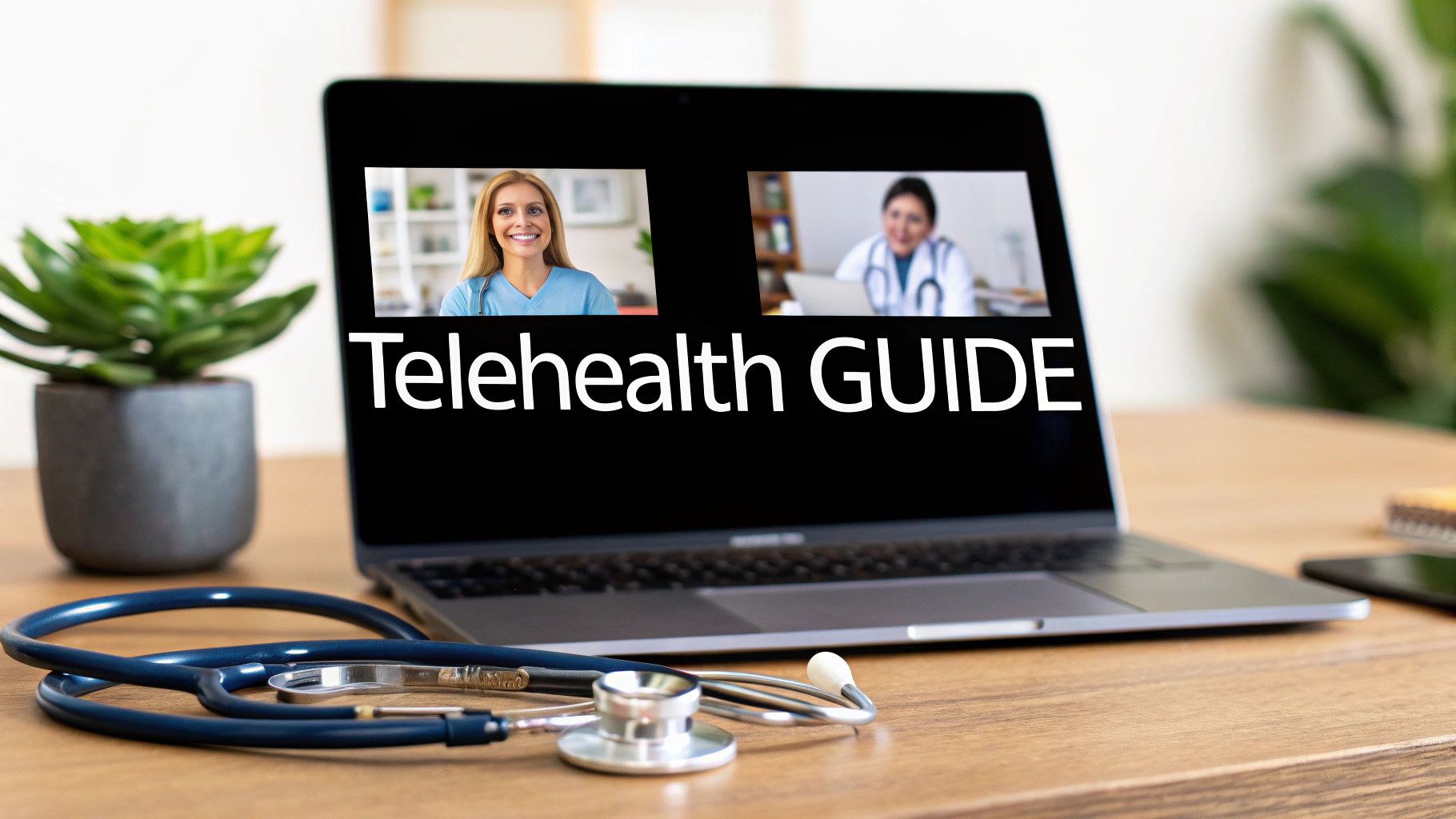
Video conferencing for healthcare is no longer just a neat "what if" technology; it’s rapidly becoming a core part of modern medicine. Think of it as the new digital front door to your practice. It lets patients connect with providers from almost anywhere, tearing down the old walls of geography and scheduling that used to be major barriers to getting care.
The New Digital Front Door to Patient Care

Healthcare just isn't confined to the four walls of a clinic anymore. This shift to virtual consultations is a huge change in how we deliver care, tackling long-standing headaches with access and efficiency. It’s way more than just a video call—it’s a completely new, patient-focused model.
This evolution has been a game-changer, especially in a few key areas:
- Chronic Condition Management: Patients with ongoing conditions like diabetes or heart disease can now have simple, low-effort check-ins. This makes it easier for them to stick with treatment plans and helps providers spot potential problems much earlier.
- Post-Operative Follow-ups: Instead of a tough trip back to the hospital, a patient recovering from surgery can have their follow-up appointments from the comfort of their own home.
- Mental Health Services: Telepsychiatry has been a breakthrough. It removes much of the stigma and logistical hassle of seeking mental health support, giving people a private, accessible way to connect with therapists.
The Growing Importance of Virtual Care
The idea of a "digital front door" goes beyond just video calls. It includes all sorts of tech that makes healthcare more accessible, like innovative dental care apps.
The market reflects this boom. The global healthcare video conferencing market was valued at USD 90.3 billion and is on track to hit USD 149.92 billion as more and more practices come on board. The growth is undeniable.
At its heart, this technology promises a more connected, continuous journey for the patient. It builds a bridge between appointments, giving people the tools to take a much more active role in their own health.
Of course, this digital shift brings a massive responsibility: protecting patient data. Any platform used for video conferencing in healthcare absolutely must follow strict privacy laws. It's crucial to select a HIPAA-compliant video conferencing platform to keep every interaction secure. This foundation of trust is what the future of patient care is being built on.
Why Virtual Care Platforms Are a Game-Changer
When we talk about video conferencing for healthcare, we're not just talking about a digital substitute for an in-person visit. We're looking at a fundamental shift that brings real, measurable wins for both patients and providers. The most obvious and powerful advantage? It completely erases geography from the equation. Suddenly, a patient in a rural community can consult with a top specialist hundreds of miles away, all without the stress and expense of a long journey.
This convenience translates directly into savings of time and money. For patients, it means no more taking a whole day off work, finding childcare, or paying for gas and parking just for a 15-minute follow-up appointment. For clinics, this shift brings incredible efficiency, slashing no-show rates and creating more flexible schedules to accommodate more patients.
Better Access, Better Health Outcomes
Where virtual care truly shines is in managing chronic diseases. Conditions like diabetes, hypertension, or COPD demand constant attention, and that’s where video conferencing excels. Regular, low-friction virtual check-ins make it so much easier for patients to stick with their care plans and feel supported.
This proactive model allows providers to spot warning signs early, adjust treatments on the fly, and stop minor issues from snowballing into full-blown health crises that land patients in the hospital. It’s a shift from occasional office visits to a continuous, supportive relationship between patient and provider.
By making healthcare more convenient and always-on, virtual platforms give patients the tools and confidence to take charge of their own health. This leads to better long-term outcomes and fewer trips to the emergency room.
To illustrate how these benefits spread across the healthcare ecosystem, let's break down the impact on each group.
Impact of Video Conferencing on Healthcare Delivery
This table highlights the core advantages for the key players involved: patients, providers, and the system as a whole.
| Stakeholder | Key Benefit | Example Outcome |
|---|---|---|
| Patients | Increased access to specialists and convenient follow-ups | A patient in a remote area consults a cardiologist in a major city without travel. |
| Providers | Improved operational efficiency and patient adherence | Reduced no-show rates and more frequent, effective check-ins for chronic care. |
| Healthcare System | Reduced costs and better management of population health | Fewer hospital readmissions due to proactive monitoring and early intervention. |
As you can see, the value isn't isolated; it creates a positive feedback loop that strengthens the entire system, making it more resilient and patient-focused.
The Economic Engine Behind Virtual Care
The move to virtual care isn’t just a passing trend—it's a major economic force reshaping how healthcare is delivered. The global telemedicine market, which is built on video conferencing technology, was valued at roughly USD 104.64 billion and is on track to hit USD 334.8 billion, growing at a staggering compound annual rate of 16.9%. You can explore the full market analysis from Fortune Business Insights to grasp the sheer scale of this movement.
This financial momentum is a direct reflection of the real-world value these platforms deliver. They are helping to build a more efficient and robust healthcare system that can better manage the health of entire populations. By making the most of available resources and expanding access, these platforms are now an essential part of modern medical infrastructure. If you want to dig deeper into these advantages, you can learn more about the key benefits of video conferencing in our dedicated guide.
How to Ensure HIPAA Compliance in Telehealth

When a patient shares their most sensitive health information, they are placing immense trust in you. In the world of video conferencing for healthcare, that trust is legally codified by the Health Insurance Portability and Accountability Act (HIPAA). A compliance failure isn't just a technical oversight; it's a fundamental breach of that trust that can come with some pretty severe penalties.
Think of HIPAA compliance like building a digital armored car for patient data. It’s not enough for the car to simply get from point A to point B. It needs impenetrable walls, secure locks, and a verified, trustworthy driver. Every single component must work in concert to guard the precious cargo inside—Protected Health Information (PHI).
This "armored car" approach demands several layers of security. It starts with ensuring data is unreadable to anyone who might try to intercept it, both while it's moving across the internet and when it’s stored on a server.
The Foundation of a Secure Telehealth Platform
To get to this level of security, a telehealth platform has to include specific technical safeguards. These aren’t just nice-to-have features; they are the absolute bedrock of protecting patient privacy. This is exactly why you can't just use a standard consumer video app like FaceTime or Skype for patient consults—they simply don't have the necessary protections built in.
Here are the key technical requirements you need to look for:
- End-to-End Encryption (E2EE): This is the "impenetrable wall" of our digital armored car. E2EE ensures that only the patient and the provider can see the video feed, making the data completely unreadable to anyone else, including the platform vendor.
- Access Controls: This works like a high-tech keycard system. It guarantees that only authorized personnel, like the patient’s direct care team, can access any stored video recordings or related PHI.
- Audit Trails: This is the detailed logbook that tracks every single action related to patient data. It allows you to monitor and investigate who accessed what information and when, which is absolutely critical for accountability.
These elements are completely non-negotiable for any video conferencing for healthcare solution. But having the right tech is only half the battle.
The Business Associate Agreement: Your Legal Safeguard
Beyond the technology, there’s a crucial legal document that underpins everything: the Business Associate Agreement (BAA). This is a legally binding contract between a healthcare provider and any third-party vendor (like a video conferencing company) that handles PHI on your behalf.
The BAA is your legal proof that your vendor acknowledges its responsibility to protect patient data according to HIPAA rules. Without a signed BAA from your video conferencing provider, you are not HIPAA compliant—period.
This document confirms that your vendor has all the necessary safeguards in place and that they accept legal liability for protecting that data. When you're vetting different platforms, one of your very first questions should be whether they will sign a BAA.
For a more detailed breakdown, our guide to making video conferencing HIPAA compliant offers a deeper look into these legal and technical must-haves. Ultimately, choosing the right partner is fundamental to building a virtual care practice that patients can trust.
When you're picking a platform for video conferencing for healthcare, you need to look for a lot more than just a clear picture and a stable connection. The run-of-the-mill video tools are built for corporate boardrooms, not clinical exam rooms. A platform designed for healthcare must be built from the ground up with features that support actual medical workflows, making sure every virtual visit is just as effective and secure as seeing a doctor in person.
Think about it like this: a standard consumer video app is a basic sedan. It’s great for simple, everyday trips. But a clinical video platform? That’s a fully equipped ambulance. It comes with specialized tools designed for specific, high-stakes situations. Beyond just crisp HD video, these platforms need to offer a whole suite of integrated features that mirror what happens in a real-world clinic.
Replicating the In-Office Experience
The best telehealth solutions work hard to create a professional, familiar environment for both the patient and the provider. This starts the very moment a patient "arrives" for their appointment.
A virtual waiting room is a perfect example of this. This digital space lets patients check in, confirm their details, and wait for the provider to start the call. It’s a simple but brilliant feature that manages patient flow, prevents interruptions, and gives the clinician total control over their schedule—just like a physical waiting room. It’s a small touch that makes the whole experience feel organized and professional.
Core Clinical and Administrative Tools
Once the consultation is underway, the platform has to provide tools that enable real clinical work. It’s not just about talking; it’s about collaborating on the patient's care.
Here are some of the absolute non-negotiables:
- Secure Screen Sharing: A doctor has to be able to securely share their screen to review important documents with a patient. This is crucial for going over lab results, looking at an MRI scan together, or walking through a treatment plan with visual aids.
- EHR/EMR Integration: Having a seamless connection to your Electronic Health Record (EHR) system is vital. This ensures that all the notes, recordings, and other data from the virtual visit automatically land in the patient’s file. It keeps everything in one place, maintaining a single, consistent source of truth for their entire care journey.
- Digital Consent and Intake Forms: The ability to send and receive digital consent forms or patient intake questionnaires before the appointment streamlines all the administrative work. This saves precious time during the actual consultation, letting you focus on the patient.
The real goal is to embed the video tool directly into the existing clinical workflow, not force clinicians to work around a clunky, disconnected piece of software. A truly great platform feels like a natural extension of how the practice already operates.
On top of that, a robust video conferencing for healthcare platform must have multi-user capabilities. This is what allows for complex case conferences where multiple specialists can jump on a call, or for a medical interpreter to be present when needed. This kind of collaborative feature is absolutely essential for coordinated care, especially for patients with complicated conditions who rely on a whole team of experts.
Without these purpose-built functionalities, a video tool is just that—a video tool. It’s not a true telehealth solution.
Putting Telehealth into Practice Across Specialties

The real magic of video conferencing for healthcare isn’t in the technology itself, but in how it’s being applied in the real world. This isn't a one-size-fits-all solution. Instead, it’s a flexible tool that adapts to the unique problems and patient needs across countless medical fields, breaking down old barriers one specialty at a time.
Take telepsychiatry, for instance. A teenager wrestling with anxiety can now connect with a therapist from the privacy and comfort of their own bedroom. This completely sidesteps the logistical and emotional stress of an in-office visit. For many, that level of accessibility is the deciding factor between seeking help and suffering in silence.
From Post-Op Care to Dermatology
Now, shift gears and think about a new parent recovering at home from a C-section. A stressful trip to the clinic with a newborn is the last thing they need. With a video follow-up, a nurse can visually check the incision, answer pressing questions, and offer crucial wound care advice, all while the parent and baby are resting comfortably.
This same adaptability shines in highly visual fields like dermatology. A patient in a remote town can show a suspicious mole to a specialist hundreds of miles away. The dermatologist can then make an initial assessment and decide if an in-person visit is urgent, dramatically cutting down the time to get answers.
These stories aren't some futuristic fantasy; they're happening every day. The common thread is simple: distance is no longer a roadblock to getting timely, expert medical care.
The data backs this up. Video conferencing for healthcare is fundamentally changing how care is delivered by opening up access, especially for people in remote or underserved communities. This growth is largely fueled by scalable, low-maintenance cloud platforms, signaling a worldwide move toward remote care models that improve both patient access and provider efficiency.
Of course, as virtual visits increase, so does the paperwork. Streamlining the administrative side is crucial for scaling these services. Exploring options for healthcare documentation automation can free up valuable time, allowing providers to focus more on patient care and less on clerical tasks.
A Step-by-Step Plan to Launch Virtual Services
Bringing telehealth into your practice might feel like a huge undertaking, but it doesn't have to be. With a clear, practical roadmap, you can successfully roll out video conferencing for healthcare and make the transition seamless for both your staff and your patients. It’s all about breaking the process down into manageable steps.
The journey starts with a good, hard look inward. Before you even start browsing vendors, you need a firm grasp of your clinic’s specific needs, your patient demographics, and what your budget can handle. This foundational work is what ensures you pick a solution that actually fits your workflow, rather than trying to shoehorn your team into a system that just doesn't work for them.
To help visualize the process, here’s a look at the essential stages for getting virtual care services up and running in a clinical setting.

As you can see, a successful launch is about so much more than just the tech. It’s about weaving a new tool into the fabric of your practice and, most importantly, getting your people ready and confident to use it.
Key Implementation Milestones
Once you’ve assessed your needs, the next major step is choosing a vendor. Your top priority should be finding HIPAA-compliant platforms that provide a Business Associate Agreement (BAA). After that, you can dive into the hands-on stages of launching your new service.
-
System Integration: The first technical hurdle is getting the new platform to talk to your existing Electronic Health Record (EHR) system. Work closely with your chosen vendor on this. A smooth connection is crucial for keeping patient records consistent and saving your staff from the headache of duplicate data entry.
-
Staff and Provider Training: Your team's confidence is everything. You'll need to run comprehensive training sessions that cover all the bases, from initiating a call to securely sharing lab results on-screen. When your staff feels empowered, your rollout will be that much smoother.
A well-planned launch isn't just about flipping a switch. It's about thoughtful preparation, strategic integration, and ongoing support to build confidence among both your care team and the patients you serve.
- Patient Onboarding and Support: Finally, it's time to get your patients on board. You can't just expect them to know what to do. Create simple, easy-to-follow guides on how to access their first virtual visit. A positive first experience is absolutely vital for building patient trust and encouraging them to use telehealth services again in the future.
Common Questions About Video Conferencing for Healthcare
As virtual care becomes more common, it's natural for both healthcare providers and patients to have questions. Stepping into the world of video conferencing for healthcare means getting a handle on the specifics of security, technology, and day-to-day use. Making sure every virtual visit is successful and trustworthy is the top priority.
Getting clear, straightforward answers to these common concerns is the first step in building confidence in telehealth. It helps everyone involved feel more comfortable and ready for this new way of delivering care.
Is It Really Secure Enough for Patient Data?
Yes, but with a big caveat: you must use a platform designed specifically for healthcare. Everyday consumer apps like FaceTime or the standard version of Skype just aren't built for this—they're missing the critical security layers needed to protect sensitive information.
A true medical-grade platform has to be HIPAA-compliant, which is far more than just a buzzword. This compliance ensures concrete protections are in place:
- End-to-end encryption is non-negotiable. It scrambles the video feed so that it's completely unreadable to anyone outside the virtual room.
- Secure access controls guarantee that only authorized providers and staff can ever view patient information.
- The platform vendor must sign a Business Associate Agreement (BAA). This is a legally binding contract where they formally accept responsibility for safeguarding protected health data.
Can Physical Exams Be Done Virtually?
While a video call can't perfectly replicate a hands-on physical exam, it's remarkably effective for a wide range of situations. Clinicians are trained to perform "guided" examinations, where they expertly instruct patients on how to check things themselves.
For example, a doctor might ask a patient to press on a specific area to check for tenderness, hold a rash up close to the camera for a better look, or use an at-home device like a blood pressure cuff or thermometer. This approach is fantastic for visual assessments, mental health consultations, and critical follow-up appointments after a procedure. It offers a powerful way to monitor a patient's progress without the hassle of an in-person visit.
The effectiveness of a virtual exam always depends on the clinical context. It excels at visual checks, follow-ups, and talk-based therapy, but it isn't a substitute for situations requiring direct physical touch or specialized diagnostic equipment.
For anyone looking to stay on top of best practices in this evolving field, exploring resources like Salthea's comprehensive telehealth blog can offer valuable, ongoing insights for both patients and providers.
At AONMeetings, we provide a browser-based, HIPAA-compliant video conferencing platform built for the rigorous demands of modern healthcare. Our solution delivers secure, high-definition virtual visits with no software installation required, ensuring both your practice and your patients are protected. Experience the future of virtual care by learning more about AONMeetings.