
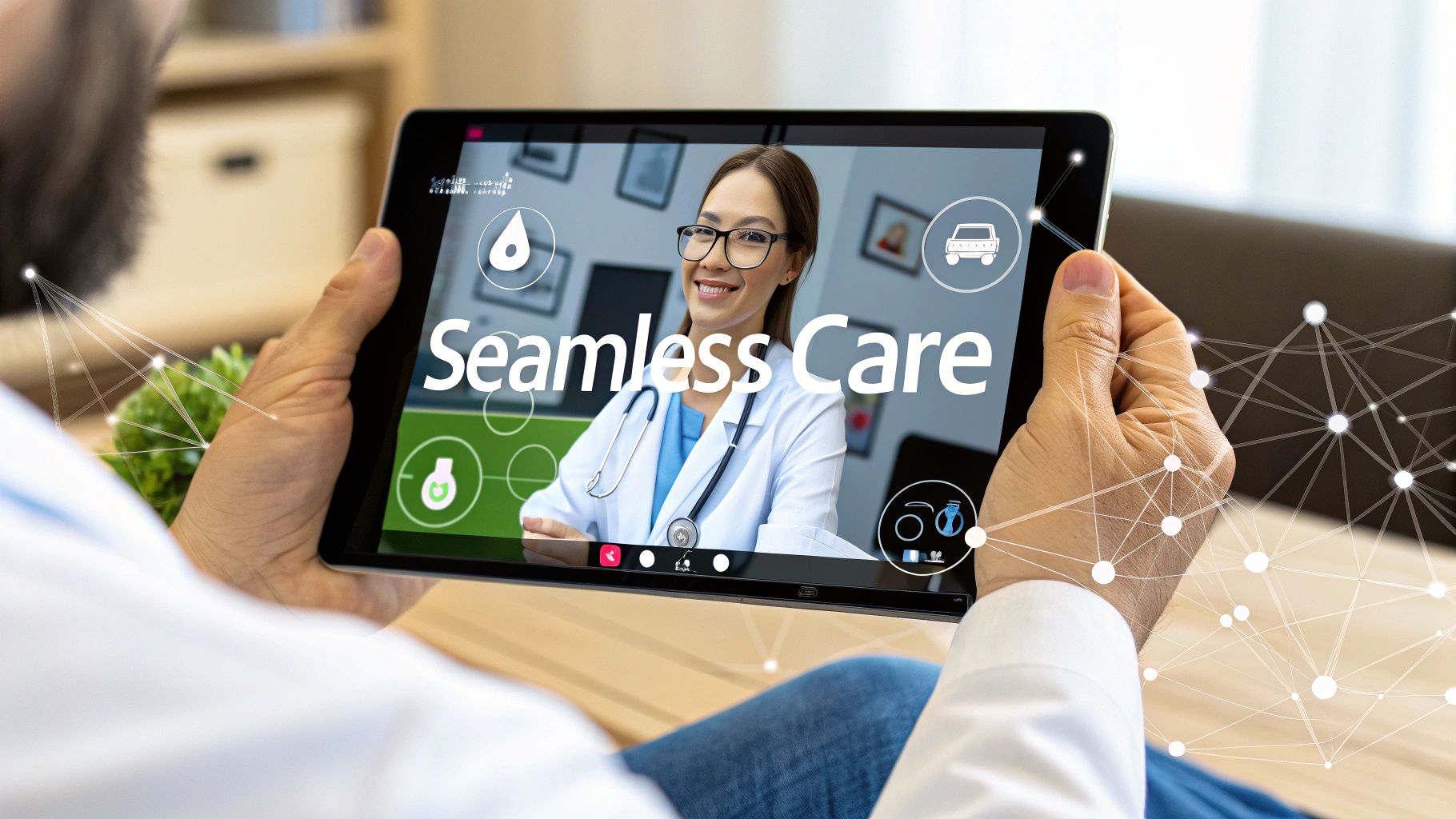
Telehealth software isn't just about video calls. Far from it. These are comprehensive digital platforms that let healthcare providers deliver care, consult with patients, and monitor them from a distance. Think of them as the digital backbone for a virtual clinic, integrating everything from scheduling and secure messaging to electronic health record (EHR) management. The goal is to create a seamless experience for everyone involved.
How Telehealth Software Is Reshaping Healthcare

Remember how mobile banking completely changed our relationship with personal finance? It took essential services out of brick-and-mortar branches and put them right in our hands, making everything instant and incredibly convenient. Telehealth software is doing the exact same thing for healthcare, fundamentally changing how we connect with doctors and manage our own health.
These platforms aren't just trendy apps; they are sophisticated ecosystems built to support the entire remote care journey. From the moment a patient books a virtual visit to the follow-up care and prescriptions that come after, these tools provide the framework for a modern, efficient, and secure way to practice medicine.
Moving Beyond Simple Video Calls
At its heart, telehealth software is about creating a connected and continuous care experience. Yes, video conferencing is a big part of it, but the real power is in how it weaves together different functions to make workflows smoother and improve patient outcomes. This is a crucial shift, especially as patient expectations evolve.
It all comes down to a few key improvements:
- Greater Accessibility: Patients in rural communities or those with mobility issues can finally see specialists without the hassle and cost of travel.
- Better Efficiency: Think automated scheduling, digital intake forms, and integrated billing. It all adds up to less administrative drag for clinic staff.
- Continuous Care: Chronic conditions can be managed far more effectively with regular virtual check-ins and remote data collection from wearables.
The market’s explosive growth tells the story. Valued at $123.26 billion, the global telehealth market is on track to hit a staggering $455.27 billion by 2030. That kind of expansion isn't a fad; it’s a permanent shift in how healthcare is delivered.
A New Standard for Patient Care
The ultimate goal here is to make healthcare more about the patient. By knocking down the old barriers, telehealth software gives people the power to take a more active role in their health. It helps build stronger relationships between patients and providers through easy, consistent communication, transforming healthcare from a series of isolated appointments into an ongoing conversation.
As this technology matures, we're seeing other innovations fold in. For example, the growing role of AI agents in healthcare shows just how sophisticated these digital ecosystems are becoming.
By transforming healthcare delivery from a location-based service to a patient-centered digital experience, telehealth software solutions are not just improving convenience—they are fundamentally redefining the standards of modern medical care and patient engagement.
Now, let's take a quick look at how these solutions specifically help the different people involved in the healthcare process.
Telehealth Software at a Glance
This table breaks down how telehealth software solutions empower different stakeholders in the healthcare ecosystem, from patients to administrators.
| Stakeholder | Primary Benefit | Key Functionality |
|---|---|---|
| Patients | Convenient access to care | Secure video calls, patient portal, appointment scheduling, prescription refills |
| Clinicians | Improved workflow efficiency | EHR integration, e-prescribing, secure messaging, remote patient monitoring |
| Administrators | Reduced operational overhead | Automated billing, digital intake forms, reporting and analytics |
| Specialists | Expanded reach for consultations | High-definition video, secure data sharing, virtual waiting rooms |
Ultimately, the software serves as a central hub that connects everyone, streamlining communication and making the entire virtual care process more cohesive and effective.
Essential Features of Modern Telehealth Platforms

To really get what makes telehealth software tick, we have to look under the hood. The best platforms aren't just about video calls; they’re a collection of core components that enable secure, efficient, and truly effective virtual care. Each feature is there to solve a real-world problem, whether it's protecting patient privacy or cutting down on administrative headaches.
Think of a telehealth platform as your digital clinic. It needs more than just a camera and a microphone. It needs a fully integrated system where every tool works in concert. Let's break down the non-negotiable features that form the backbone of any quality platform.
HIPAA Compliant Video Conferencing
At the very heart of telehealth is the ability to connect with patients face-to-face, even from miles away. But this is so much more than a simple video chat. Unlike consumer apps like FaceTime or Skype, professional telehealth video conferencing absolutely must be HIPAA compliant.
This compliance is the digital equivalent of a private, soundproof examination room. It guarantees that every conversation is shielded by powerful security measures like end-to-end encryption, protecting sensitive patient health information (PHI) from prying eyes. Without it, a practice leaves itself—and its patients—wide open to serious legal and privacy risks.
A telehealth platform without HIPAA-compliant video is like a bank vault with no lock. It might look the part, but it fails at its most fundamental job—protecting what's inside. True security is a baseline requirement, not a luxury.
Of course, high-definition video and crystal-clear audio are also vital. They make visual assessments more accurate and help build the personal, trusting interactions that make a virtual appointment feel as close as possible to an in-person visit.
Integrated Patient Scheduling
Administrative busywork can quickly eat up a clinic's day. Integrated scheduling tools tackle this problem head-on by putting the appointment booking process on autopilot. This feature basically acts as a smart digital receptionist who’s on the clock 24/7.
Patients can see when a provider is free, book their own virtual appointments, and get automatic reminders sent straight to their email or phone. This one function dramatically cuts down on no-shows and frees up your staff to handle more complex patient needs. For providers, it simply means a more organized and predictable schedule.
A solid scheduling tool usually includes:
- Automated Reminders: Sending notifications to patients before their appointment to minimize missed visits.
- Patient Self-Scheduling: Giving patients the power to book, reschedule, or cancel their own appointments through a secure portal.
- Calendar Syncing: Tying into provider calendars to prevent any double-bookings and manage availability without the back-and-forth.
Secure Messaging and Communication
Let's be honest, not every patient interaction needs a full-blown video call. Sometimes, a quick, secure message is all you need for follow-up questions, lab result updates, or medication clarifications. That’s where secure messaging comes in, providing a safe, documented line of communication.
This isn't your standard email or text message. It all happens inside the secure, HIPAA-compliant telehealth platform. This creates a clear, traceable log of all patient-provider chats, which becomes part of the official patient record, ensuring nothing gets lost in translation.
E-Prescribing for Medication Management
Another must-have for modern telehealth software is e-prescribing. This feature lets clinicians send accurate, error-free prescriptions electronically, right to a patient's preferred pharmacy. It’s a simple change that wipes out problems like illegible handwriting and significantly lowers the risk of medication errors.
This integration delivers some major wins:
- Improved Patient Safety: E-prescribing systems can flag potential drug interactions or allergies automatically.
- Enhanced Convenience: No more paper scripts for patients to lose. Their medication is often ready for pickup much sooner.
- Better Medication Adherence: By making the refill process a breeze, e-prescribing helps patients stick to their treatment plans.
Seamless EHR and EMR Integration
Finally, none of this works well if it’s an island. The ability to integrate with a clinic's existing Electronic Health Record (EHR) or Electronic Medical Record (EMR) system is absolutely critical. Without it, the telehealth platform creates data silos, forcing staff to do double the work and fragmenting patient information.
Seamless integration means that every bit of information from a virtual visit—notes, prescriptions, messages—is automatically synced with the patient's main health record. This creates a single, unified source of truth for every patient, giving providers a complete picture of their health history, no matter if the care was delivered in-person or on a screen. This connection is what makes continuous, coordinated care a reality.
Meeting Security and HIPAA Compliance Standards
When you're dealing with someone's health, security isn't just another feature on a list. It's the absolute bedrock of trust. Diving into the security and compliance side of telehealth software solutions can feel a bit overwhelming, but it really boils down to one simple idea: protecting sensitive patient information, no matter what. This is where the Health Insurance Portability and Accountability Act (HIPAA) comes in, setting the gold standard for the industry.
It helps to think of HIPAA not as a big, scary rulebook, but as a promise you make to every patient that their personal health information (PHI) is safe. That promise has to extend into the digital world, which means telehealth platforms need ironclad safeguards. A single data breach doesn't just break that trust; it can lead to crippling financial penalties, with fines for violations sometimes running into the millions of dollars.
For any provider, choosing a platform that meets these standards isn't optional. It’s how you protect your patients, your practice, and your reputation from serious risk.
Understanding Technical Safeguards
To be HIPAA compliant, telehealth software needs specific technical measures baked right in to protect PHI. These aren't just buzzwords; they're practical security layers that work in concert to create a truly secure space for virtual care.
One of the most important safeguards is end-to-end encryption. Think of it like sending a sensitive document via a special courier. Encryption puts that document inside a digital lockbox that can only be opened with a key held by the intended recipient—in our case, the provider and the patient. Even if someone managed to intercept the package along the way, the contents would be completely unreadable and useless to them.
This is a massive difference between professional telehealth tools and your everyday video chat app. If you want to dig deeper into this critical distinction, this guide to HIPAA compliant video conferencing is a great resource that breaks down what’s required. Of course, encryption is just one piece of the puzzle. Other key safeguards work right alongside it.
Your Practical Compliance Checklist
When you're looking at different telehealth software solutions, you need to know exactly what to look for. Don't just take a vendor's word that they're "secure." You have to confirm they have tangible features and formal agreements in place. A genuinely compliant platform will be completely upfront about its security measures.
Here's a quick checklist of the non-negotiables every provider should look for:
- Business Associate Agreement (BAA): This is a formal, legally binding contract between a healthcare provider and a software vendor. It spells out the vendor's legal responsibility to protect PHI according to HIPAA. If a vendor won't sign a BAA, you can't use their platform for healthcare. It's that simple.
- Access Controls: The system must let you dictate exactly who can see patient data. This means every user needs a unique ID, and staff should only be able to access the specific information they need to do their jobs.
- Audit Trails: The software needs to log every single action taken on the platform—like who accessed a patient's record and when. This creates a detailed trail that's essential for security audits and for investigating any potential issues.
- Secure Data Storage: Any PHI, from recorded video sessions and chat logs to patient notes, has to be stored in an encrypted state on secure servers.
- Multi-Factor Authentication (MFA): This adds an extra layer of security that makes it much harder for unauthorized users to get in. It requires a second form of verification (like a code sent to your phone) before granting access.
This diagram lays out the key phases for bringing a compliant telehealth solution into your practice, from the initial assessment all the way through to ongoing support.

As you can see, a successful rollout is a structured process, not just a one-off event. It requires careful planning around your specific needs, integration with existing systems, and proper user training to get it right.
Picking a telehealth platform is a big decision that directly affects patient safety and your practice's legal standing. A vendor’s dedication to security and compliance should be one of the first things you evaluate, making sure they're a true partner in protecting sensitive health information.
The Real-World Benefits of Adopting Virtual Care

Technical specs and security protocols are essential, but the true magic of telehealth software solutions happens in the real world. This technology is fundamentally changing how healthcare is accessed and experienced, creating powerful wins for patients, providers, and entire health systems. It’s about much more than just convenience—it's about building a more equitable, efficient, and patient-first model of care.
For patients, the most obvious benefit is that telehealth simply tears down the old barriers to seeing a doctor. It brings medical expertise right into their homes.
This shift isn't just a trend; it's a market explosion. The telehealth software market was recently valued at $9.52 billion and is expected to jump to $11.29 billion in the next year alone. That 18.7% compound annual growth rate is being driven by real people demanding better care and a smarter way to manage chronic conditions. You can discover more insights about the telehealth market growth here.
Transforming the Patient Experience
Imagine a patient living in a rural town who needs to see a specialist several hundred miles away. In the past, this meant taking a full day off work, paying for gas, and dealing with the stress of a long trip. With a telehealth platform, that same appointment can happen from their couch. That's a huge saving in both time and money.
Think about these everyday situations where virtual care is a game-changer:
- Mobility-Impaired Individuals: Patients with physical disabilities or those recovering from surgery can easily attend follow-ups without the logistical nightmare of arranging special transportation.
- Busy Parents and Professionals: A working parent can join a quick video call with their child's pediatrician from the office, avoiding the hassle of pulling a kid out of school for a simple check-in.
- Chronic Disease Management: Someone with diabetes or hypertension can have more frequent, less disruptive check-ins with their doctor, leading to much better monitoring and improved health outcomes.
Virtual care dismantles geographical and logistical walls, making consistent medical guidance accessible to everyone. It redefines the "doctor's visit" from a place you must travel to, into a service you can access when and where you need it.
Boosting Provider and Clinic Efficiency
The perks for providers are just as compelling, centered on streamlining workflows and slashing the administrative busywork. When routine tasks are automated, clinicians can finally dedicate more of their time to what they do best: caring for patients. This operational lift is a core benefit of modern telehealth software solutions.
A lighter administrative load just makes a practice run better. Digital intake forms, automated appointment reminders, and integrated billing free up front-office staff from endless phone calls and mountains of paperwork. This efficiency trickles down, shortening patient wait times and creating a calmer, more pleasant experience for everyone. In fact, by enhancing patient consultations with AONMeetings for healthcare, providers can put their focus back on human interaction instead of logistical hurdles.
On top of that, telehealth allows a provider's reach to extend far beyond their zip code. A mental health therapist, for instance, can offer their services to patients across an entire state, filling critical care gaps in underserved areas. This ability to serve a wider population doesn't just help more people—it builds a more sustainable and resilient practice model for the future.
How to Choose the Right Telehealth Software
With a flood of telehealth software solutions on the market, picking the right one can feel overwhelming. It helps to think of it like choosing a vehicle. You wouldn't buy a two-seater sports car if you need to haul around a family of five, and you wouldn't get a giant pickup truck for a simple city commute. The best choice always, always starts with your specific needs.
This decision is a serious investment in your practice's future, so it pays to be methodical. By breaking down the process into a few manageable steps, you can confidently land on a solution that feels like a natural extension of your clinical workflows, patient base, and long-term vision.
Start By Assessing Your Practice's Unique Needs
Before you even glance at a single vendor website, the first and most critical step is to look inward. What does your practice actually need to function effectively in a virtual setting? The requirements for a mental health practice are worlds apart from those of a dermatology clinic or a physical therapy group.
Start by mapping out the fundamentals:
- What are your specialties? A practice focused on telepsychiatry will probably prioritize things like rock-solid secure messaging and long, uninterrupted session times. A dermatologist, on the other hand, absolutely needs high-definition video and seamless image-sharing.
- Who are your patients? You have to consider their comfort level with technology. An older patient population might need a dead-simple, one-click solution with zero downloads. A younger demographic will likely be perfectly comfortable navigating a feature-rich patient portal.
- What technology is already in place? This one’s a dealbreaker. Your new telehealth platform must integrate smoothly with your existing Electronic Health Record (EHR) system. Without that link, you’re just creating frustrating data silos and an administrative nightmare for your staff.
To get a better handle on what’s out there, it can be useful to look at detailed comparisons of different tools, like a voice charting software comparison, which can shine a light on specific features that matter most in your field.
Key Criteria for Evaluating Your Shortlist
Once you have a crystal-clear picture of your must-haves, you can start sizing up potential vendors. It's time to look past the flashy marketing and dig into the core criteria that will genuinely impact your day-to-day work and the quality of patient care. This is where you separate the good-enough platforms from the truly great ones.
Ease of use is non-negotiable for both your clinicians and your patients. A clunky, confusing interface is a one-way ticket to frustration and low adoption. The platform should feel intuitive right from the first login. Another massive factor is the quality of vendor support. When a technical glitch happens—and trust me, it will—you need a responsive and knowledgeable support team on your side to get things fixed fast.
Don't forget to think about scalability. Your practice is going to grow, and your telehealth software needs to be able to grow with it. Whether that means adding more providers, branching out into new services, or simply seeing more patients, the platform shouldn't hold you back.
The ideal telehealth platform should feel like a natural extension of your practice, not a cumbersome add-on. It has to simplify workflows, not complicate them, making sure the technology always serves the ultimate goal: delivering excellent patient care.
Making Sense of Pricing Models
Finally, let's talk about the bottom line. You need to understand the total cost of ownership, which often goes way beyond the advertised subscription price. Telehealth software vendors typically use a few common pricing models, and knowing the difference is key to avoiding sticker shock later on.
Here are the most common structures you'll see:
- Per-Provider/Per-Month: This is a flat monthly fee for each clinician using the platform. It's usually predictable and makes budgeting straightforward.
- Per-Visit/Usage-Based: You pay based on how many virtual consultations you conduct. This can be a great deal for practices just starting out with telehealth, but costs can climb quickly as your volume increases.
- Tiered Subscriptions: These are bundled packages offering different sets of features at various price points. This lets you pick a plan that fits your immediate needs and budget, with the option to upgrade later.
As you compare costs, be sure to ask about any potential hidden fees for things like implementation, training, data storage, or premium customer support. For a really detailed breakdown of what to look for, especially with the video component of these platforms, check out this complete guide on choosing the right video conferencing solution for healthcare. Making an informed choice now ensures your telehealth software will be a sustainable asset for years to come.
The Future of Telehealth and Patient Care
Telehealth is rapidly shedding its skin as a simple tool for virtual appointments. What’s emerging is something far more powerful: a proactive, and even predictive, force in healthcare. The next wave of telehealth software solutions isn't just about recreating a doctor's visit online; it's about building a system that anticipates needs, personalizes treatments, and empowers everyone with more data than ever before. We're moving from a world of scheduled check-ups to one of continuous, connected care.
Artificial intelligence is the engine driving much of this change. AI is becoming the analytical powerhouse behind modern telehealth, tackling tasks that once sounded like science fiction. For instance, AI algorithms can now scan medical images like X-rays or MRIs with incredible precision, often catching subtle warning signs the human eye might miss. AI-powered smart chatbots are also handling initial symptom checks, helping guide patients to the right level of care before a clinician even enters the picture.
Integrating Continuous Patient Data
Another massive leap forward is happening with the integration of Remote Patient Monitoring (RPM) devices. Think of the smartwatches, continuous glucose monitors, and even smart scales that people use every day. These are no longer just consumer gadgets; they are vital outposts constantly feeding real-world health information back to a central telehealth platform. This creates a live stream of data, giving clinicians a near real-time view into chronic conditions like hypertension or diabetes.
This constant flow of information allows for a fundamental shift from reactive to proactive care. Instead of waiting for a patient to call in with a problem, a provider might get an alert about a slow but steady rise in blood pressure. That simple notification can trigger an early intervention and potentially head off a serious health crisis down the road.
The future of telehealth isn't just about recreating an in-person visit on a screen. It's about building a connected care ecosystem where technology works in the background to keep patients healthier, enabling providers to act proactively based on continuous data rather than episodic check-ins.
The Foundation for Advanced Care
This connected future is being built on the backbone of next-generation connectivity like 5G. This will give us the bandwidth we need for high-quality remote procedures and the seamless transfer of massive medical files. As these technologies come into their own, they’ll pave the way for a healthcare model that's more predictive and deeply personalized.
The growth numbers alone tell a compelling story. The telehealth software market is on a trajectory for explosive expansion, fueled by everything from AI-driven diagnostics to the boom in portable health devices. Projections show the market is expected to more than quadruple, climbing from an estimated $9.2 billion to a staggering $39.6 billion by 2035—a compound annual growth rate of about 15.7%. You can explore more about these telehealth market projections and what drives them. This isn't just a fleeting trend; it’s a glimpse into how telehealth software solutions are fundamentally evolving to deliver a smarter, more powerful, and more personal standard of care.
Frequently Asked Questions About Telehealth
Making the jump to virtual care always brings up a few questions, both for providers and for the patients they serve. Getting a handle on the common concerns around telehealth software solutions is the first step to a smooth and successful rollout. This section cuts through the noise to give you clear, straightforward answers.
Our goal here is to demystify the technology so everyone involved feels confident and ready. We'll tackle everything from ease-of-use for less tech-savvy patients to the nitty-gritty of billing, because addressing these points head-on is what builds trust and gets people on board.
Is Telehealth Software Hard for Patients to Use?
This is probably the biggest worry we hear: will patients, especially older individuals or those who aren't comfortable with technology, struggle with the software? The short answer is no. The good news is that modern telehealth platforms are built with simplicity at their core.
For example, most systems are designed for one-click access. A patient gets a secure link in an email or text message, clicks it, and they’re in the virtual appointment. That’s it. No complicated downloads, no confusing logins. Most companies also provide simple guides for patients and have support teams ready to help, ensuring the experience is stress-free for everyone.
What Kind of Internet Is Needed for a Good Call?
While a stable, high-speed connection is always best for video quality, you don’t need the most expensive, top-tier internet plan out there. For most situations, a download and upload speed of at least 15-25 Mbps is more than enough for a reliable, high-definition video call.
Think of it like streaming a movie in HD; whatever you use for Netflix will likely work just fine. Many telehealth platforms are also smart enough to adapt to slower speeds by slightly reducing video quality, which is a great feature that helps prevent calls from dropping unexpectedly. If you want maximum stability, plugging directly into your router with an Ethernet cable is always a good bet over Wi-Fi.
How Does Billing for Telehealth Compare to In-Person Visits?
Billing for virtual care used to be a real headache, but those days are largely behind us. It’s become much more standardized, and most compliant telehealth platforms are designed to integrate directly with the billing systems you already use.
There are now specific CPT and HCPCS codes just for services delivered via telehealth, and reimbursement policies from major insurance payers have expanded dramatically. Payers like Medicare, Medicaid, and nearly all private insurance companies now cover a huge range of telehealth services, often paying at the same rate as they would for a traditional, in-person appointment. This move toward payment parity has been a massive factor in making virtual care a mainstream option.
Ready to provide secure, seamless, and user-friendly virtual care? AONMeetings offers a browser-based, HIPAA-compliant video conferencing solution that requires no downloads, making it easy for both your clinicians and patients. Learn more and get started at https://aonmeetings.com.