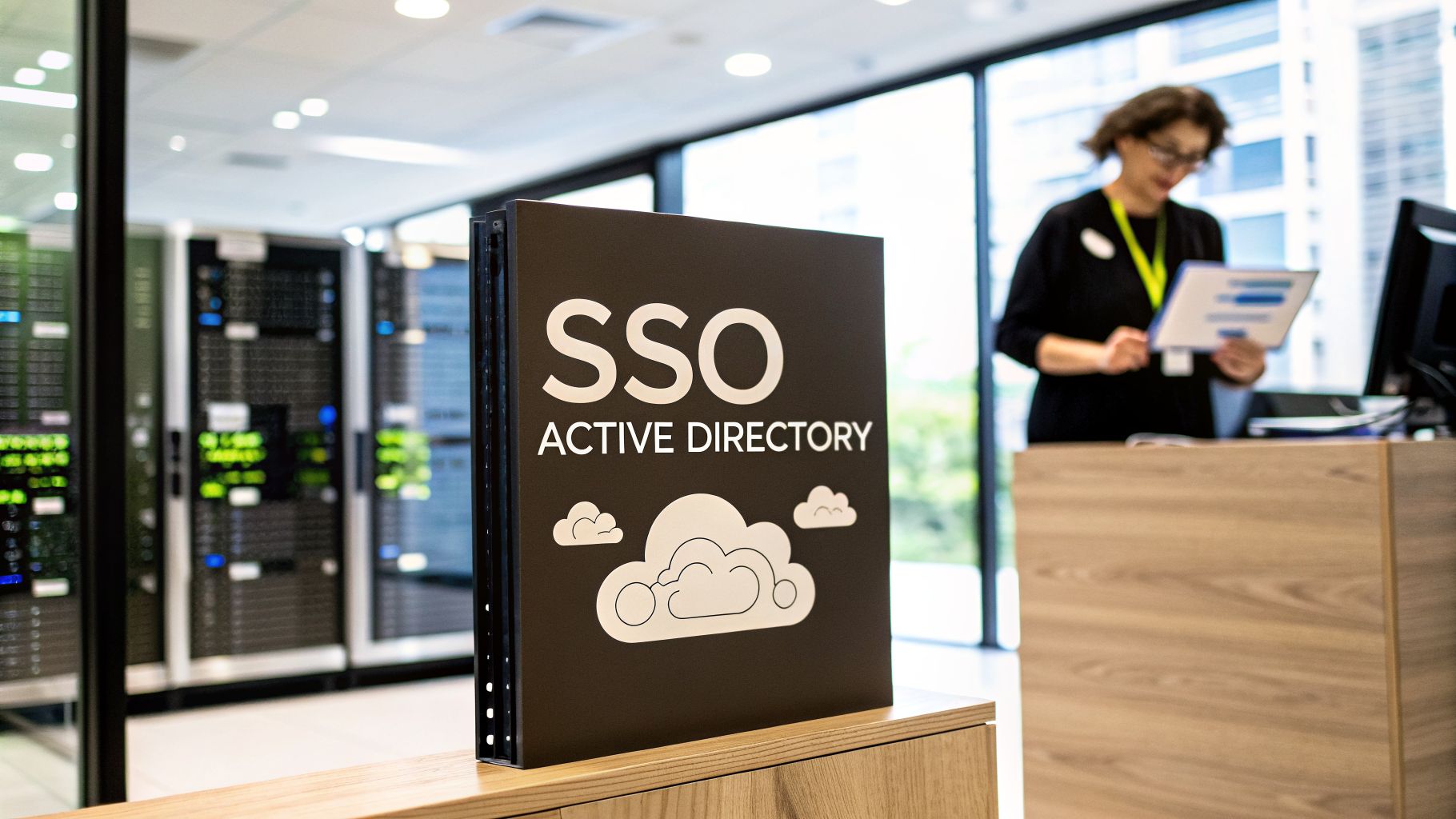
Integrating single sign on with Active Directory isn't just a technical tweak—it's a strategic business decision that simplifies user access while seriously beefing up your security. For AONMeetings, this means your team gets immediate, secure access to video conferences using the company credentials they already know. No more password fatigue, and a lot less work for your IT helpdesk.

The Strategic Advantage of SSO with Active Directory
Tying your AONMeetings authentication to a central source of truth like Active Directory is far more than a convenience. It's a foundational upgrade for your security and productivity. It doesn't matter if you’re running an on-premise Active Directory Federation Services (AD FS) or using the cloud-based Azure AD—the principle is gold: one identity, one password, and a single point of control.
This centralized approach immediately shrinks your company's attack surface. Think about it. Instead of managing hundreds of different password combinations across a dozen platforms (each one a potential weak link), your IT team can focus on locking down one robust directory. Implementing SSO with Active Directory is a cornerstone of modern security and lines up perfectly with many of the Top 10 Network Security Best Practices experts recommend.
Real-World Impact and Business Growth
Let's make this real. Imagine a law firm using AONMeetings for highly sensitive client depositions. With SSO, access is tied directly to their Active Directory accounts. The moment an attorney leaves the firm, disabling their AD account instantly revokes access to everything, including AONMeetings. Confidential information stays locked down.
Or consider a university giving thousands of students seamless access to online classes. No one needs to create and remember a separate AONMeetings login; they use the same credentials they use for email and course registration. This simple change massively improves the user experience and drives up adoption rates.
This is why the market for SSO, driven heavily by AD integrations, is booming. Projections show the global SSO market hitting USD 3.34 billion in 2025 and climbing to USD 6.29 billion by 2030, which reflects a powerful 13.5% compound annual growth rate. Mordor Intelligence has some great insights on this trend if you want to dig deeper.
For a quick overview of what this means for your organization, here's a simple breakdown.
SSO with Active Directory Benefits at a Glance
This table sums up the core advantages you gain by implementing SSO with Active Directory for AONMeetings, touching on everything from security to employee satisfaction.
| Benefit Area | Impact on Your Business |
|---|---|
| Enhanced Security | Centralizes credentials, drastically cutting the risk of password-related breaches and simplifying security policy enforcement. |
| Improved Productivity | Employees log in once to access all tools, saving valuable time and reducing login-related frustrations. |
| Simplified IT Management | Onboarding and offboarding become a breeze. User provisioning is handled in one place, streamlining operations. |
| Reduced IT Overhead | Fewer password reset requests mean your IT team can focus on high-value projects instead of routine support tickets. |
| Better User Experience | Eliminates password fatigue and provides a frictionless access experience, which encourages tool adoption and satisfaction. |
As you can see, the benefits go far beyond simple convenience. Centralizing authentication transforms how you manage and secure your digital workspace.
By centralizing authentication, you’re not just making logins easier; you’re creating a single chokepoint for security monitoring and policy enforcement. This shift from a distributed to a centralized model is a game-changer for IT teams.
Ultimately, integrating SSO delivers tangible benefits that ripple across the entire organization.
- Enhanced Security: Centralized user credentials drastically reduce the risk of password-related breaches.
- Improved Productivity: Employees save time by logging in once to access all their necessary tools, including AONMeetings.
- Simplified IT Management: User provisioning and de-provisioning are handled in one place, streamlining operations and reducing administrative burdens.
If you're interested in learning more, we have a great article that takes a closer look at how SSO for video conferencing is a game-changer for modern businesses.
Getting Your Active Directory Ready for a Seamless Integration
Any successful single sign on Active Directory project is built on a solid foundation. Before you even think about touching a configuration file or logging into an admin portal, preparing your environment is the single best thing you can do to sidestep frustrating errors and give your users a smooth rollout.
Think of it like laying the groundwork for a house—if you skip this part, you're just asking for trouble down the road.
First things first: run an Active Directory health check. Your AD is the ultimate source of truth for all your user identities. If it isn't healthy, your SSO setup will inherit every single one of its problems. This means hunting down and fixing replication errors, making sure your domain controllers are all in sync, and doing some spring cleaning on stale user and computer accounts. A clean directory is a reliable one.
Aligning User Attributes for SSO
I've seen it time and again: one of the most common reasons an SSO setup fails is because of inconsistent user data. Your identity provider (whether it's AD FS or Azure AD) sends a packet of user attributes, called claims, over to AONMeetings. If that data is missing, mismatched, or just plain wrong, the login is going to fail. Every time.
Pay very close attention to these key attributes for every user you plan to enable for SSO:
- UserPrincipalName (UPN): This is usually the main identifier. It's absolutely critical that the UPN suffix (the part after the "@") matches a domain you've verified and can be routed over the internet. For example, if your internal AD domain is
corp.localbut everyone's email isusername@company.com, you have to addcompany.comas a UPN suffix in AD Domains and Trusts and then update your users. - Email Address: The mail attribute in Active Directory needs to be filled out and accurate for every single user. You'd be surprised how many login issues I've traced back to something as simple as a blank email field.
- Display Name and User Groups: Keep your user names consistent, and make sure people are in the right security groups. You'll be using these exact groups later on to grant access to AONMeetings.
A clean, consistent Active Directory isn't just a best practice; it's a non-negotiable prerequisite for reliable single sign-on. The time you invest in data hygiene now will save you hours of troubleshooting headaches later.
On-Premise vs. Cloud: What’s Different in Prep Work
How you prepare will look a little different depending on whether you're using on-premise AD FS or going with the cloud-native Azure AD. The end goal is the same—centralized authentication—but the infrastructure demands are worlds apart.
For an on-premise AD FS deployment, your checklist is going to be heavy on infrastructure. You'll need to get a valid, third-party SSL certificate for your federation service name (like sso.yourcompany.com). A self-signed certificate is a non-starter; it won't be trusted by your users' browsers or by AONMeetings. You'll also need to get your firewall rules in order to allow HTTPS traffic on port 443 to your AD FS and Web Application Proxy (WAP) servers.
On the other hand, getting ready for Azure AD is less about physical servers and more about your cloud identity strategy. The big job here is making sure your on-premise Active Directory is synchronizing properly with Azure AD, which is handled by Azure AD Connect. You'll need to make a key decision on your sign-in method—like Password Hash Synchronization or Pass-through Authentication—as this determines exactly how your users authenticate against the cloud.
Making sure this all fits with how you already work is a huge part of the process. Our guide on integrating AONMeetings with your existing workflow offers some great context on that front.
No matter which path you take, creating a dedicated service account is a smart move. For AD FS, this account will run the federation service. For Azure AD Connect, it’s the account used for the sync. Using a specific service account with limited, well-documented permissions is always more secure than throwing a domain admin account at the problem.
How to Configure AD FS for AONMeetings SSO
If your organization is running on-premise infrastructure, the most direct path to enabling a secure single sign on Active Directory experience for AONMeetings is through Active Directory Federation Services (AD FS). The whole process boils down to establishing a formal trust relationship, which is a fancy way of saying you’re telling your AD FS server to vouch for your users when they try to log into AONMeetings.
At the heart of this setup is creating what's called a Relying Party Trust. You can think of it as a digital handshake. AONMeetings, the "relying party," agrees to trust AD FS, your "identity provider," to handle all the authentication heavy lifting. This means AONMeetings won't ask for its own password; it will simply turn to AD FS and ask, "Is this person who they say they are?"
Before you jump into the configuration, it helps to have a clear picture of the prep work involved. Getting the groundwork right—health checks, user sync, and certificate management—is half the battle.

This flow really drives home the point: a successful AD FS setup is built on a healthy, well-maintained Active Directory environment. You need that solid foundation before you even think about building trusts.
Establishing the Relying Party Trust
Your journey starts in the AD FS Management console. You’ll be leaning on the "Add Relying Party Trust Wizard," which thankfully simplifies the initial connection. AONMeetings makes this even easier by providing a federation metadata XML file—think of it as a configuration cheat sheet. It contains all the endpoints and certificates AD FS needs to talk securely with the AONMeetings platform.
When the wizard prompts you, import this file directly. This action will automatically populate most of the required settings, saving you from tedious manual entry and, more importantly, reducing the risk of typos that can bring the whole setup to a grinding halt.
You'll need to give the trust a clear, descriptive name like "AONMeetings SSO" so it's easy to spot later. For the initial issuance authorization rules, it's standard practice to permit all users to access this relying party. Don't worry, you can—and absolutely should—lock this down later with more specific security groups.
Defining What Information to Send
With the trust created, the real magic happens when you configure the claim issuance policies. A claim is simply a piece of information about a user that AD FS sends over to AONMeetings, like their email address or full name. Your job is to tell AD FS exactly which Active Directory attributes to send and what to call them so AONMeetings can make sense of it all.
This attribute mapping is what makes or breaks the user experience. For instance, AONMeetings needs to identify a user by their email. To make that happen, you'll create a rule that maps the E-mail-Addresses LDAP attribute from Active Directory to an outgoing claim type called uid.
Getting this mapping right ensures that when a user logs in, AONMeetings receives user.name@company.com and can match it to the right user account—or even provision a new one on the fly if you’re using Just-In-Time (JIT) provisioning.
Pro Tip: Your claim rules are the bridge between your internal Active Directory and your external SaaS applications. Get them right, and the user experience is seamless. Get them wrong, and users will be met with cryptic error messages. Always double-check that the outgoing claim type names exactly match what the service provider (AONMeetings) expects.
The move toward these kinds of integrations is only accelerating. Enterprise SSO, driven largely by Active Directory solutions, is on track to become a USD 1.81 billion market by 2025, growing at a 12.4% CAGR. Data reveals that larger enterprises ($1B+) heavily favor on-prem AD (30%) and Azure AD (42%), reflecting the need for tight security over collaborative tools like AONMeetings. Adoption rates tell a similar story, with 64% of large firms (1,000+ staff) using SSO compared to just 25% of smaller ones. You can explore more about these SSO market trends to see the bigger picture.
Crafting the NameID and Finalizing the Setup
Beyond basic user attributes, you also have to configure how AD FS packages the user's primary identifier. This is done with the NameID, a specific type of SAML claim. Like many modern applications, AONMeetings expects the NameID to be in a "transient" format. This is a security measure that provides a temporary, session-specific identifier for the user instead of sending something permanent like their email address.
You’ll create a custom claim rule to transform the user's Windows account name into this required transient NameID format. The rule also involves embedding the entityID from both your AD FS metadata and the AONMeetings metadata. This final step explicitly links the authentication assertion to both parties, confirming that the login request is valid and truly intended for AONMeetings.
After your claim rules are set, there’s one last technical tweak: set the secure hash algorithm to SHA-256, which is the current industry standard. With that done, you're ready to export your own AD FS federation metadata. This file contains your public key and endpoint URLs, which you’ll provide to AONMeetings to complete the circle of trust.
When your organization is already in the cloud, using Azure Active Directory for single sign on active directory integration with AONMeetings just makes sense. It’s the most direct and efficient way to get things running.
Unlike a traditional, on-premise AD FS setup, Azure AD is entirely cloud-based. That means you can forget about managing physical servers, dealing with patches, or worrying about uptime—Microsoft handles all of that for you. The end goal, however, is exactly the same: create a secure and trusted link where Azure AD confirms your users' identities so they can access AONMeetings seamlessly.
The whole process centers on creating a new Enterprise Application right inside your Azure portal. Think of this application as the digital stand-in for AONMeetings within your Azure AD world. By configuring this app, you’re essentially teaching Azure AD how to process and approve sign-in requests from your team.
Creating the AONMeetings Enterprise Application
First things first, you'll need to head over to the Azure portal. Your starting point is the Enterprise Applications area, where you'll add a new application. Be sure to select the "non-gallery application" option. This gives you a clean slate, letting you build the SAML-based sign-on method from the ground up to match AONMeetings’ requirements perfectly.
Give your new application a clear name—something like "AONMeetings SSO"—and then jump into the Single sign-on settings. This is where the real magic happens. Azure AD even provides a simple, step-by-step workflow to walk you through the SAML configuration.
To really see why this is the go-to method for most cloud-focused companies, it helps to compare it directly with the on-premise alternative.
AD FS vs Azure AD for AONMeetings SSO
Here’s a comparative look at the two primary methods for Active Directory SSO to help you decide which is best for your organization's needs.
| Feature | AD FS (On-Premise) | Azure AD (Cloud) |
|---|---|---|
| Infrastructure | Requires dedicated on-premise servers for AD FS and WAP roles. | Fully cloud-based; no server management required. |
| Maintenance | Your IT team is responsible for patching, updates, and uptime. | Microsoft manages the infrastructure, ensuring high availability. |
| Initial Setup | More complex, involving server roles, certificates, and firewall rules. | Simpler setup via the Azure portal's guided workflow. |
| Best For | Organizations with strict on-premise data policies or complex legacy needs. | Cloud-first organizations, especially those already using Microsoft 365. |
For most businesses already comfortable with cloud services, the simplicity and lower maintenance of Azure AD make it a clear winner.
Configuring the Basic SAML Trust
With your Enterprise Application created, the first real configuration step is to establish the basic trust relationship. You'll do this in the "Basic SAML Configuration" section. This is where you connect the dots between your Azure AD and AONMeetings.
AONMeetings will give you two critical pieces of information you need to plug into Azure:
- Identifier (Entity ID): A unique URL that acts as the official name for AONMeetings in the SAML world.
- Reply URL (Assertion Consumer Service URL): This tells Azure AD exactly where to send the user with their authentication token after a successful sign-in.
Nailing these two values is non-negotiable. A single typo or a misplaced character will break the entire authentication flow. My advice? Always copy and paste these URLs directly from your AONMeetings admin panel to prevent any frustrating errors down the line.
Think of it like this: The Entity ID is the unique mailing address for AONMeetings, and the Reply URL is the specific delivery dock where it expects to receive authentication packages. If either is wrong, the package gets lost, and your user is left stranded outside.
Customizing User Attributes and Claims
Once that initial trust is established, you need to tell Azure AD what information to send about the user. This is all handled under "User Attributes & Claims." Azure AD sends a few standard details by default, but you'll want to customize these to ensure AONMeetings profiles get populated correctly.
The most important claim is the Unique User Identifier (NameID). AONMeetings almost always expects this to be the user's email address. To set this up, you’ll configure the claim to pull from the user.mail attribute in Azure AD.
You can—and should—add other claims to pass more user data. This is particularly powerful if you're using Just-In-Time (JIT) provisioning. For instance, you can map:
user.givennameto a claim calledfirstNameuser.surnameto a claim calledlastNameuser.userprincipalnametoemail
With this mapping, the first time a new user signs in, AONMeetings can instantly create their account with their name and email already filled out. It’s a completely frictionless way to onboard new team members.
Assigning Users and Finalizing the Setup
The last few steps are all about granting access and sharing the final configuration details. You probably don't want everyone in your organization to have access to AONMeetings right away. In the "Users and groups" section of your Enterprise Application, you can assign access to specific people or, even better, to entire security groups. This gives you precise control over who can use the SSO connection.
After setting up your claims and assigning users, Azure AD will provide you with the Federation Metadata XML file. This file is the other half of the puzzle. It contains Azure AD’s public key and sign-in details—everything AONMeetings needs to verify that authentication requests are coming from a trusted source.
Simply download this XML file and upload it into your AONMeetings SSO settings. This completes the circle of trust. With a final test to verify everything works, your cloud-based SSO is officially ready for action.
Finalizing and Testing Your SSO Configuration
You've done the heavy lifting by getting your identity provider—whether it's AD FS or Azure AD—all configured. Now comes the moment of truth. This is where we connect everything back to the AONMeetings platform and make sure it all works seamlessly. Getting this final step right is what guarantees a smooth and secure login for your users from day one.
The last piece of the puzzle is that federation metadata file you exported earlier. You’ll need to upload it directly into your AONMeetings admin dashboard. This simple action completes the "circle of trust," giving our platform the public key and endpoint info it needs to validate sign-in requests coming from your Active Directory.

Enabling Just-In-Time Provisioning
While you're in the AONMeetings dashboard, you’ll see an option for Just-In-Time (JIT) provisioning. I strongly recommend flipping this switch on. When it's active, JIT automatically creates an AONMeetings account for someone the very first time they log in using SSO.
This completely gets rid of manual account creation, which is a huge time-saver for your onboarding process. As long as you mapped your user attributes correctly (like firstName, lastName, and email) back in AD FS or Azure AD, their new AONMeetings profile will populate with the right information instantly.
Your Comprehensive Testing Plan
Let me be clear: thorough testing is non-negotiable. Don't even think about announcing the new login method until you've validated every part of the user journey. A rushed rollout is a recipe for confused users and a mountain of helpdesk tickets.
First, pull together a small, diverse group of test users. Make sure this group includes people with different access levels and from various departments to cover as many real-world scenarios as possible.
Here's what your testing checklist should cover:
- First-Time Login: Can a brand-new user, who has never touched AONMeetings before, sign in successfully? More importantly, is their account created automatically by JIT provisioning?
- Attribute Mapping Verification: Once a test user logs in, go into AONMeetings and check their profile. Are their first name, last name, and email address all correct? This is a common failure point.
- Existing User Login: Grab a user who already has an AONMeetings account and have them try the SSO login. The system should correctly link them to their existing account, not create a duplicate.
- Access Denial Test: Try to log in as a user from your Active Directory who has not been given access to the AONMeetings application. The login must fail with a clear "access denied" error. This is how you confirm your security controls are working.
- Multi-Device Test: Have your users try logging in from different browsers and devices (desktop, mobile) to catch any weird client-side compatibility issues.
Key Takeaway: Testing isn’t just about making sure things work; it's about actively trying to break them. The access denial test is probably the most critical one on this list, as it proves your security perimeter is holding firm.
Layering Security with Multi-Factor Authentication
A solid SSO setup is a fantastic security baseline, but it gets even better when you layer on Multi-Factor Authentication (MFA). As you finalize your SSO, this is the perfect time to integrate a Multi Factor Authentication rollout plan. MFA adoption has exploded for a reason—it's expected that 70% of users will have it by January 2025.
This trend is driven by the growing need for stronger security, especially for platforms like AONMeetings where sensitive discussions might take place. It’s no surprise that larger firms rely on Microsoft AD (30%) and Azure AD (42%) for identity management to enforce these policies.
This layered approach is absolutely vital. Our guide on securing your account, https://aonmeetings.com/mfa-login/, gives more context on why this is such a critical step. By following a structured testing plan and reinforcing your setup with MFA, you can confidently deploy a secure and efficient single sign-on experience for your entire organization.
Answering Your Questions About Single Sign On Active Directory
Integrating single sign on Active Directory for the first time? You've probably got questions. It's totally normal. Whether you're trying to decide between on-prem and cloud infrastructure or just curious about what the day-to-day will look like for your team, getting clear answers upfront is the key to a smooth rollout.
Let's tackle some of the most common questions we hear from organizations setting up SSO for AONMeetings. We'll give you direct, straightforward answers to help you get a better handle on the tech and sidestep any potential roadblocks.
What's the Real Difference Between AD FS and Azure AD for SSO?
The biggest difference boils down to one thing: where your identity management lives. It's a classic on-premise versus cloud debate.
AD FS (Active Directory Federation Services) is the on-premise player. This means you own and manage the servers it runs on. You get maximum control, which is great, but it also means you're on the hook for all the maintenance, patching, and making sure it's always available. It's a lot of overhead.
On the other hand, Azure AD is Microsoft's cloud-based identity service. If your company is already deep into the Microsoft 365 ecosystem or has a "cloud-first" mindset, this is almost always the way to go. It dramatically simplifies the setup and completely removes the headache of server management. For AONMeetings, if your team is already using Microsoft’s cloud services, Azure AD is the most direct path to getting SSO up and running.
So, which one is for you? If you have strict on-premise data policies that you can't get around, AD FS is your best bet. For almost everyone else, Azure AD offers a much smoother ride.
Can New Employee Accounts Be Created Automatically with SSO?
Absolutely. In fact, this is one of the biggest wins you'll get from a well-configured SSO integration. The magic behind this is a feature called Just-In-Time (JIT) provisioning.
Here's how it works: When you set up your SAML claims in either AD FS or Azure AD, you configure them to send essential user details—like first name, last name, and email—over to AONMeetings during their very first login. AONMeetings sees this data from a trusted source, and poof, it creates their account right on the spot.
This completely automates your onboarding process. No more manually creating AONMeetings accounts for new hires. They get access on day one, and your IT team saves a ton of time.
JIT provisioning is a game-changer for administrative efficiency. It turns a multi-step, manual onboarding task into a zero-touch, automated process that's triggered by the user's first login.
What Happens If My AD FS Token-Signing Certificate Expires?
This is a big one, and something you absolutely have to stay on top of with an AD FS setup. If that token-signing certificate expires, your SSO integration will stop working. Immediately.
AONMeetings will no longer trust the authentication assertions coming from your AD FS server. The result? Your users will get slapped with a login error, and they'll be completely locked out.
It's critical to monitor those expiration dates. AD FS has a built-in auto-rollover feature that generates a new certificate before the old one expires, but don't be fooled—the process isn't fully automatic. You still need to manually export the new federation metadata (which contains the new certificate's public key) and upload it into your AONMeetings SSO configuration. If you forget this step, you're looking at a service outage.
Does SSO for AONMeetings Require a Specific Subscription Plan?
Yes, features like SSO that are built for centralized management and security are typically part of our higher-tier plans. For AONMeetings, single sign on Active Directory integration is available on our Business Pro and custom Enterprise plans.
These plans are built for organizations that need to manage users at scale, demand stronger security protocols, and want seamless integration with an identity provider like Active Directory. The best way to confirm if your current plan has SSO is to check our official pricing page or have a quick chat with our sales team.
Ready to streamline your team's access and fortify your security? AONMeetings makes it easy with powerful, browser-based video conferencing integrated directly with your Active Directory. Explore our enterprise-ready plans and simplify your workflow today.