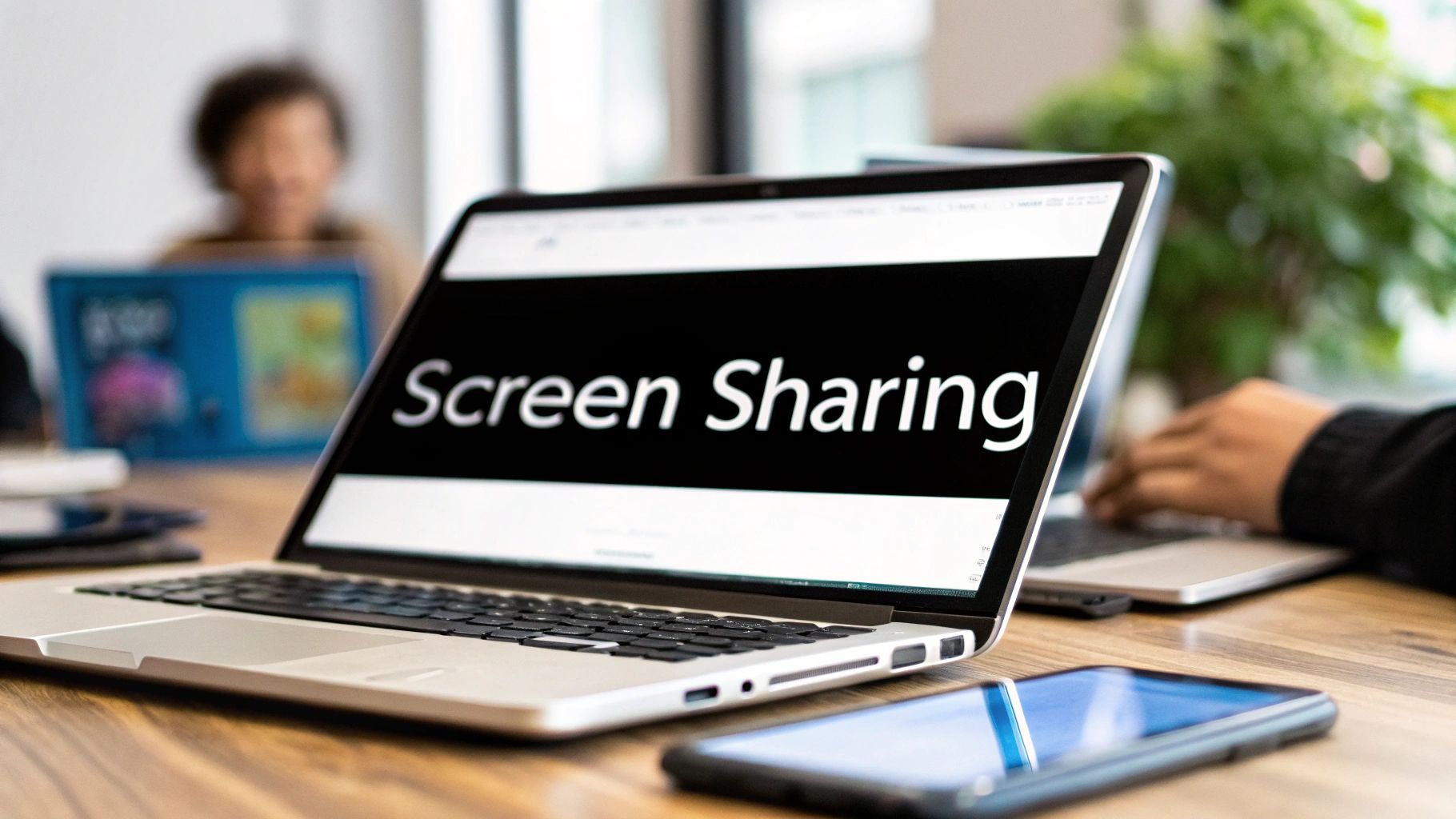
Online screen sharing is the tech that lets you broadcast your computer screen to someone else—or a whole group—in real-time. Think of it like a shared digital window. It allows others to see exactly what you see on your desktop, in a specific app, or even just a single browser tab, no matter where they are.
What Is Online Screen Sharing

At its heart, online screen sharing is all about creating a common visual ground. Instead of trying to describe a complex process over the phone or explain a chart through email, you can just show it. This simple act closes the communication gap that so often trips up teams, clients, and students who are miles apart.
This technology has come a long way from its early days as a niche tool for IT support. Now, it's a must-have for modern collaboration, baked into just about every video conferencing and remote work platform out there. By giving everyone a shared visual context, it makes communication more direct, efficient, and way less likely to be misinterpreted.
The Foundation of Remote Collaboration
The real magic of screen sharing is its ability to replicate that simple office experience of looking over someone's shoulder. This capability is absolutely fundamental for the kinds of activities that define how we work today. You can dive deeper into the basics of what is screen sharing and see how it really greases the wheels of teamwork.
It has become the backbone for so many critical tasks:
- Real-time feedback: Designers can present mockups and get immediate, on-the-spot input from stakeholders.
- Effective training: A new hire can watch a live software demo instead of trying to make sense of a static manual.
- Collaborative problem-solving: Developers can walk through code together, spotting and fixing bugs as a team.
- Engaging sales demos: A salesperson can guide a potential customer through a product's features live, answering questions as they pop up.
In essence, online screen sharing transforms abstract conversations into concrete, visual experiences. It ensures everyone is on the same page because they are—quite literally—looking at the same page. This fosters clearer understanding and helps teams make decisions faster.
What Are the Key Features of Online Screen Sharing?
Modern online screen sharing is a far cry from the clunky, one-way broadcasts of the past. Today's platforms are brimming with dynamic features that transform a simple presentation into a full-blown collaborative workspace. These tools are no longer just a "nice-to-have"—they're built to make remote interactions just as productive, if not more so, than sitting in the same room.
This isn't just a trend; it's a fundamental shift in how we work. The market for screen sharing software, valued at roughly USD 682.2 million in 2025, is on track to hit USD 1.27 billion by 2033. This explosion is fueled by features that don't just show a screen but actively help teams get things done.
Core Features That Drive Real Collaboration
While different platforms offer a long list of bells and whistles, a handful of features have become absolutely essential for any professional team. Think of these as the building blocks for clear, efficient remote communication.
- Real-Time Annotation: Imagine drawing on your screen with your colleagues, even if they're thousands of miles away. Annotation tools let participants highlight, circle, or type directly onto the shared content. It's perfect for brainstorming on a design mockup or zeroing in on a specific number in a dense spreadsheet.
- Application-Specific Sharing: We've all been there—sharing our entire desktop only to have a personal notification pop up for everyone to see. Application sharing solves this by letting you broadcast just one specific window, like a browser tab or a PowerPoint presentation. It keeps your work private and your audience focused.
- Session Recording: Many tools let you record your screen sharing sessions with a single click. This is incredibly useful. It creates a video log for anyone who couldn't make the meeting and helps build a library of hands-on training materials for new hires to review at their own pace.
But perhaps the most powerful feature is also the simplest: remote control. This allows one person to grant temporary access of their mouse and keyboard to someone else in the meeting. It turns a passive viewing experience into a hands-on support session, making it a game-changer for IT support and collaborative coding.
This isn't just about convenience; these features directly boost comprehension and efficiency.

As the data shows, it's not a minor improvement. A staggering 90% of users report a better grasp of the material when screen sharing is involved.
Essential Online Screen Sharing Features and Their Impact
To make sense of it all, here's a quick breakdown of the most common features you'll encounter and what they actually do for you and your team.
| Feature | Description | Primary Use Case |
|---|---|---|
| Full-Screen Sharing | Broadcasts your entire desktop, including the taskbar and notifications. | Showing a complete workflow across multiple applications or system settings. |
| Application Sharing | Shares only a single, specific application window while keeping the rest of your desktop private. | Presenting a slide deck or demonstrating software without distractions. |
| Browser Tab Sharing | Limits the share to a single tab within your web browser. | Walking a team through a website or web-based tool securely. |
| Annotation Tools | Allows participants to draw, highlight, or add text directly on the shared screen. | Brainstorming on a mockup, reviewing a document, or highlighting data points. |
| Remote Control | Grants temporary mouse and keyboard control to another participant. | Providing hands-on IT support or co-editing a file in real-time. |
| Session Recording | Records the screen share session (and audio/video) to create a shareable video file. | Creating training materials or sharing a meeting with absentees. |
| Presenter Switching | Enables seamless transitions, allowing different participants to become the presenter and share their screen without ending the session. | Team meetings where multiple people need to present their work. |
Ultimately, these features aren't just isolated tools. They work together to create a shared space where ideas can be exchanged clearly and problems can be solved quickly.
Putting These Features to Work
Knowing what the features are is one thing; seeing how they work in the real world is another.
For example, an IT support specialist can use remote control to jump onto an employee's computer and fix a software bug in minutes—a process that might have taken hours of back-and-forth emails. A sales team can use annotation to circle key benefits during a live product demo, making their pitch far more interactive and memorable.
As you start looking at different tools, it helps to see how these features are implemented on specific platforms. A guide on how to share your screen in Google Meet, for instance, can connect these abstract ideas to the practical steps you'll take daily. At the end of the day, these tools are all designed to do one thing: reduce misunderstandings and help your team make better decisions, faster.
The Real-World Benefits of Sharing Your Screen

While specific features give you the tools for collaboration, the real value of online screen sharing comes from the tangible results it delivers. It’s not just about showing your work; it’s about actively accelerating it.
By giving everyone a shared visual context, teams can finally sidestep the frustrating misunderstandings that come from endless email chains and vague phone calls. Instead of describing a design tweak, you show it. Instead of trying to explain a software bug, you demonstrate it live.
That kind of directness is a game-changer for efficiency. It clears up confusion in seconds, not hours.
Accelerate Project Timelines
One of the most immediate impacts you’ll see is on project speed. When feedback loops are tightened, projects simply move faster. This is especially true for creative work, software development, or any task that depends on getting visual details just right.
With screen sharing, you get instant reactions and approvals, cutting down on endless back-and-forth.
- For Designers: Present a new website mockup and get on-the-spot feedback from stakeholders. You can make revisions right then and there instead of waiting for annotated screenshots to trickle in.
- For Developers: Run live code reviews where the whole team can navigate the codebase together, pointing out issues and brainstorming solutions in real time.
- For Marketers: Walk the team through an ad campaign’s analytics dashboard, making sure everyone is on the same page with the data before deciding on the next steps.
This immediate, interactive process slashes revision cycles and helps teams hit their deadlines with way less friction. It’s one of the many video conferencing benefits that create a much more agile and responsive workflow.
Improve Training and Onboarding
Great training has always been about showing, not just telling. Online screen sharing is an incredibly powerful educational tool that makes learning more engaging and helps new information stick, whether for new hires or customers.
Think about it: a live demonstration of a software workflow is infinitely more effective than a static user manual. Trainers can guide people step-by-step, answer questions as they pop up, and even grant remote control to let trainees try the process themselves under supervision. It’s a hands-on approach that builds confidence and competence in record time.
By turning every meeting into a potential teaching moment, you empower your team to learn continuously. This reduces the time it takes for new employees to become fully productive and ensures everyone is using tools and processes correctly.
Drive Down Operational Costs
Ultimately, all of these efficiency gains translate directly to your bottom line. By enabling high-fidelity collaboration from anywhere, screen sharing significantly reduces operational expenses.
The most obvious saving is on travel. Sales teams can deliver compelling, interactive demos to clients across the globe without ever booking a flight.
Plus, IT support teams can resolve technical issues much faster using remote control, minimizing employee downtime. When a problem that once took hours of confusing emails is solved in a single 10-minute session, the productivity savings add up quickly. Screen sharing isn't just another communication tool—it's a strategic asset that makes your business faster, smarter, and more cost-effective.
How Different Industries Use Screen Sharing
To really see what screen sharing can do, you have to look past the features and benefits and into the real world. Its true power isn't just in the tech itself but in how it solves nagging, everyday problems for all sorts of professionals. Think of it as the digital glue holding modern workflows together.
The global screen sharing market is blowing up, mostly because of the massive shift to remote work and the constant need for better collaboration. Big players in enterprise communication, education, healthcare, and finance are all jumping on board, each finding their own clever ways to put it to work.
IT Support and Troubleshooting
For any IT pro, screen sharing is like a digital superpower. Picture this: a remote employee is tangled up in a complex software installation. Instead of a painfully slow phone call where they try—and fail—to describe cryptic error messages, the IT specialist simply asks them to share their screen.
In an instant, the specialist sees the exact problem. If they need to, they can request remote control, take over the mouse, and fix the tricky settings themselves. A problem that could have turned into an hour of confused back-and-forth gets sorted out in under 10 minutes.
Sales Demos and Client Onboarding
Sales teams use screen sharing to make their products pop. A salesperson can hop on a video call with a potential client halfway across the world and share their screen for a live, interactive demo. They can guide the prospect through the most important features, field questions on the fly, and tweak the presentation to hit on what that specific client cares about most.
It’s so much more engaging than just clicking through a boring slide deck. This approach builds a ton of trust and helps clients "get" the value right away, which naturally speeds up the sales cycle.
By giving a crystal-clear, visual walkthrough, sales and customer success teams can get clients onboarded the right way from the start. This cuts down on future support tickets and boosts satisfaction from day one—a true cornerstone of modern customer relationships.
Education and Collaborative Learning
In the world of online tutoring, screen sharing turns a basic video call into a real virtual classroom. A math tutor can pull up a digital whiteboard and work through a tough equation with a student, and both of them can write on the screen. It's the next best thing to sitting side-by-side.
This technology makes remote learning far more effective and keeps students locked in. It gives educators the power to offer personalized, one-on-one help no matter where they are. That ability to work together in a shared visual space is especially critical for making hybrid work and office collaboration models successful.
Software Development and Code Review
For software developers, screen sharing is at the very heart of how they collaborate. A developer can share their code editor with the team to run through a live code review, which is a massive time-saver.
This lets the whole team:
- Walk through new code line-by-line to make sure it's up to snuff.
- Debug tricky issues together by watching the code run in real time.
- Brainstorm big-picture decisions by sketching out ideas on a shared screen.
This kind of teamwork helps catch bugs early, leads to better code, and makes sure everyone on the team feels a sense of ownership over the project.
Keeping Your Shared Sessions Secure

When you share your screen, you’re essentially opening a window into your digital life for others to see. It’s an incredibly useful tool, but it also means that security can't be an afterthought—it has to be front and center. The whole point is to collaborate with confidence, knowing your sensitive information is safe from prying eyes or accidental leaks.
The rapid growth of this technology tells a story of both opportunity and risk. The screen sharing software market was projected to hit around USD 715 million by 2025, a number that screams just how essential it's become. But with that expansion comes a sharp focus on cybersecurity and data privacy, pushing providers to deliver solutions that are as secure as they are seamless.
The Role of Encryption
The absolute bedrock of any secure screen sharing tool is end-to-end encryption (E2EE). Think of it like a digital armored truck for your data. E2EE scrambles everything the moment it leaves your device and only unscrambles it when it reaches your recipient's screen, making it completely unreadable to anyone trying to intercept it in transit.
This level of protection is non-negotiable, especially when you’re dealing with financial reports, private client data, or proprietary code. Without it, you’re broadcasting your session in the clear. And while you’re at it, layering in secure encrypted document sharing solutions can add another vault-like door to protect any files you might display during your presentation.
Best Practices for Secure Sharing
Great technology is only half the battle; your habits matter just as much. A few simple practices can dramatically lower the risk of showing something you didn't mean to.
If you build just one habit, make it this: share a single application window instead of your entire desktop. This one move prevents stray notifications, personal messages, or confidential files sitting on your desktop from ever being seen by your audience.
Here are a few other critical habits to get into:
- Close Unnecessary Tabs and Apps: Before you start, do a quick sweep. Close any browser tabs or applications that aren't directly related to what you're presenting. This declutters your workspace and removes the chance of an accidental click on the wrong window.
- Manage Participant Permissions: Dive into your tool’s settings and get intentional about what attendees can do. Can they take control of your screen? Record the session? Only grant these permissions to trusted participants, and only when absolutely necessary.
- Be Mindful of Background Information: Take a quick look at the application you’re about to share. Are there bookmarks, recent file lists, or other little details visible that could give away sensitive information? A five-second check can prevent a seriously embarrassing—or costly—data leak.
By pairing powerful security features with smart, mindful habits, you can ensure every screen sharing session is both productive and completely secure.
How to Choose the Right Screen Sharing Tool
With so many screen sharing tools on the market, picking the right one can feel like a tough choice. It’s tempting to get swayed by a long list of flashy features, but the real key is to zero in on the core functions that will actually make a difference in your team's day-to-day work. A tool that looks amazing on paper can quickly become a headache if it’s a pain to use or doesn't sync up with the software you already have.
First things first, look at ease of use. The best tool is always the one your team will actually adopt and use without complaint. Is the interface intuitive? Can a brand-new user jump in and start a session in a couple of clicks, no manual required? A clunky, confusing platform creates friction, slowing everyone down and defeating the whole purpose of getting it in the first place.
Next up is platform compatibility. Let's be real—your team is probably using a mix of everything: Windows, macOS, smartphones, and tablets. A solid screen sharing tool needs to deliver a consistent, reliable experience across all of them. This ensures nobody gets left out of a critical meeting just because of the device they're using.
Core Evaluation Criteria
Beyond just being user-friendly and accessible, you need to dig a little deeper into how a tool will fit into your specific business environment. Integrations are a massive piece of this puzzle. How well does the screen sharing software play with the tools your team already depends on every day, like your calendars, project management apps, or CRM?
A seamless integration can automate things like scheduling meetings and smooth out your workflows, saving a surprising amount of time.
One factor that's easy to overlook is scalability. The tool that’s perfect for your five-person team today might not cut it for a team of 50 next year. Look for a solution that can grow with you, offering flexible plans and features that support your business as it gets bigger.
Thinking ahead like this saves you from the massive disruption of having to switch providers and retrain everyone down the line.
Finally, you have to get real about the pricing models. Keep an eye out for hidden costs or annoying usage caps. You want transparent, predictable pricing that fits your budget. The best choice offers clear value without trying to lock you into an expensive, long-term contract for features you might never even touch.
Screen Sharing Software Selection Checklist
To help you systematically compare your options and cut through the marketing fluff, we’ve put together this checklist. It breaks down the most important factors into simple, direct questions to guide your decision-making.
| Evaluation Criteria | Why It Matters | Questions to Ask |
|---|---|---|
| Ease of Use | High adoption rates hinge on a simple, intuitive user experience. | How many clicks does it take to start a session? Is the interface clean and easy to navigate? |
| Integrations | The tool should fit into your existing workflow, not force you to create a new one. | Does it sync with our team's calendar and project management software? |
| Security | Protecting sensitive company information during sessions isn't optional. | Does the platform offer end-to-end encryption and granular user permissions? |
| Performance | Lag-free, high-definition streaming is essential for clear communication. | How does the video and audio quality hold up with multiple participants? |
| Scalability & Pricing | The solution must support future growth while fitting your current budget. | Are there flexible plans available? Are the pricing tiers transparent and predictable? |
By carefully weighing these criteria, you can move past the sales pitches and choose an online screen sharing solution that genuinely empowers your team to collaborate better.
Got Questions About Screen Sharing?
If you're still curious about a few details, you're not alone. Here are a few of the most common questions we get, with straightforward answers to clear things up.
Is Online Screen Sharing Secure for Confidential Work?
Absolutely, as long as you’re using a tool that offers end-to-end encryption (E2EE). Think of E2EE as the gold standard for security—it scrambles your data from the moment it leaves your device until it reaches your participants, making it unreadable to anyone else.
For an extra layer of privacy, get into the habit of sharing a single application window instead of your entire desktop. This simple move prevents you from accidentally broadcasting personal notifications or other files you have open.
Do I Need a Super-Fast Internet Connection?
Not necessarily. A stable connection is actually more important than raw speed. For a smooth, lag-free experience, you’ll want at least 1.5 Mbps for both uploading and downloading.
That said, if you’re planning on streaming high-definition video or have several people in a meeting, aiming for 5-10 Mbps is a smart move. It’ll give you the headroom needed to prevent frustrating freezes or delays and ensure everyone has a great experience.
What's Better: A Browser-Based Tool or an App?
It really comes down to what you need it for.
Browser-based tools are incredibly convenient. Guests can join with a single click—no downloads, no installations. This makes them perfect for meetings with clients or anyone outside your organization.
On the other hand, desktop apps often pack more powerful features, deliver slightly better performance, and offer deeper integrations with other software. This makes them a solid choice for your internal team's day-to-day collaboration.
Ready for a seamless, secure, and browser-based experience? AONMeetings gives you all the tools you need for effective online screen sharing without any downloads. Start your free trial today!