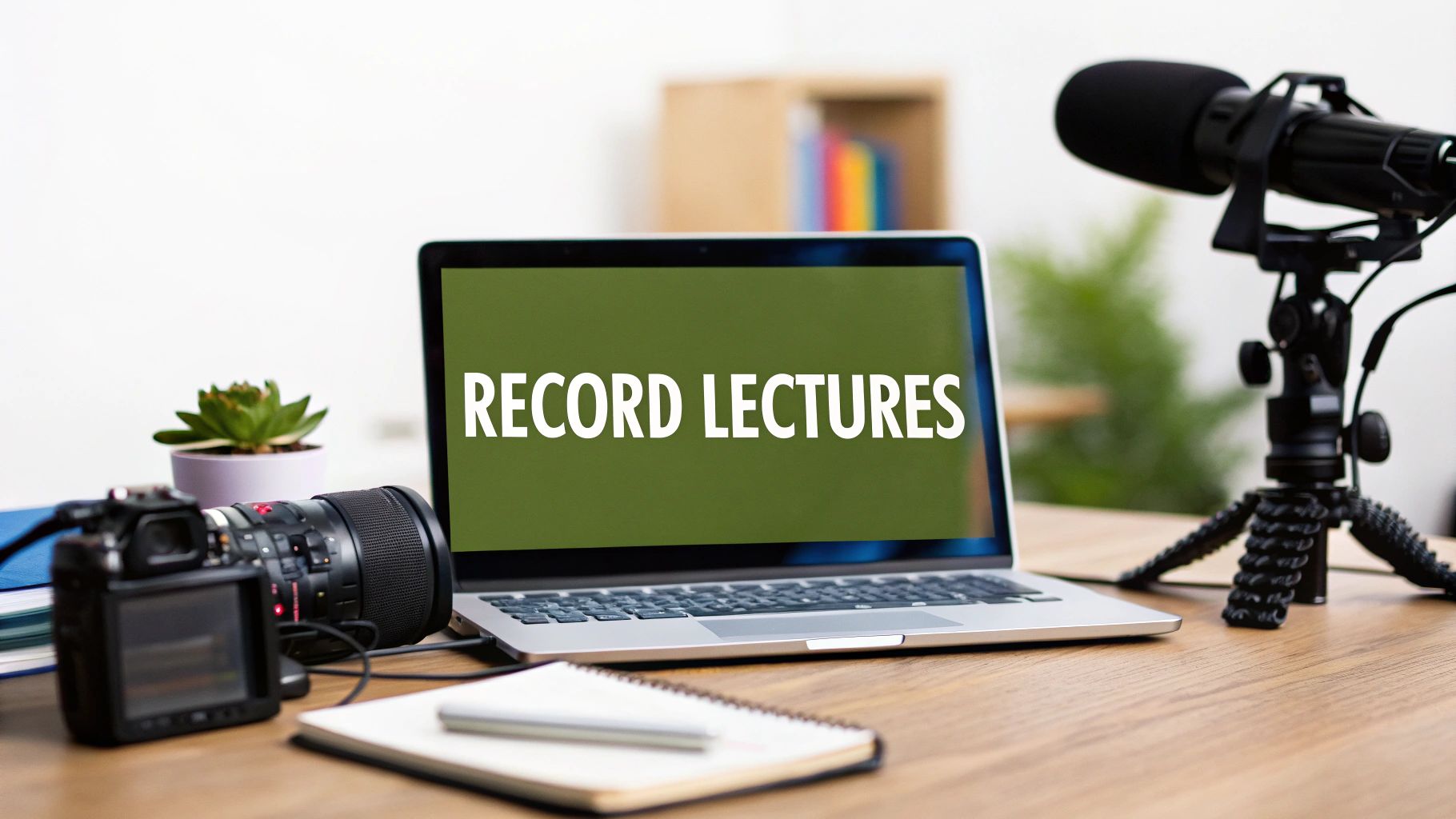
Knowing how to record a lecture is pretty straightforward: you get your content ready, pick a solid tool like AONMeetings, check your mic and camera, and just hit record. The real secret sauce is focusing on crystal-clear audio and a well-organized presentation. Get those right, and you’ll create an amazing resource for your students.
Why Recorded Lectures Are a Game-Changer for Modern Learning
The move toward flexible learning has turned recorded lectures from a nice-to-have into an absolute necessity. Today’s students don’t just want on-demand access to course materials—they expect it. It’s how they manage their packed schedules and unique learning styles.
Giving them recordings means you’re empowering them to rewind complex topics, catch up on a missed class, or just study at a pace that works for them.
This isn’t just a passing trend. It’s a fundamental shift in how education is delivered. The market for smart lecture capture systems was valued at around USD 22.37 billion and is expected to rocket past USD 77.58 billion by 2029. That kind of growth tells you everything you need to know about the demand for tools that support hybrid and remote learning. You can dig deeper into this educational technology boom and its market drivers to see where things are headed.
Fostering an Inclusive Learning Environment
One of the biggest wins that comes from recording your lectures is creating a more accessible and inclusive classroom. Students with different learning needs or those who speak English as a second language can go back through the material as often as they need to, without any pressure.
- Supports Different Pacing: Learners can hit pause to scribble down detailed notes or rewind to catch a critical point again. Nobody gets left behind.
- Aids Exam Prep: Recordings become an incredible study tool. Students can review specific concepts directly from the source instead of relying on memory alone.
- Removes Barriers from Absences: Life happens. When a student is sick or has a family emergency, recordings ensure they don’t fall behind on crucial content.
By offering recorded lectures, you're not just distributing information; you’re building a flexible support system that meets every student where they are. It’s an acknowledgment that learning isn't a one-size-fits-all experience.
Ultimately, embracing lecture recording completely changes your teaching dynamic. You start building a reusable library of core content, which frees up precious class time for more interactive activities—think lively discussions, deep-dive Q&A sessions, and hands-on projects. It's a strategic move that helps you build a future-proof teaching toolkit that serves both you and your students for years to come.
Choosing the Right Lecture Recording Software
Your software is the engine of your recording setup, and honestly, the "best" choice comes down to what you actually need to accomplish. It's tempting to just grab the most popular tool, but you'll save yourself a lot of headaches by thinking through your teaching style and technical comfort zone first. The goal is to find software that makes recording lectures feel like a natural part of your workflow, not another complicated task on your to-do list.
The move toward digital learning is not just a trend; it's a massive shift. The global market for lecture capture systems was already worth around USD 15.17 billion recently and is projected to explode to an eye-watering USD 153.39 billion by 2031. This tells us that institutions everywhere are seriously investing in these solutions. You can dig into the numbers yourself in the full lecture capture systems market research.
Matching the Tool to the Task
There’s no one-size-fits-all answer here. The software that works perfectly for a professor in a high-tech smart classroom is probably overkill for an online course creator recording from their home office. Let's break down the main categories.
- Dedicated Platforms (e.g., Panopto, Kaltura): Think of these as the all-in-one powerhouses built for universities. They plug directly into Learning Management Systems (LMS) like Canvas, automatically handling scheduling and uploads. They're designed for scale, but for a single user, they can feel a bit like using a sledgehammer to crack a nut.
- Versatile Meeting Tools (e.g., AONMeetings, Zoom): These are fantastic for live, interactive sessions that you also need to record for students to watch later. Their real strength is blending that live engagement with dead-simple recording features, making them a go-to for hybrid classes, office hours, or webinars.
- Screen Recorders (e.g., OBS, QuickTime): If you want total control over what your students see, this is your category. OBS is a prime example—it’s free, incredibly powerful, and lets you create professional-looking scenes combining your camera, slides, and other media. It does have a steeper learning curve, but the flexibility for polished, pre-recorded videos is unmatched. For different contexts, even specialized tools for recording sermons can offer unique features worth exploring.
The real secret is to map out your workflow. If you're managing a huge course and need to automate everything, a dedicated platform is your best bet. If live interaction is your priority, a tool like AONMeetings is perfect. But if you're crafting high-quality, pre-recorded videos, a screen recorder like OBS gives you all the creative freedom you could want.
Making the right choice upfront saves a ton of time and frustration down the road. For instance, a biology professor who needs to capture detailed footage from a microscope would probably lean on OBS for its customizable scenes. On the other hand, a business professor running interactive case studies would get far more value from the live polling and easy recording of a video conferencing tool.
Here's a quick comparison to help you weigh your options:
Comparing Lecture Recording Tools
Choosing your software is a big decision. This table breaks down the most common options to help you figure out which one aligns with your teaching style, technical skills, and specific needs.
| Tool Type | Best For | Key Features | Potential Drawbacks |
|---|---|---|---|
| Dedicated Platforms | Universities and large institutions needing automated, integrated systems. | LMS integration, scheduled recordings, advanced analytics, secure hosting. | High cost, complex setup, can be overkill for individual creators. |
| Meeting Tools | Live, interactive classes, hybrid learning, webinars, and office hours. | Live chat & polls, screen sharing, breakout rooms, simple cloud recording. | Recording quality can depend on internet connection; less editing control. |
| Screen Recorders | Creating polished, pre-recorded video lectures and detailed tutorials. | High-quality local recording, custom scenes & layouts, total creative control. | Steeper learning curve (especially OBS), requires manual uploading and management. |
Ultimately, the best tool is the one that feels intuitive to you and disappears into the background, letting you focus on what you do best: teaching.

Setting Up Your Recording Space

A truly great recording is planned long before you ever hit the 'record' button. The environment you create plays a massive role in the final quality, influencing everything from audio clarity to how connected your audience feels. Taking just a few minutes to prepare your space can be the difference between a distracting video and a professional, polished lecture.
First things first, let's talk about what your microphone hears. Background noise is the absolute enemy of clear audio, and built-in mics are notorious for picking up every little sound—from a whirring computer fan to a distant barking dog. Find the quietest room you can, close the door, and put your phone on silent. You’d be surprised what a quick test recording can reveal.
Next, think about what your camera sees. You don’t need a movie set, just a clean, professional-looking background. A simple bookshelf, a piece of art, or even a healthy plant can create a pleasant, non-distracting setting. Just be sure to avoid sitting with a bright window directly behind you, or you’ll turn into a silhouette.
Optimizing Your Digital Materials
Your physical space is only half the battle; your on-screen materials need to be ready for their close-up, too. What works on a huge projector in a lecture hall often falls flat on a small laptop screen. The mantra here is big, bold, and simple.
- Boost Font Sizes: Use much larger fonts on your slides than you normally would. Text that looks perfectly fine in a classroom can become unreadable on a phone.
- Increase Visual Contrast: Stick with high-contrast color schemes, like dark text on a light background. This is a game-changer for readability.
- Simplify Your Slides: Resist the urge to cram too much information onto one slide. Let visuals tell the story and keep your on-screen text minimal. For more dynamic explanations, an online whiteboard for enhanced remote collaboration can be an incredibly powerful tool.
Setting up your recording space is fundamentally about removing distractions. Whether it’s an annoying echo or a cluttered slide, every element should serve one purpose: to help your audience focus completely on your message.
Pacing is another thing you really have to watch. Without the immediate feedback of a live audience, it's incredibly easy to start talking way too fast. Make a conscious effort to slow down and build natural pauses into your delivery. This gives students the time they need to process what you're saying and keeps the recording from feeling rushed and overwhelming.
Mastering Your Audio and Video Setup

Let's be honest: even the most brilliant lecture falls flat if the audio is scratchy and the video is a pixelated mess. If your students are straining to hear you or squinting at a grainy, poorly lit image, their focus isn't on the material—it's on deciphering what you're trying to say.
Getting your tech right is probably the single most important thing you can do to create professional and effective lecture recordings. The good news? You don’t need a Hollywood budget. A few smart investments and simple tweaks can take your recordings from amateur hour to polished and engaging.
It all starts with sound.
Why Your Microphone Is Everything
Your laptop's built-in microphone just wasn't designed for this kind of work. It’s a master at picking up every distracting background noise imaginable—the hum of your computer fan, the echo in the room, even your own typing. For anyone serious about recording lectures, investing in an external microphone is non-negotiable.
To really dial in your sound, check out this fantastic guide on creating perfect audio; the principles apply far beyond just events.
Here are a couple of popular, wallet-friendly options that will make a world of difference:
- USB Microphones: These are the trusty workhorses of home recording. You just plug them into your computer, and you get a massive leap in clarity. A model like the Audio-Technica ATR2100x is a great choice because it’s built to isolate your voice and cut down on background noise.
- Lavalier (Lapel) Mics: These tiny mics clip right onto your shirt, which is perfect for keeping the sound consistent even when you move around. They're a game-changer if you're doing a demonstration or not sitting right at your desk.
Here's a simple rule of thumb for mic placement: get it as close to your mouth as possible without it creeping into the video frame. This one move drastically improves your signal-to-noise ratio, making your voice the undeniable star of the show.
Elevating Your Video Quality
Once you've sorted out your audio, it's time to focus on the visuals. Your laptop’s built-in webcam is a decent starting point, but an external HD webcam will give you much better resolution, more accurate colors, and stronger performance in low-light situations for a pretty small investment.
But the camera itself is only half the battle; framing and lighting are just as important.
Try to position the camera at eye level. You don't need fancy equipment—stacking it on a few books works perfectly. This creates a much more direct and personal connection with your audience. As for lighting, while a "three-point lighting" setup is the professional standard, you can get great results with a simple ring light or even a desk lamp placed behind your camera to kill any harsh shadows.
Your Guide to Recording and Polishing Your Lecture
With your setup dialed in, it's showtime. But before you go live, a quick test run is non-negotiable. Seriously, always record a 30-second clip to make sure your audio is crisp, your video is clear, and your screen share actually shows what you think it's showing. It’s a simple habit that will save you from the utter heartbreak of discovering a technical glitch after you’ve wrapped the entire session.
Once you hit record, try to speak at a natural, conversational pace. It’s surprisingly easy to rush when you don't have a live audience giving you cues, so you have to consciously build in pauses to let your key points sink in. Every so often, make a point to look directly into the camera lens. This little trick simulates eye contact and builds a much stronger connection with your viewers.
Don't chase a perfect, one-take recording. You'll drive yourself crazy. It’s far more efficient to record a longer session, mistakes and all, and simply edit them out later. Pausing to restart after every tiny stumble is a recipe for frustration.
Simple Polishing for a Professional Finish
Post-production doesn’t need to be a huge, complicated ordeal. You’re not trying to create a Hollywood blockbuster here—just a clean, professional video that’s easy for students to follow. The main goal is to trim the fat, like those awkward pauses at the beginning and end, and snip out any major mistakes or tangents that kill the flow.
This infographic lays out a really simple editing workflow to get your video polished up.

As you can see, effective editing is mostly about subtraction—just removing the distractions to make your message clearer.
You probably already have great, user-friendly tools on your computer. Things like iMovie on Mac or Clipchamp on Windows are more than capable of handling these basic edits. Most of them make simple tasks a breeze:
- Trimming: Just cut out the dead air at the start and end of your recording.
- Cutting: Snip out those sections where you misspoke or went off on a tangent.
- Adding Titles: Pop in a simple title card with the lecture topic and your name.
These skills are valuable no matter what you're recording. For a deeper dive, check out our step-by-step guide to record a webinar efficiently, since a lot of the same principles apply. If you really want to level up your visual storytelling, consulting a comprehensive filmmaking guide can offer some fantastic techniques. Trust me, even this minimal effort in editing makes a massive difference in the final product.
How to Share and Organize Your Recordings
So, you’ve put in the work and your polished lecture recording is ready to go. What now? The final piece of the puzzle is getting it into your students' hands securely and without a ton of hassle. Just throwing it up on a public platform is a definite no-go—you've got student privacy and your own intellectual property to think about.
Honestly, how you share and organize your recordings is just as critical as the quality of the lecture itself.
Your first, and usually best, bet is to use your school’s Learning Management System (LMS). Platforms like Canvas or Blackboard are built for this exact purpose. They keep your content tucked away in a password-protected space that students are already logging into every day. This approach keeps everything in one place and avoids sending students on a scavenger hunt across the web.
Structuring Your Video Library
As you start to build up a collection of recordings, things can get messy fast. A little organization upfront will save you (and your students) a massive headache later. A clear, consistent naming convention is your best friend here.
- Be Descriptive: Don’t just name a file
Lecture_Video.mp4. Instead, try something likePSYC101_Wk4_MemoryModels.mp4. Anyone can see exactly what that file is at a glance. - Create Playlists: Group related videos into modules or playlists within your LMS. This creates a natural, sequential path for students to follow and makes it a breeze for them to find specific topics when they're cramming for an exam.
For larger institutions that need more firepower, enterprise lecture capture services offer integrated platforms with beefed-up features like configurable access controls and automated indexing. Some even provide analytics to see how students are engaging with the content.
The goal is to make your video library so intuitive that students can find exactly what they need in seconds, without ever having to email you for a link. Think of a well-organized library as a valuable, long-term educational asset.
And don't forget to let your students know when a new recording is up! Just like with a live event, a quick follow-up notification is key. The same principles for a good event follow-up apply here. You can find some great advice in this guide on effective strategies for crafting a webinar follow-up email to make sure students actually see and use your new content.
Ready to record and share your lectures effortlessly? AONMeetings offers a secure, browser-based platform with HD recording, screen sharing, and simple sharing options perfect for any educational setting. https://aonmeetings.com