Why Meeting Security Matters Right Now
If you host or join online meetings, video security should be on your checklist because every virtual room is a doorway to your organization’s people, files, and reputation, and doors need locks that fit your specific risks and culture, not just generic defaults that were never tuned for your workflows or regulatory landscape. Recent breach reports indicate that more than 70 percent of incidents involve the human element, which means settings, habits, and awareness are as decisive as encryption, so your goal is to combine technical controls that prevent misuse with simple routines your team will actually follow without friction or confusion. Think of your meeting like a conference center where the lobby is open but rooms are reserved, because you want to welcome the right guests while quietly screening out uninvited visitors, limiting what each participant can do until trust is established, and ensuring that recordings, chat logs, and whiteboards do not wander. As you move through this guide, you will see how to apply layered defenses such as passcodes, waiting rooms, authentication, and HIPAA-compliant encryption while keeping collaboration fast, with practical examples for healthcare, education, legal, and corporate teams and with guidance on when a fully browser-based platform like AONMeetings removes risk by eliminating downloads and minimizing attack surface.
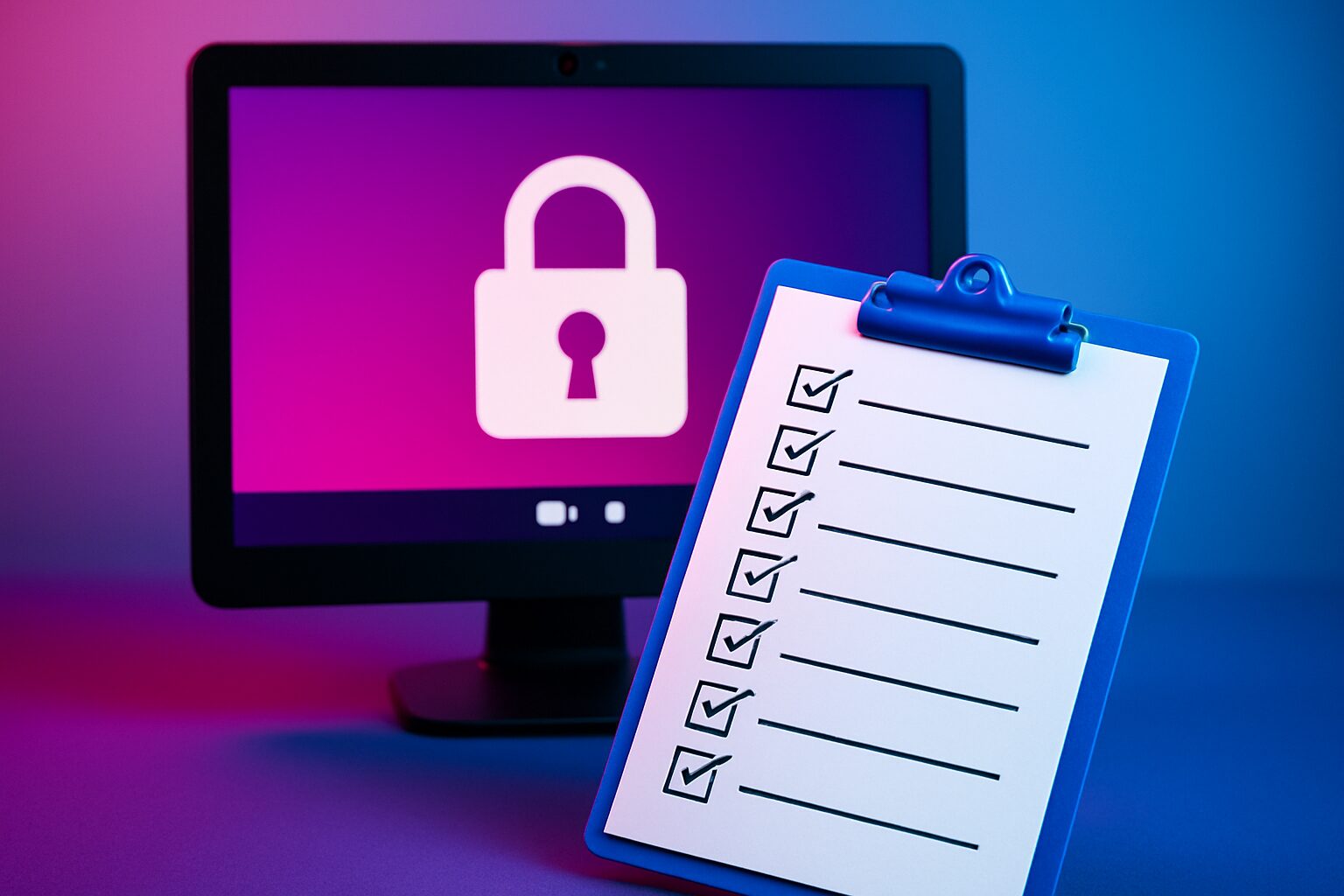
Your Video Security Checklist: 10 Essential Steps
This checklist distills field-tested practices into a sequence you can adopt in minutes, because the fastest way to raise your security baseline is to make the safe path the easy path, starting with identity and access controls and moving through content protection, device hygiene, and post-meeting governance that closes the loop on privacy, compliance, and auditability. You will notice that most steps are platform-agnostic and map cleanly to common controls in video meeting products, yet we call out AONMeetings where a browser-first architecture powered by Web Real-Time Communication (WebRTC) can simplify execution by avoiding software installs, reducing outdated client risks, and enabling enterprise policies to live at the network and identity layer rather than on unmanaged endpoints. For regulated environments like healthcare under the Health Insurance Portability and Accountability Act (HIPAA) or education where local privacy rules apply, the order of operations matters, so you will see authentication, consent, and encryption decisions appear before convenience features, and you will also see alternatives for low-friction external meetings where guests join from mobile devices on cellular networks. As you implement each step, test with a small pilot group, capture feedback, and adjust wording in invites, lobby messages, and host scripts, because small usability tweaks like a friendly lobby notice or a pre-meeting checklist slide can drive adoption and reduce user workarounds that otherwise bypass your best settings.
Watch This Helpful Video
To help you better understand zoom video security, we’ve included this informative video from eufy Official. It provides valuable insights and visual demonstrations that complement the written content.
- Require authenticated entry and unique meeting IDs: Use meeting-specific IDs instead of personal IDs and allow only signed-in users when appropriate; in AONMeetings, enable single sign-on (SSO) or guest pin-link flows to balance security with guest access.
- Enforce strong passcodes and waiting rooms: Combine passcodes with the waiting room so hosts can admit verified participants; add a lobby message reminding guests to use their real names for audit consistency.
- Limit screen sharing to host or co-hosts: Default to host-only sharing and grant temporary privileges as needed; in large sessions, enable content moderation and watermarking to deter leaks.
- Lock the meeting after all expected attendees arrive: A single click prevents late intrusion; co-host a colleague so the discussion continues while one person manages the door.
- Use the highest feasible encryption mode for sensitive topics: Turn on strong, HIPAA-aligned encryption modes, confirm all clients support them, and document exceptions when interoperability is essential.
- Control chat, file transfer, and annotation: Disable or restrict features that create exfiltration paths; in training sessions, allow moderated Q and A, but keep file sharing off unless explicitly needed.
- Harden recording practices: Record only when necessary, capture consent, enable on-screen recording indicators, apply retention limits, and restrict access to people with a business need-to-know.
- Apply multi-factor authentication (MFA) and role-based access controls: Protect host accounts with MFA and assign roles like host, co-host, presenter, and attendee thoughtfully to enforce least privilege.
- Maintain device and browser hygiene: Keep operating systems, browsers, and extensions updated, use Transport Layer Security (TLS) 1.2 or higher, and avoid untrusted plug-ins; AONMeetings’ 100 percent browser-based model reduces outdated client risk.
- Audit, alert, and train: Review logs, enable unusual activity alerts, run short tabletop exercises, and use artificial intelligence (AI) summaries in AONMeetings to document actions and decisions without exposing raw recordings widely.
Video Security Settings That Matter: From Defaults to Best Practices
Security posture depends on what is on by default and what your administrators and hosts consistently enforce, so translate policy into settings and templates, minimize one-off exceptions, and use language your team understands rather than jargon that hides risk, because clarity reduces the urge to bypass controls in the moment when stakes are high and time is short. Start by separating meeting types into profiles such as internal standups, external sales calls, and highly sensitive reviews, then create templates that bake security into invitations so hosts do less manual setup and guests see consistent lobby messages, naming conventions, and consent prompts that set expectations. Many organizations also benefit from a short pre-flight host checklist that runs through identity, lobby, sharing, recording, and backup host assignments in under 60 seconds, and posting that list in the calendar invite increases the odds it will be used when schedules are compressed or when a substitute facilitator steps in. Below is a practical map of high-impact settings to risk reduction outcomes, including where an AONMeetings control can streamline or strengthen the default, especially for teams that want HIPAA-ready workflows, browser-only access, and unlimited webinars without juggling add-ons or worrying about client patch levels.
| Control | Risk Addressed | Recommended Setting | Host Tip | AONMeetings Equivalent |
|---|---|---|---|---|
| Meeting ID | Guessable personal rooms | Use unique meeting IDs for each session | Avoid reusing links in public posts | One-click unique links generated per session |
| Passcode + Waiting Room | Unauthorized entry and drive-by disruption | Passcode required and waiting room enabled for all | Customize lobby message with conduct notes | Default lobby with host-controlled admit and notes |
| Screen Sharing | Malicious or accidental content exposure | Host only by default; elevate case-by-case | Use co-host for presenters, then revoke | Presenter token with automatic time-bound expiry |
| Recording | Oversharing of sensitive content | Off by default; enable with consent and retention | Record summaries, not entire sessions, when possible | AI summaries with access policies and no extra fees |
| Authentication | Impersonation and guest sprawl | Single sign-on (SSO) with multi-factor authentication (MFA) | Restrict hosts to corporate domains | SSO and domain-locked rooms for sensitive meetings |
| Encryption | Interception or tampering | Use the highest feasible encryption (HIPAA-aligned) for high-sensitivity calls | Verify client compatibility before critical sessions | Advanced encryption and HIPAA-aligned configurations |
| Chat and File Transfer | Data exfiltration and malware | Disable by default; enable moderated Q and A if needed | Use links to sanctioned repositories | Granular chat controls and DLP-friendly configurations |
| Participant Video/Audio | Background data leakage | Mute on entry, video off for large public events | Ask speakers to review backgrounds | Green-room controls and consent prompts |
| Watermarking | Untraceable leaks | Enable for confidential demos and reviews | Inform attendees in the invite | On-screen watermark and viewer-specific tags |
| Reporting and Removal | Persistent disruption | Enable in-meeting reporting and quick removal | Assign a co-host as safety lead | One-click remove and session incident log |
Given that small misconfigurations often produce outsized consequences, pair these settings with smart defaults at the admin level and lightweight training that shows hosts where to click and why it matters, because when the intent is understood the habit sticks and your mean time to secure goes down without adding friction that drives users to shadow tools. For global organizations, publish short, localized guidance for guest-heavy regions where bring-your-own-device is common and cellular bandwidth can degrade connections, and remember that encrypted browser-based platforms like AONMeetings reduce the need for risky workarounds by making secure joins as easy as tapping a link in any modern browser. If you must relax a control for a specific event such as a public town hall, compensate with additional monitoring and staff co-hosts, and document the exception in your event runbook so lessons learned can flow back into policy. Above all, revisit your templates quarterly, because product updates and organizational changes will open new opportunities to simplify, consolidate, or retire settings you no longer need, and that periodic housekeeping is one of the least costly ways to keep your defenses sharp all year.
Compliance, Encryption, and Data Stewardship Explained
Confidential conversations carry legal and ethical duties that transcend convenience, so align your meeting practices with frameworks like the Health Insurance Portability and Accountability Act (HIPAA), the General Data Protection Regulation (GDPR), the International Organization for Standardization (ISO) 27001, and Service Organization Control 2 (SOC 2), and translate high-level principles into specific controls you can audit. Encryption is the foundation but not the whole house, which means you should understand the difference between transport encryption using Transport Layer Security (TLS) and other encryption modes, decide when the strongest encryption mode is essential, and verify that participants’ devices and feature requirements are compatible with that mode so you do not discover limitations during a critical negotiation or telehealth consult. Data retention, recording access, and consent are equally central, so define who may initiate recordings, where those files live, how long they persist, whether transcripts are generated, and which approvals are required before sharing with third parties, because many privacy incidents stem from recordings stored in broadly accessible folders or sent via email. AONMeetings is designed to support these obligations with advanced encryption, HIPAA-ready workflows, and artificial intelligence (AI) summaries that capture decisions without pushing raw audio or video to wide audiences, providing a minimal-exposure path for orgs that want a documented trail without the storage and privacy overhead of large media archives.
| Framework | Who It Impacts | Implications for Meetings | How AONMeetings Helps |
|---|---|---|---|
| Health Insurance Portability and Accountability Act (HIPAA) | Healthcare providers and partners | Safeguard Protected Health Information, obtain consent, audit access | HIPAA-aligned encryption, access controls, audit logs, browser-based simplicity for patients |
| General Data Protection Regulation (GDPR) | Organizations handling EU data | Lawful basis for processing, minimization, subject rights | Configurable retention, fine-grained permissions, data export support |
| Education privacy requirements | Schools and universities | Protect student records and classroom content | Waiting rooms, roster controls, moderated chat, recording consent prompts |
| International Organization for Standardization (ISO) 27001 | Security management across industries | Governance, risk, and control documentation | Policy templates, role-based access, logs exportable to SIEMs |
| Service Organization Control 2 (SOC 2) | Service providers managing customer data | Controls over security, availability, and confidentiality | Change management alignment, resilient architecture, reporting |
To operationalize these obligations, map each regulation to concrete controls in your meeting stack and create a single policy page for hosts that explains when to use the highest feasible encryption mode, when to require single sign-on (SSO), and when recordings are allowed or prohibited, and then wire that policy into your meeting templates and admin defaults so the correct choice is preselected. For external calls with unknown participants, lean on browser-based joins that avoid software downloads, because unmanaged clients and hurried installs are a frequent route for privilege prompts, unsafe permissions, or outdated libraries, and shifting trust to the browser’s sandbox with Transport Layer Security (TLS) reduces that risk significantly. Document data flows for transcripts, captions, and artificial intelligence (AI) processing, and ensure any vendor processing aligns with your data residency, retention, and confidentiality needs; with AONMeetings, teams can generate AI summaries and stream events live without paying extra webinar fees or shipping raw content to unsanctioned tools. Finally, test your controls under stress in a short exercise that simulates a sensitive call interrupted by an unexpected guest, an accidental screen share, or a recording consent dispute, because nothing reveals policy gaps faster than a realistic dry run with a timer and stakes.
Scenario Playbook: Applying the Checklist in the Real World
Security becomes intuitive when you see it in action, so this playbook walks through brief scenarios across healthcare, education, legal, and corporate environments to show how the same core controls adapt to different goals, stakeholders, and regulatory pressures without slowing people down. For a telehealth clinic, the priority is safeguarding Protected Health Information while ensuring a low-friction patient experience, so the host relies on single sign-on (SSO) for staff, employs HIPAA-compliant encryption, uses waiting rooms to verify names, and records only explicit patient consent with clear retention, whereas the patient joins via a mobile browser in AONMeetings with no downloads, lowering friction and support calls. In a school district, teachers schedule classes with authenticated students only, keep screen sharing restricted, moderate chat, and prevent file transfers during exams, while a co-host handles admits and discipline, and for parent-teacher conferences they switch to a template that allows vetted guest entry with clear lobby messages designed to reduce anxiety and guide behavior. Legal teams hosting settlement talks prioritize identity assurance and transcription control, so they disable cloud recording, rely on artificial intelligence (AI) summaries restricted to the legal team’s workspace, watermark any shared documents, and use role-based access to prevent junior staff from invoking features that might violate litigation holds, while corporate sales teams balance accessibility with confidentiality by authenticating employees, providing guest links with passcodes, disabling attendee downloads, and relying on presenter tokens that expire at the end of each segment.
- Healthcare mini-case: A behavioral health clinic saw patient no-show support tickets fall by 28 percent after moving to AONMeetings’ 100 percent browser-based joins, while HIPAA-aligned templates reduced staff setup time during intake.
- Education mini-case: A university’s remote exams used locked meetings, proctor co-hosts, and chat disabled by default; incident rates dropped notably once waiting room scripts reminded students of conduct policies upfront.
- Legal mini-case: A boutique firm replaced broad recordings with AI summaries that excluded sensitive names, achieving a better privilege posture and faster brief drafting without sprawling media archives.
- Corporate mini-case: A global sales org limited sharing to presenters and used watermarking on pricing slides; leaks decreased while attendee satisfaction improved thanks to a smoother green-room flow.
As you adopt these practices, keep score with a lightweight dashboard that tracks the percentage of meetings using unique IDs, passcodes, waiting rooms, and least-privilege sharing, because progress you can see motivates consistent behavior and spotlights training needs across departments and regions. Many teams publish a monthly digest that celebrates improvements like fewer incident reports or faster admits while reminding hosts of a single focus area such as watermarking for confidential demos, and that cadence keeps security visible without overwhelming calendars with long trainings. For leadership, pair the metrics with a brief narrative about risk reduction and productivity gains, such as fewer support tickets after moving to browser-only joins or quicker deal cycles after adopting a clean presenter workflow with green-room rehearsals, so stakeholders connect controls to business outcomes. When teams understand why settings exist and experience the benefits, the checklist transforms from a compliance chore into a shared skill that makes every meeting calmer, faster, and safer.
Why AONMeetings Elevates Your Video Security Strategy
Organizations want security without hurdles, and AONMeetings was designed for that balance by combining HD video and audio quality powered by Web Real-Time Communication (WebRTC) with a 100 percent browser-based experience that removes installs, patches, and outdated client risks, while delivering unlimited webinars on every plan so you do not juggle add-ons or surprise fees when your needs grow. Advanced encryption and HIPAA-oriented configurations align with healthcare, education, legal, and corporate policies, while role-based controls, domain restrictions, and single sign-on (SSO) with multi-factor authentication (MFA) keep identity and access in your hands, not stuck behind scattered host preferences that get lost under pressure. Artificial intelligence (AI) features such as live streaming and meeting summaries deliver the outcomes stakeholders want without proliferating raw recordings, and the platform’s logging and export capabilities let you integrate with existing governance and analytics tools without rebuilding workflows or asking users to learn yet another interface. Because AONMeetings is designed for cross-industry use, the same template-driven approach can serve a cardiology consult, a doctoral defense, a settlement conference, or a quarterly business review, while the browser-based model ensures every participant arrives with the same current security posture, protected by the modern browser’s sandbox and secured transport using Transport Layer Security (TLS).
| Capability | What It Delivers | Security Outcome | Who Benefits |
|---|---|---|---|
| Web Real-Time Communication (WebRTC) HD video and audio | Crisp media without native apps | Smaller attack surface, fewer outdated clients | Everyone, especially guests on mobile |
| 100 percent browser-based joins | No downloads or plugins | Reduces install-time phishing and permission risks | IT, security, and all end users |
| Unlimited webinars on every plan | Scale events without extra fees | Simplifies governance and reduces tool sprawl | Marketing, HR, education, community outreach |
| Advanced encryption and HIPAA support | Confidential sessions with auditability | Aligns with Health Insurance Portability and Accountability Act (HIPAA) and similar standards | Healthcare, legal, enterprise compliance teams |
| Artificial intelligence (AI) summaries and live streaming | Decision trails and broad reach | Minimizes raw recording exposure while informing stakeholders | Executives, project managers, legal reviewers |
| Role-based access and domain restriction | Least privilege by default | Prevents accidental feature misuse and impersonation | Admins and hosts in all industries |
Behind these capabilities is a philosophy that security and simplicity reinforce each other when the path of least resistance is also the safest, and that is why AONMeetings focuses on template-driven defaults, clear host guidance, and controls that are visible but not intrusive, letting your people collaborate without toggling through complex menus or installing tools that your policies will later block. For healthcare teams, HIPAA-ready encryption, consent prompts, and audit trails reduce administrative headaches while keeping clinicians present with patients, and for educators, moderated chat, waiting rooms, and roster controls make classroom management predictable so instruction time is not lost to access hurdles. Legal and corporate teams get watermarking, retention policies, and domain-locked rooms that match privacy and deal discipline, while support staff appreciate that browser-native performance makes troubleshooting simpler across operating systems, devices, and networks without remote desktop interventions. If your strategy is to reduce risk while improving speed, a secure, fully browser-based platform that respects compliance and scales events with no surprise fees is a practical lever you can pull today.
From Policy to Practice: Turn Your Checklist into a Habit Loop
Sustainable security thrives on habit loops where triggers, actions, and rewards are aligned, so embed the checklist into your scheduling templates, lobby messages, onboarding, and leadership dashboards until doing the right thing feels automatic rather than exceptional, and measure not just incidents avoided but friction reduced. A short pre-meeting ritual works wonders, for example a 45-second pause in the green room where the host verifies identity controls, reviews screen sharing roles, checks recording status, and confirms a co-host is present to handle admits, and that ritual can be reinforced by a simple on-screen cue that fades once each item is green, keeping momentum without adding cognitive load. Reward the behavior you want by celebrating hosts who consistently achieve secure defaults, publish a monthly tip that answers a frequent question in plain language, and rotate a security champion role that attends team standups to gather feedback on settings that feel heavy so you can streamline without sacrificing safety, because every unnecessary click is a future workaround waiting to happen. Finally, keep improving by running a quarterly fire drill where a facilitator injects a realistic issue such as a suspicious name in the waiting room, a request to share a window with confidential tabs nearby, or an urgent need to invite an executive mid-call, and afterwards document what worked, what lagged, and which admin defaults or templates you will tweak next, so your video security playbook stays alive rather than dusty.
| Habit | Trigger | Action | Reward | Tooling Support |
|---|---|---|---|---|
| Use unique IDs | Creating an invite | Select the secure template | No uninvited guests | Admin-locked default templates |
| Verify lobby names | First admits start | Read names, ask for confirmation | Smoother meeting start | Custom lobby instructions |
| Limit sharing | Presenter joins | Assign co-host then revoke | Fewer mistakes on screen | Presenter tokens with timers |
| Consent before record | Agenda item requires recap | Display consent slide and enable recording | Trace without oversharing | AI summaries and retention policies |
| Review logs | Weekly wrap | Scan alerts and anomalies | Early issue detection | Export to SIEM and admin dashboards |
FAQ: Fast Answers to Common Security Questions
Security questions often arrive at the speed of a calendar invite, so here are concise answers you can share with colleagues and guests to reduce hesitation and prevent risky improvisation that trades a minute saved for a headache later. Should you use a personal meeting ID for public webinars, or should you generate a unique link each time, and why; the best practice is unique links with passcodes and waiting rooms so your personal room remains private and predictable, which dramatically lowers the chance of unwanted drop-ins across future sessions. What about recording a training for absent team members when sensitive content might appear on screen, and how do you protect privacy; limit recording to the demo portion, announce recording with a consent slide, and rely on artificial intelligence (AI) summaries for Q and A to capture decisions without archiving entire discussions, then store the media in a restricted repository with retention that matches policy. Finally, how should guests join if they are on locked-down corporate machines that forbid new software installs; invite them to AONMeetings via a secure browser link to leverage the modern browser’s sandbox, Transport Layer Security (TLS), and managed cookies for authentication, which avoids the common failure mode of last-minute downloads on unmanaged devices.
- Rhetorical checkpoint: If you would not leave your office door ajar at night, why leave your meeting room unlocked once all attendees have arrived?
- Analogy to remember: Waiting rooms are like a friendly receptionist who greets guests, verifies identity, and ushers them to the right room without slowing regulars.
- Quick micro-checklist: Unique ID, passcode, lobby on, host-only share, consent before record, lock after start, review logs later.
Ready to Take Your zoom video security to the Next Level?
At AONMeetings, we’re experts in zoom video security. We help businesses overcome businesses and organizations need a reliable, secure, and easy-to-use video conferencing tool that complies with industry regulations, offers advanced features, and works seamlessly for teams and clients without complex installations. through aonmeetings solves this by offering a fully browser-based platform with no extra fees for webinars and advanced security measures such as encryption and hipaa compliance, ensuring a seamless user experience and peace of mind for organizations of all sizes.. Ready to take the next step?