
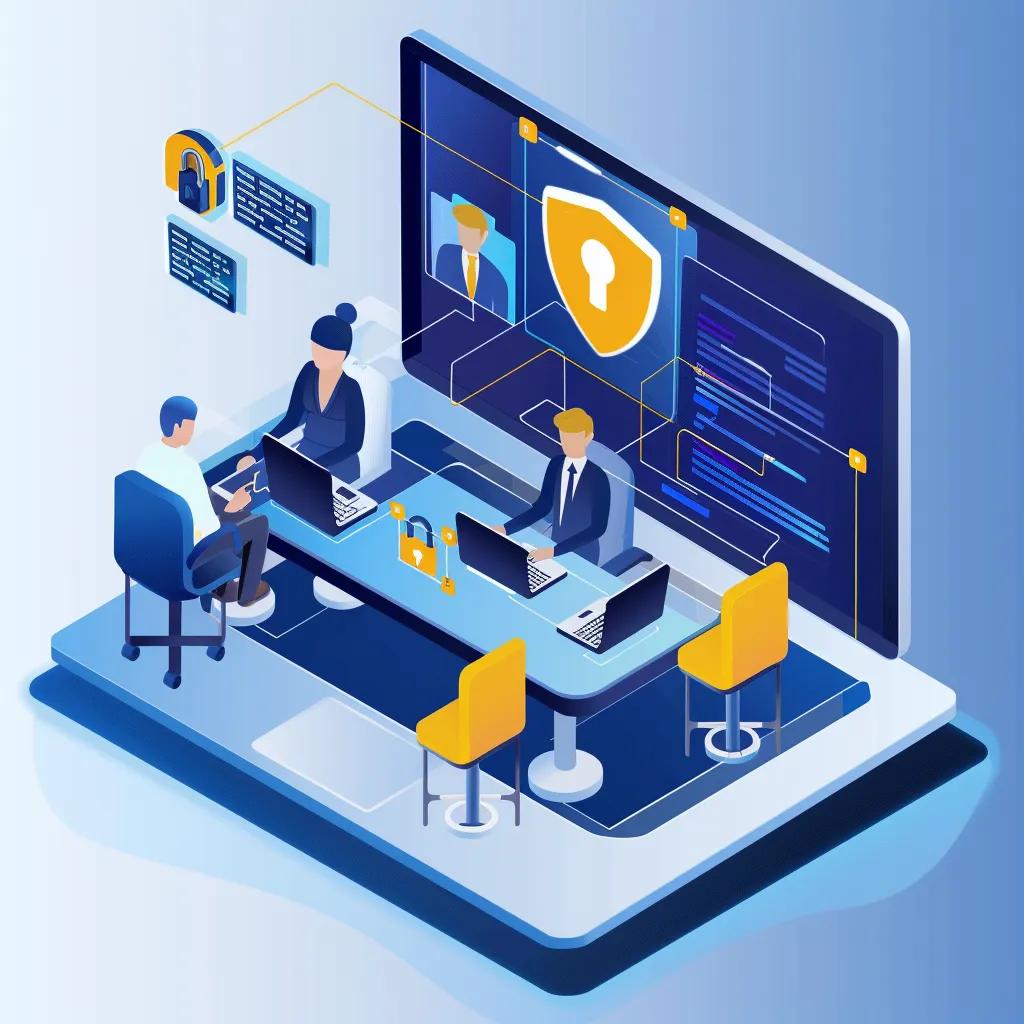

End To End Encryption and Security Essentials for Virtual Depositions and Court Proceedings
Virtual legal proceedings handle highly sensitive testimony and confidential exhibits, making security a non-negotiable foundation. This guide explains how end-to-end encryption, multi-factor authentication, secure exhibit sharing and compliance frameworks work together to protect remote depositions and virtual court hearings. You will learn what defines virtual depositions and court proceedings, which technical safeguards are essential, how regulatory standards like FRCP and HIPAA apply, best practices for data protection, and actionable steps for implementation. Each section builds on the last to map out a comprehensive security and compliance blueprint for legal professionals conducting virtual proceedings.
What Are Virtual Depositions and Court Proceedings?
Virtual depositions and remote court proceedings transform courtroom interactions into secure online experiences. They rely on videoconferencing platforms, digital exhibit management and real-time transcription to capture testimony from anywhere. By replicating traditional procedures—oath administration, witness examination, recording—these virtual environments maintain legal validity while reducing travel costs and scheduling delays. Understanding their core structure sets the stage for exploring specialized security requirements in subsequent sections.
How Do Virtual Depositions Work in Remote Legal Settings?
A virtual deposition is a remote testimony session conducted over a secure platform that authenticates participants, records audiovisual feeds, and manages evidence exchange. During the proceeding, attorneys and court reporters connect via encrypted channels, administer oaths electronically, mark and share exhibits through secure portals, and produce an official transcript.
This model preserves procedural integrity while offering flexibility, and it paves the way for robust encryption and compliance controls in the next discussion of court hearings.
What Defines Court Proceedings in a Virtual Environment?
Virtual court proceedings encompass formal hearings and trials conducted over secure digital systems that adhere to judicial protocols. Judges, clerks, litigants and counsel join via authenticated sessions, present arguments, admit evidence and record rulings with the same legal standing as in-person appearances. Video evidence is streamed under strict access controls, and e-filing systems integrate securely with case management tools. Defining these elements clarifies why specialized security measures and regulatory compliance are indispensable.
Why Is Security Critical in Virtual Legal Proceedings?
Security is critical because unauthorized access or data breaches can compromise witness privacy, taint the integrity of testimony and expose privileged communications. Confidential exhibits—including medical records or trade secrets—require end-to-end safeguards to prevent interception. Ensuring secure authentication and audit trails preserves chain-of-custody and supports admissibility under rules of evidence. Recognizing these stakes leads directly into identifying essential technical measures for depositions.
Which Security Measures Are Essential for Virtual Depositions?
Secure virtual depositions depend on a layered approach combining encryption, user authentication, exhibit protection and adherence to industry standards. Implementing these measures prevents eavesdropping, impersonation and data leaks while maintaining procedural integrity.
Before diving into specifics, consider linking to detailed guidance on secure virtual deposition platforms for platform selection and configuration.
How Does End-to-End Encryption Protect Virtual Depositions?
End-to-end encryption ensures that audio, video and file transfers are encrypted at the sender’s device and decrypted only at the recipient’s endpoint, preventing intermediaries from accessing sensitive content. This mechanism uses public-key cryptography to generate unique session keys for each participant, guaranteeing confidentiality of court record and witness testimony. By applying AES-256 or equivalent algorithms, encryption preserves data integrity and prevents malicious interception during remote depositions.
End-to-End Encryption in Virtual Depositions
End-to-end encryption ensures that only the sender and recipient can access the content of communications, protecting sensitive information from unauthorized access. This is achieved through the use of cryptographic algorithms like AES-256, which provide a high level of data integrity and confidentiality during remote depositions.
National Institute of Standards and Technology (NIST), “Advanced Encryption Standard (AES)” (2001)
This research supports the article’s claims about the importance and implementation of end-to-end encryption in securing virtual depositions.
What Role Does Multi-Factor Authentication Play in Secure Access?

Multi-factor authentication (MFA) enhances security by requiring two or more verification factors—something the user knows (password), something the user has (hardware token or mobile app), and something the user is (biometric scan). Implementing MFA for attorneys, court reporters and witnesses mitigates credential theft and unauthorized login attempts. When combined with role-based access controls, MFA creates a robust barrier against impersonation and ensures only approved participants join the session.
Multi-Factor Authentication for Secure Access
Multi-factor authentication (MFA) enhances security by requiring users to verify their identity through multiple factors, such as a password and a one-time code from a mobile app. This approach significantly reduces the risk of unauthorized access, even if one factor is compromised, and is crucial for protecting sensitive legal information.
OWASP, “Multi-Factor Authentication Cheat Sheet” (2024)
This citation reinforces the article’s emphasis on the role of MFA in securing access to virtual deposition platforms and preventing unauthorized logins.
How Is Secure Exhibit Sharing Managed in Virtual Depositions?

Secure exhibit sharing relies on encrypted document repositories, time-limited access links and digital watermarking to protect sensitive materials. Exhibits are uploaded to a secure server, assigned unique access tokens, and displayed within the platform’s exhibition viewer without direct download capabilities. Audit logs record each view and download event for full chain-of-custody tracking. This approach prevents unauthorized distribution and preserves evidence authenticity.
What Technical Security Standards Apply to Deposition Platforms?
Deposition platforms often adhere to established cybersecurity frameworks such as ISO 27001 and SOC 2 Type II to demonstrate rigorous security controls. These certifications encompass policies for risk assessment, incident response, encryption management, physical security and continuous monitoring. Platforms may also implement NIST SP 800-53 controls for data protection and FIPS 140-2 validated cryptographic modules to secure communications.
| Entity | Attribute | Value |
|---|---|---|
| Virtual Deposition Platform | Security Certification | ISO 27001, SOC 2 Type II, NIST SP 800-53 |
| Encryption Algorithm | Strength | AES-256, RSA-2048 |
| Authentication Method | Type | Password + TOTP, Hardware Token, Biometric |
| Exhibit Sharing | Access Control | Time-limited tokens, Watermarking, View-only mode |
| Audit Logging | Scope | Participant joins, Document access, Session recording |
Platforms certified under these standards deliver audited assurance of robust controls, making them suitable for high-stakes legal proceedings.
How Can Platforms Prevent Witness Coaching and Maintain Integrity?
Advanced platforms integrate anti-coaching features such as randomized witness positioning, delayed video feeds for attorneys, and AI-driven behavior analysis that flags off-screen prompts. These measures detect suspicious interactions—like repeated glances off-camera—and alert the judge or remote court officer in real time. By combining secure session design with proactive monitoring, platforms uphold the credibility of witness testimony and deter improper coaching.
How Do Compliance Standards Impact Virtual Court Proceedings?
Virtual courtrooms must comply with procedural and data privacy regulations to validate remote hearings and protect participant rights. Adherence to local and federal rules ensures admissibility of electronic evidence and safeguards personal information under sector-specific laws.
What Are the Federal Rules of Civil Procedure (FRCP) Requirements for Virtual Hearings?
The Federal Rules of Civil Procedure permit remote depositions and hearings under Rules 30(b)(4) and 43(a), provided that all parties consent and reasonable measures ensure witness identification and cross-examination integrity. Platforms must record verbatim testimony and timestamp exhibits, maintaining a clear record for appeals. For detailed procedural tips, see our guide on FRCP requirements for virtual hearings.
How Is HIPAA Compliance Ensured in Legal Virtual Proceedings?
HIPAA compliance mandates that protected health information (PHI) remains confidential during remote depositions involving medical records. Platforms implement Business Associate Agreements (BAAs), end-to-end encryption, audit trails and secure backups in HIPAA-compliant cloud environments. Access logs capture all PHI views and downloads, while role-based permissions prevent unauthorized disclosure. These safeguards align with Privacy and Security Rules to protect patient information.
What Jurisdictional Requirements Affect Remote Court Proceedings?
Remote proceedings must respect state-specific regulations on e-filing, electronic service of process and notarization. Some jurisdictions require in-person verification for oaths or impose time-zone restrictions for official filings. Understanding each court’s local e-court guidelines—covering recording retention periods, transcript certification and data residency—is essential for full compliance and procedural validity.
How Is Electronic Filing Secured and Compliant?
Electronic filing systems use secure transport protocols such as TLS 1.2+, digital signatures based on PKI certificates, and role-based access controls to prevent tampering. Filings are hashed and timestamped on receipt, with audit trails capturing submission metadata. System certifications under standards like CJIS Security Policy or CourtView compliance ensure the integrity and admissibility of e-filed documents.
What Is Data Sovereignty and Why Does It Matter in Cloud-Based Legal Systems?
Data sovereignty refers to the requirement that client data reside within specific geographic boundaries to comply with local privacy laws. Cloud-based legal systems may offer region-specific data centers in the US, EU or APAC to meet GDPR, CCPA and other data residency rules. Ensuring data remains in authorized locations prevents cross-border legal conflicts and protects client confidentiality.
What Are Best Practices for Data Protection in Legal Technology?
Law firms and court administrators should adopt a comprehensive cybersecurity posture that addresses people, processes and technology. Combining preventive controls with incident response planning ensures resilience against evolving threats.
Before diving deeper, explore our full framework on data protection in legal tech.
An ordered list outlines key recommendations for law firms:
- Implement a least-privilege model for user access to minimize exposure of sensitive data.
- Apply end-to-end encryption for all court-related communications and document transfers.
- Enforce multi-factor authentication across applications, VPNs and cloud portals.
- Conduct regular penetration tests and vulnerability assessments to identify security gaps.
- Maintain updated backups in encrypted, off-site locations to enable rapid recovery.
Which Cybersecurity Practices Are Recommended for Law Firms?
Advanced cybersecurity strategies include continuous endpoint monitoring, threat intelligence integration and security awareness training. Deploying Extended Detection and Response (XDR) platforms allows correlation of network, endpoint and cloud logs for proactive threat hunting. Regular phishing simulations and mandatory training ensure staff recognize social engineering attempts, reinforcing human-centric security controls.
How Can Ransomware Attacks Be Prevented in Legal Data Systems?
Preventing ransomware requires a combination of immutable backups, network segmentation and application whitelisting. Law firms should deploy offline, air-gapped backups with regular restore testing. Network segmentation isolates critical legal data from user workstations. Employing application control and email sandboxing blocks malicious payloads from executing within the environment.
Why Is Multi-Factor Authentication Vital in Legal Software?
Multi-factor authentication reduces credential compromise by requiring additional verification layers beyond passwords. In legal software—where client confidentiality is paramount—MFA prevents unauthorized logins even if credentials are phished or leaked. Combining hardware tokens with mobile authenticator apps offers a balance of security and usability for attorneys and court staff.
How Should Law Firms Plan Incident Response for Data Breaches?
Incident response plans define roles, communication procedures and technical playbooks to contain and remediate breaches. Key steps include immediate isolation of affected systems, forensic investigation, notification to regulatory bodies, and client communication.
| Entity | Attribute | Value |
|---|---|---|
| Identification | Trigger | Unusual network traffic, anomaly detection alerts |
| Containment | Actions | Network isolation, credential resets |
| Eradication | Tasks | Malware removal, patching vulnerable systems |
| Recovery | Objectives | Restore from clean backups, resume normal operations |
| Post-Incident Analysis | Deliverables | Root cause report, update response plan |
A well-rehearsed plan limits damage and accelerates restoration of secure operations.
What Are Key Cloud Security Measures for Legal Professionals?
Cloud security for legal data includes encryption at rest, granular access controls and continuous compliance monitoring. Legal professionals should verify that cloud providers offer dedicated key management and support customer-managed encryption keys. Integrating Security Information and Event Management (SIEM) tools enables real-time log analysis and automated alerts for anomalous activity.
How Does Legal Technology Enhance Security and Compliance in Virtual Proceedings?
Legal technology platforms integrate specialized features that reinforce security and streamline compliance, elevating remote proceedings to the same standard as in-person sessions.
What Features Define a Secure Virtual Deposition Platform?
A secure deposition platform offers end-to-end encryption, MFA login, secure exhibit libraries, audit trails and real-time transcription. Advanced offerings include hardware-level encryption for media streams, breakout room isolation, and controlled screen-sharing that restricts display to marked exhibits. These features collectively safeguard witness integrity and document confidentiality.
How Does Real-Time Transcription Support Compliance and Security?
Real-time transcription creates an immutable text record of proceedings that integrates with time-stamped video and exhibit logs. This transcript aids in instant redaction of protected information and provides clear evidence for appeals. By linking transcription entries to encrypted exhibits, platforms ensure traceable audit trails that satisfy legal chain-of-custody requirements.
What Role Does AI Play in Enhancing Security and Witness Integrity?
AI enhances security through automated behavior analysis, voice biometrics for speaker verification, and anomaly detection that flags unusual patterns—such as repeated off-screen prompts or unauthorized device connections. These capabilities deter witness coaching, verify identity continuously and generate compliance alerts for unusual activities.
How Is Technical Support Critical for Secure Virtual Proceedings?
24/7 technical support staffed by certified security engineers ensures rapid resolution of connectivity or configuration issues without compromising security controls. Support teams guide participants through secure login procedures, troubleshoot encryption mismatches and verify proper exhibit handling. Reliable assistance minimizes downtime and maintains the integrity of ongoing legal processes.
What Are Common Security Risks in Virtual Court and Deposition Settings?
Identifying and mitigating cybersecurity threats, unauthorized access scenarios and procedural vulnerabilities is essential for safeguarding virtual legal environments.
What Are the Main Cybersecurity Threats Facing Legal Virtual Proceedings?
Remote depositions and virtual hearings face phishing campaigns targeting attorneys, man-in-the-middle attacks on unsecured networks, and zero-day exploits in conferencing software. Malware infections on participant devices can capture audio or screen content before encryption. Understanding these threats guides investment in endpoint protection and secure network configurations.
How Does Unauthorized Access Impact Virtual Depositions?
Unauthorized access can disrupt proceedings, expose confidential exhibits and compromise witness identities. Intruders might inject malicious code to record or alter testimonies, undermining evidentiary validity. Robust authentication, virtual waiting rooms and participant verification protocols prevent these attacks and preserve the integrity of remote depositions.
What Are the Challenges of Witness Tampering and Coaching?
Without physical courtroom oversight, remote settings are vulnerable to off-camera coaching via instant messaging or secondary devices. Suspicious interactions compromise credibility and may require replay review or sanctions. Platforms that randomize camera angles, implement AI-based behavior monitoring and restrict unmonitored private chat effectively deter witness tampering.
How Can Technical Issues Affect Security and Compliance?
Technical failures—such as dropped connections, audio/video desynchronization or encryption handshake errors—can force platforms to revert to less secure modes, exposing data to risk. Pre-session connectivity checks, redundant network paths and automated re-encryption routines ensure stability without compromising security. Anticipating these issues maintains compliance and uninterrupted proceedings.
How Can Legal Professionals Implement Secure Virtual Depositions and Court Proceedings?
Implementing a secure virtual framework involves careful configuration, participant training and continuous compliance checks. Follow these steps to ensure robust protection:
- Enable End-to-End Encryption: Configure the platform to use FIPS-validated cryptographic modules and enforce encryption for all media and document channels.
- Deploy Multi-Factor Authentication: Require MFA for every participant, leveraging hardware tokens or mobile authenticators to harden access controls.
- Verify Witness Identity Remotely: Use video ID checks, dynamic challenge questions and biometric voiceprints to confirm each witness before testimony.
- Secure Exhibit Sharing: Upload exhibits to an encrypted repository, assign time-limited access links, and display documents via locked presentation modes.
- Establish Audit Trails: Activate detailed logging of participant actions—logins, document views, chat entries—and store logs in a tamper-evident environment.
- Conduct Compliance Audits Continuously: Schedule automated scans for configuration drift, certificate expirations and policy changes to ensure ongoing adherence.
- Develop Incident Response Playbooks: Define roles, escalation paths and technical steps for containment, forensic analysis and client notification in the event of a breach.
What Are Frequently Asked Questions About Security and Compliance in Virtual Legal Proceedings?
Legal teams often seek clarity on critical security topics before adopting virtual platforms. This section highlights common challenges and expert recommendations in narrative form to guide informed decision-making.
How Do You Secure a Virtual Deposition Effectively?
Securing a virtual deposition effectively requires end-to-end encryption of audio, video and exhibits; multi-factor authentication for all participants; secure exhibit management with watermarking; and continuous audit logs that track every interaction. Combining these controls with pre-session readiness checks and participant training establishes a trusted environment for remote testimony.
Is Zoom HIPAA Compliant for Depositions?
Zoom can be configured for HIPAA compliance when used under a Business Associate Agreement (BAA), with end-to-end encryption enabled, proper role-based access controls and audit logging. Careful configuration—disabling cloud recordings without encryption and enforcing strong passwords—ensures that PHI remains protected during remote depositions involving medical evidence.
What Are the Best Practices for Remote Court Proceedings?
Best practices include using a platform certified under ISO 27001 or SOC 2, enforcing MFA, verifying participant identities through biometric or dynamic authentication methods, and maintaining encrypted e-filing and transcription services. Regular penetration tests and staff cybersecurity training further strengthen defenses against evolving threats.
How Does End-to-End Encryption Protect Virtual Court Proceedings?
End-to-end encryption protects virtual court proceedings by encrypting data streams at the source and decrypting only at endpoints, preventing interception by unauthorized parties. This mechanism preserves confidentiality of witness statements and court records while ensuring that only authenticated participants can access sensitive information.
What Are the Legal Risks of Non-Compliance in Virtual Proceedings?
Non-compliance can result in lost evidence admissibility, sanctions for improper procedures, data breach liabilities under HIPAA or GDPR, and reputational damage. Courts may reject testimonies or exhibits if security controls fall short of regulatory standards, emphasizing the need for rigorous compliance frameworks in virtual settings.
Virtual depositions and court proceedings demand holistic security and compliance architectures that blend end-to-end encryption, strong authentication, secure document handling and adherence to procedural rules. By implementing the measures and best practices outlined here, legal professionals safeguard witness integrity, protect confidential data and uphold the highest standards of remote justice. Integrating these controls today ensures resilient, legally sound virtual proceedings well into the future.