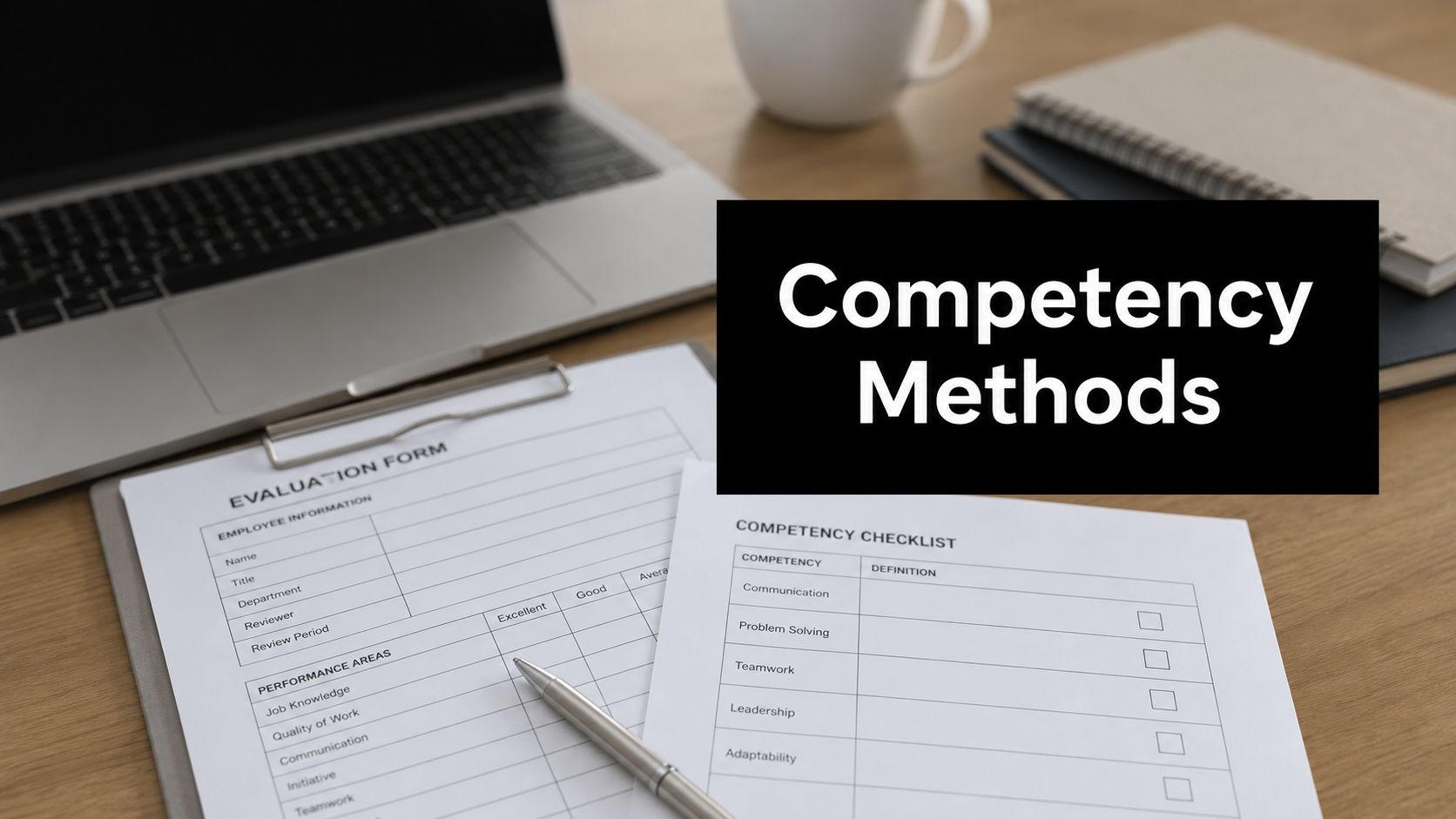
You already know the feeling. A manager says a hire “looks good on paper,” but the person struggles in client meetings. A high performer gets promoted, then stumbles because the new role asks for a different mix of judgment, communication, and execution. That's where competency assessment methods matter, because they help teams measure what people can do, not just what they can describe. Performance-based approaches are especially strong here, with work-sample and simulation methods showing validity coefficients of 0.45–0.54 compared with 0.20–0.30 for knowledge-only multiple-choice tests, which makes them about 2× as predictive for job performance (performance-based assessment statistics).
The practical challenge is that most roles don't live neatly inside one test. A sales manager might need observation, a structured interview, and peer input. A nurse leader may need direct observation, record review, and case-based problem solving. The best programs use multiple evidence sources, because competency really means demonstrated performance in a real context, not a guess dressed up as a score.
1. 360-Degree Feedback Assessment
A manager may see steady performance at the surface while the team experiences missed follow-through, weak collaboration, or uneven coaching. 360-degree feedback is designed for that gap. It gathers input from supervisors, peers, direct reports, and sometimes customers, then combines those views into a more complete picture of how someone works. For leadership development, that wider lens is useful because a manager's impact is often clearer to the people around them than to the manager themself. For a practical explanation of the format, see what is a 360 degree review.

Make the process safe enough for honest feedback
Anonymity matters because raters who feel identifiable tend to soften their comments and avoid specifics. That weakens the whole process. Use a validated survey instrument or a provider that can protect confidentiality well, then review the results in a coaching conversation instead of treating them like a surprise performance review. If the debrief happens remotely, a browser-based meeting platform like AONMeetings can support confidential review sessions without asking people to install software.
Practical rule: Use 360 feedback to surface patterns, not to settle every debate about one person's behavior.
Keep the rubric tight
A weak 360 process asks broad questions and collects comments that do not map to action. A stronger one ties feedback to a small set of defined competencies, such as stakeholder communication, decision quality, or coaching ability. Add a few open-text prompts, but keep the scoring anchored to behavior, not personality. That makes the results easier to compare across raters and easier to turn into a development plan.
For real-world use, many organizations apply 360 feedback at promotion points, after leadership training, or before succession reviews. That timing matters because the feedback connects to a next step instead of sitting in an HR file. The method works because it captures how others experience the person across relationships, but it does not replace direct evidence of performance. It pairs well with coaching, and it becomes much stronger when the organization follows through on development plans instead of leaving the results untouched.
2. Competency-Based Interviews
A competency-based interview tests whether a candidate has already shown the behaviours a role needs. The interviewer asks for concrete past examples, usually in a Situation, Task, Action, Result structure, then drills into the details until the answer shows exactly what the candidate did. That makes it useful in hiring, where a confident answer can hide limited experience.

Start with the competencies before you write the questions. A role-specific matrix keeps the interview anchored to the behaviours that matter, such as client handling, problem solving, or technical judgment. It also helps interviewers avoid drifting into general chat that produces pleasant conversations but weak evidence. If you want a practical guide for structuring the process, the resource on how to conduct effective interviews is a useful companion for building a consistent interview flow. For candidates who need to prepare for this style of questioning, interview preparation for UK finance roles is a direct fit for the format.
Score evidence, not charm
Interviewers often remember confidence more than content. That creates risk, because a polished answer can still be weak evidence. Train multiple interviewers on the same rubric, use a shared scorecard, and write down the candidate's exact words before the panel starts discussing impressions. If the interview is remote, record it with consent so the panel can review answers later and align scoring on the same examples.
The strongest interviewers keep asking until they can point to a specific action, not a general claim.
Use video to widen access without lowering standards
Remote interviews can improve the process when they are set up well. Candidates in different locations can join without travel friction, and panelists can debrief soon after the call while the details are still fresh. The interviewer still needs to watch for the same evidence, who made the decision, what alternatives were considered, and what result followed. A candidate who says “I led the project” should still be able to explain scope, trade-offs, and outcomes in plain language.
Competency interviews work best for roles where behaviour matters as much as knowledge, such as leadership, client management, teaching, clinical judgment, and cross-functional collaboration. They do not replace work samples. They show how someone talks about past behaviour, while a task-based method shows what they can produce under pressure.
3. Simulation and Role-Play Exercises
Simulations separate description from execution. Instead of asking someone how they'd handle a complaint, a negotiation, or a crisis, you put them in a realistic scenario and watch what they do. That makes this method especially valuable for customer-facing, operational, and leadership roles where judgment shows up in the moment.

Build the scenario from real job pressure
Good role-plays mirror actual work problems, not abstract puzzles. If you assess a service manager, the scenario should include an upset customer, a policy constraint, and time pressure. If you assess a team lead, put in conflict, incomplete information, and a decision point. The more the situation resembles the job, the more useful the result becomes.
Use multiple trained observers when you can, because one person rarely catches everything. One assessor may focus on communication, another on judgment, another on composure. A simple rubric helps them stay aligned. For distributed teams, training employees online can be adapted to virtual simulations, especially when breakout rooms are used for parallel exercises and cloud recording is available for review.
Debrief fast while the memory is fresh
A simulation is not just an assessment tool. It's also a learning event. Immediate debriefing helps the participant connect behavior to outcome while the scenario is still vivid. Keep the feedback behavior-based, specific, and tied to the rubric. “You stayed calm” is less useful than “you acknowledged the issue first, then asked two clarifying questions before proposing a fix.”
For remote delivery, video conferencing can make role-play access easier across offices and time zones. Use stable audio, clear instructions, and time limits that are long enough to let the participant think but short enough to preserve realism. Simulations are resource-heavy, but they're hard to beat when you need to see how someone handles complexity in real time.
4. Work Sample Tests
Work sample tests are one of the most defensible competency assessment methods because they ask for the actual task, or something very close to it. A coder writes code. A marketer drafts a campaign plan. A legal candidate reviews a brief. A project manager structures a delivery plan. The assessor isn't guessing from indirect signals, they're looking at the output itself.
Match the sample to the role
The test needs to feel like a slice of the actual job, not a classroom exercise. If the task is too simple, it won't separate good candidates from average ones. If it's too complex or too time-consuming, it may penalize otherwise strong people who can't afford to spend hours on speculative work. Set a realistic window and make the complexity proportional to the role.
A strong rubric is essential. Before the task goes out, define what good looks like in terms of accuracy, judgment, structure, completeness, and communication. For live technical exercises, AONMeetings can support coding interviews or whiteboarding sessions without forcing candidates into a separate install.
Practical rule: If two assessors can't score the same work sample in a similar way, the rubric isn't ready.
Use the test as part of a larger picture
Work samples are powerful, but they don't tell the whole story. A candidate can produce a strong deliverable and still struggle to explain decisions, collaborate, or adapt when requirements change. That's why many teams pair the sample with a short interview to understand reasoning. The test shows execution. The interview shows judgment.
Remote candidates can submit work digitally, which makes this method friendly to distributed hiring. That flexibility matters in modern talent markets, but fairness still depends on clarity. Candidates should know the time limit, the expected output format, and whether they can use external references. The more standardized the conditions, the more trustworthy the result.
5. Assessment Centers
Assessment centers bundle several methods into one structured process. A candidate might complete an interview, a simulation, a group exercise, and a presentation over the course of a day or more. The value comes from triangulation, because one exercise rarely captures the full range of competencies needed for a high-stakes role.
Keep the competency set focused
Too many competencies make assessment centers muddy and exhausting. A better design usually targets a small group of critical competencies, then uses different exercises to observe each one from more than one angle. A group discussion may surface influence and listening. A presentation may surface clarity and executive presence. A role-play may surface resilience under pressure.
Assessor training matters more here than in almost any other method. People need to know what they're looking for, how to score it, and how to avoid letting one strong performance color every other judgment. If the program is remote or hybrid, video conferencing can handle parts of the center well, especially when participants are distributed across locations.
Use the center for both selection and development
Assessment centers are often used for promotions, succession planning, and leadership development because they reveal strengths and gaps in the same process. That makes the feedback highly usable. A participant may not be ready for the role today, but the result can still guide a targeted development plan.
A good center also documents results carefully. Notes, ratings, and behavioral evidence should be captured in real time, not reconstructed later from memory. That helps with fairness, internal calibration, and audit readiness. The process is intensive, but when the role carries real organizational risk, the extra structure is often worth it.
6. Peer and Self-Assessment Methods
Self-assessment and peer assessment are most useful when they're framed as developmental tools, not as a verdict. Self-ratings reveal how people see their own capability. Peer ratings show how colleagues experience day-to-day behavior. Put together, they can expose blind spots that a manager alone might miss.
Treat self-ratings as one input, not the truth
Self-assessment is common because it's easy to administer and it encourages reflection. The limitation is obvious, people don't always see themselves accurately. That doesn't make the method useless. It makes it useful in the right way. When someone rates themself highly on collaboration but peers consistently describe friction, the gap becomes a coaching signal.
Keep the form simple. Clear competency definitions and a modest rating scale usually work better than a sprawling questionnaire. If peer feedback is anonymous, people are more likely to be honest. If you're gathering responses from distributed teams, online survey tools are usually the cleanest delivery mechanism, and a short group debrief can happen over video when the discussion needs context.
Use peers for behavior, not popularity
Peer assessment can drift into social preference if the questions are too vague. Ask about observable behaviors instead. Did the person share information clearly. Did they follow through on commitments. Did they help resolve blockers. Those prompts are more actionable than asking whether someone is “good to work with.”
A useful pattern is to combine three to five peer raters, then compare that view with the employee's self-rating and the manager's perspective. That combination usually tells a much more reliable story than any single source. The method works particularly well in remote-first teams, where day-to-day collaboration is visible in shared projects, documents, and response patterns, not just in office chatter.
7. Observation and Direct Assessment
Direct observation is still one of the strongest ways to assess competence because it shows behavior in context. A manager, HR professional, or trained assessor watches the person perform the work, then rates specific behaviors against a defined standard. In healthcare, manufacturing, sales, and teaching, this method often captures the difference between theoretical understanding and real performance.
Watch for behaviors that matter on the job
Observation only works if the observer knows what to look for. Vague impressions like “seems confident” are easy to overrate and hard to defend. Define the behavioral indicators first. For example, in a client meeting, the observer might track how the person structures the conversation, handles objections, and closes next steps.
A structured observation form helps reduce bias. So does observing in more than one context when possible. One meeting or one shift can be misleading. Unannounced observation can also reduce the tendency to perform for the assessor, although it needs to be handled carefully so it doesn't feel punitive. Use the evidence to support timely feedback, then follow it with coaching if the person needs help improving.
Make remote observation work deliberately
Hybrid and remote roles make direct assessment harder, but not impossible. Screen recording can capture digital workflows, presentations, and screen-share interactions when the role depends on them. The key is to be explicit about what's being observed and why. If the behavior lives in a digital workspace, the assessment should too.
Observation works best when the manager documents what happened, not what they assumed was happening.
Combine the observation with employee self-reflection. That conversation often reveals intent, constraints, and context that the observer couldn't see. The result is a better developmental discussion and, in regulated environments, a stronger record of competence.
8. Competency Testing and Psychometric Assessments
Psychometric tools can add structure where human judgment gets fuzzy. They're useful for measuring cognitive ability, behavioral tendencies, and personality-related traits that influence how someone works. The most important rule is simple: use assessments that are validated for the competency you care about.
Pick the test for the question
A personality inventory is not a substitute for a job sample. A cognitive test doesn't tell you how someone handles a difficult customer. Each tool answers a different question. If you need to understand analytical reasoning, use a validated ability test. If you want to understand communication style or leadership preferences, use a tool designed for that purpose. If you're unsure whether a test belongs in the process, ask whether it maps cleanly to a job competency.
Administering these tools remotely is common, but security and interpretation matter. The person using the results should know how to read them in context and avoid overclaiming what the score means. In development settings, the value often comes from the conversation around the result, not the number itself.
Don't let a test replace judgment
Psychometrics are strongest when they support other methods. A candidate might score well on abstract reasoning and still struggle in a team environment. Another may show a useful leadership profile but need coaching on communication. That's why multi-method assessment is the standard in serious programs. It reduces overreliance on any single signal.
Because these tools can affect selection or promotion, they also need clear communication and legal care. Explain the purpose, how the data will be used, and who will see the results. If the goal is development, say so. If the goal is selection, be transparent about that too.
9. Portfolio and Evidence-Based Assessment
Portfolio assessment lets people prove competence over time. Instead of one snapshot, you review a body of evidence, project outcomes, work samples, certifications, client feedback, or performance artifacts, and map them to the competencies in question. That makes it especially useful in professions where results accumulate across projects or client relationships.
Ask for mapped evidence, not just a folder of files
A good portfolio is curated, not random. Each item should connect to a defined competency, such as project delivery, technical depth, teaching practice, or client communication. If the portfolio is just a pile of documents, the assessor has to do too much translation work. Give the person guidance on what evidence to collect and how to label it.
Cloud-based portfolios make sharing easier, especially across distributed teams. They also let assessors review artifacts over time rather than rushing through them in one sitting. For formal review conversations, a video meeting helps the reviewer and employee talk through the evidence, its context, and what changed over time.
Use the portfolio to support development conversations
Portfolio assessment works well for career progression because it shows growth, not just a final score. A consultant's project summaries, a teacher's lesson artifacts, or an engineer's code repository can reveal patterns in problem solving and quality. The strongest portfolios include both outcomes and reflection. What happened, what the person learned, and what they would do differently next time.
Confidentiality still matters. Some artifacts contain client data, intellectual property, or personal information. Set clear rules for what can be shared and how it will be stored. Done well, portfolio review becomes a practical record of capability rather than a ceremonial binder.
10. Competency Interview Focus Groups and Panel Discussions
Panel discussions and structured focus groups can be effective when the organization needs a consensus view from multiple assessors. Instead of one person making a call in isolation, several people discuss evidence, compare observations, and reach a shared view about the person's competencies. That's useful for senior hiring, leadership selection, and cross-functional roles.
Design the conversation around evidence
A panel should not turn into a free-form debate. Give the participants a clear competency framework, ask them to review specific scenarios or work evidence, and assign a facilitator who can keep the discussion on track. The goal is to compare observations, not let the loudest voice win. If the panel is remote, how to moderate a panel discussion like a pro is a practical reference for structuring the session and keeping the conversation balanced.
Use breakout rooms when smaller sub-groups need to assess different dimensions before reconvening. Record the session with consent if you need to review the discussion later for calibration or documentation. A shared note-taking template helps the group capture ratings in real time.
Protect against groupthink
Panels can be valuable, but they also carry risk. People may anchor on one strong opinion or defer too quickly to authority. That's why psychological safety and diverse panel composition matter. When assessors feel free to disagree respectfully, the final rating tends to be more credible. Keep the process centered on observable evidence, not on who sounds most certain.
This method works well when the organization wants one integrated view rather than a stack of separate scores. It's less useful when speed or high volume matters. For that reason, panel discussions usually sit near the top of the funnel for important roles, where the cost of a weak decision is high and the number of candidates is manageable.
Top 10 Competency Assessment Comparison
| Method | Implementation complexity | Resource requirements | Expected outcomes | Ideal use cases | Key advantages |
|---|---|---|---|---|---|
| 360-Degree Feedback Assessment | High, coordinate multiple raters, anonymity and platform setup | Moderate–High, survey platform, time from raters, possible vendor support | Holistic multi-source insights; identification of blind spots and development areas | Leadership development, performance reviews, distributed large teams | Comprehensive credibility; multi-perspective, good for coaching |
| Competency-Based Interviews | Low–Moderate, develop structured questions and scoring rubrics | Low–Moderate, trained interviewers, time per interview | Behaviorally anchored evidence tied to job tasks; predictive of performance | Hiring and selection for role-fit across industries | Structured and replicable; reduces bias; cost-effective |
| Simulation and Role-Play Exercises | High, design realistic scenarios and assessment criteria | High, skilled facilitators, technology/platforms, evaluator time | Observable application of competencies; decision-making and stress responses | Customer-facing roles, leadership assessment, clinical training | Real-time evidence of behavior; engaging; high validity |
| Work Sample Tests | Moderate, create authentic tasks and objective scoring | Moderate, task development, scoring rubrics, review capacity | Direct demonstration of job-relevant skills; high predictive validity | Technical roles, high-volume screening, specialized skill hires | Strongest job performance predictor; focuses on outputs |
| Assessment Centers | Very high, multi-method, multi-day coordination and design | Very high, multiple assessors, trained facilitators, logistics and cost | Comprehensive competency profile; development and succession insights | Executive selection, succession planning, leadership pipelines | Most comprehensive assessment; rich developmental feedback |
| Peer and Self-Assessment Methods | Low, implement structured surveys and guidance | Low, online survey tools, minimal training | Self-awareness and peer-viewed strengths; variable objectivity | Continuous development, remote/distributed teams, small businesses | Cost-effective, scalable, encourages reflection and collaboration |
| Observation and Direct Assessment | Moderate, observer training and structured observation tools | Low–Moderate, assessor time, observation forms, possible recording | In-context performance data; contextual factors and behavioral examples | Frontline operations, healthcare, manufacturing, customer service | Real-world evidence without simulated scenarios; timely feedback |
| Competency Testing and Psychometric Assessments | Moderate, select validated instruments and interpretation process | Moderate, licensed tools, trained interpreters, digital delivery | Objective, normed measures of cognitive and personality traits | Large-scale screening, leadership identification, talent programs | High reliability and validity when well-chosen; scalable and fast |
| Portfolio and Evidence-Based Assessment | Moderate, define frameworks and evidence mapping | Moderate, digital platforms, documentation and review effort | Longitudinal proof of competence and growth; credible artifacts | Professional services, education, clinical and creative roles | Demonstrates real work over time; supports mobility and development |
| Competency Interview Focus Groups & Panels | Moderate–High, facilitator-led design and panel preparation | Moderate, multiple assessors, facilitator, coordinated meeting time | Consensus-based, context-rich judgments and development dialogue | Complex hiring decisions, academic and healthcare panels, distributed orgs | Integrates multiple perspectives efficiently; builds assessor buy-in |
Choosing and Integrating the Right Assessment Methods
The best competency assessment program is rarely built on one method alone. It's built on a mix that fits the role, the decision, and the risk. A technical role may need work samples and psychometric tools. A leadership role may need 360-degree feedback, structured interviews, and an assessment center. A regulated role may need observation, record review, and case-based exercises. The right combination depends on what you're trying to predict and what evidence you can gather fairly.
The main trade-off is always the same. More realism usually means more time, more cost, and more assessor training. More convenience usually means less predictive power. That's why the strongest programs define critical competencies first, then choose methods that can observe those competencies in action. If the goal is promotion, development, or hiring, the evidence should match the decision. A work sample can show execution. A behavioral interview can show judgment. A 360 review can show how the person lands with others. Together, they create a more balanced picture than any one method alone.
Organizations also need to think about format. Remote and hybrid work don't make assessment impossible, they change the delivery model. Video conferencing, cloud recording, breakout rooms, and digital portfolios all help modernize the process, especially when teams are spread across locations. The key is to preserve structure. A remote assessment should still have clear rubrics, trained assessors, and consistent scoring rules. Technology should improve access and documentation, not blur the standard.
Calibration is where many programs succeed or fail. Without regular rater alignment, the same behavior can get scored differently by different people. Without periodic review, old competencies can stay in place long after the job has changed. And without follow-through, the assessment becomes a reporting exercise instead of a development tool. The best organizations treat these methods as part of a living talent system. They measure, compare, coach, and revise.
If you're building or refreshing your own assessment program, start with one role family and one business decision. Define the competencies, choose two or three methods that fit, then test the process with a small group before scaling. That approach gives you cleaner data and fewer surprises than launching a broad, one-size-fits-all program.
AONMeetings can support remote interviews, panel discussions, feedback debriefs, simulations, and recorded review sessions without forcing participants to install software. If your team is building competency assessments across distributed locations, visit AONMeetings to see how browser-based video collaboration can fit into your assessment workflow.