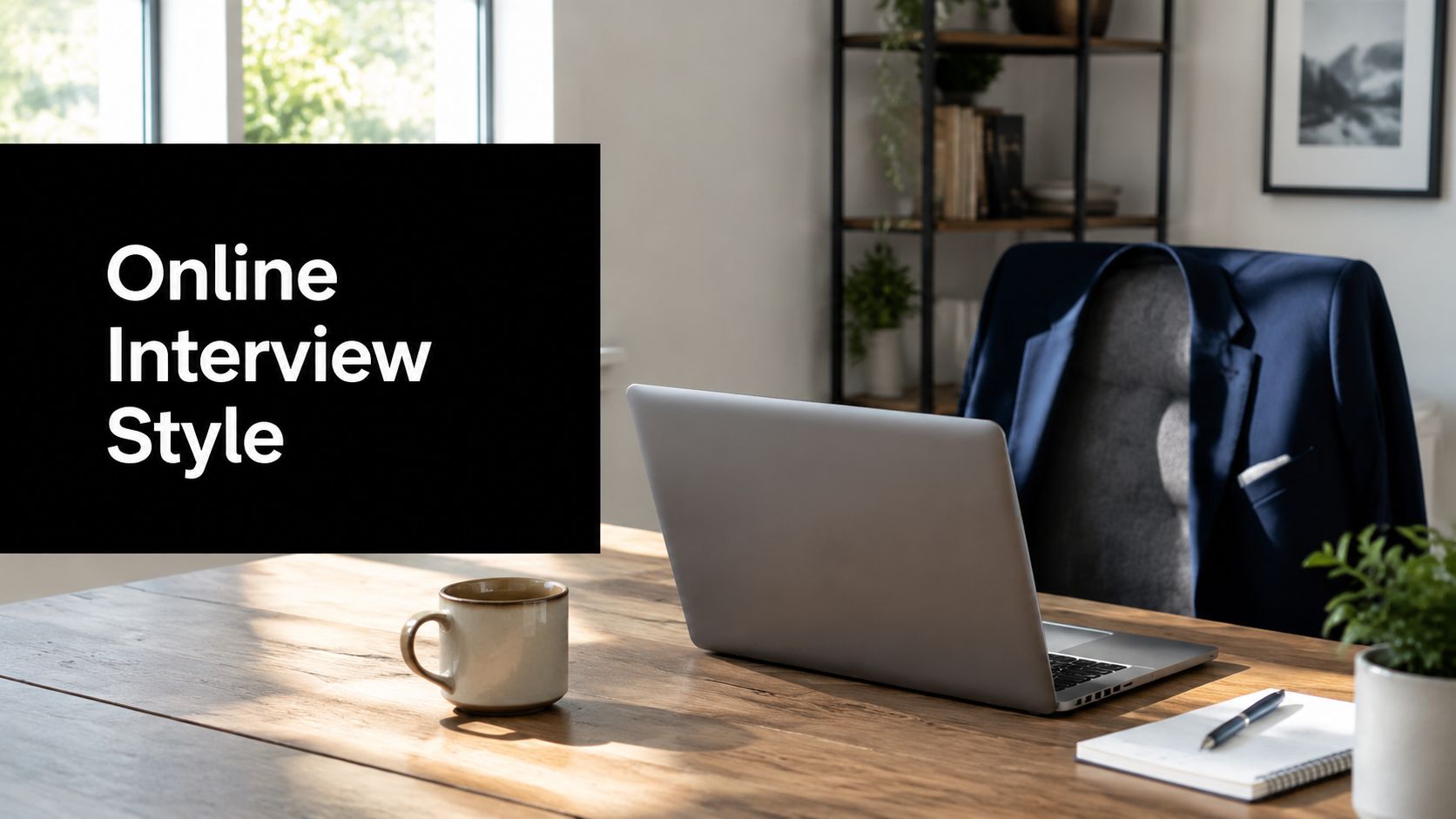
You're probably doing what most candidates do right before a virtual interview. One tab has the company website open. Another has your resume. Your camera is on, then off, then on again while you check your hair, your background, and whether that shirt looks polished or oddly shiny on screen.
That last part matters more than people think.
When candidates ask me what to wear for an online interview, they're usually asking a deeper question. They want to know how to look credible, prepared, and calm through a webcam that can flatten color, exaggerate texture, and turn a good outfit into a distracting one. On video, clothing isn't just fashion. It's part of lighting, framing, and screen presence.
A lot changed in hiring when interviews moved online, but the standard for professional presentation didn't disappear. It just became more technical. The camera now has a vote. Compression has a vote. Your lighting definitely has a vote.
Your First Impression Is Now on Camera
The interview opens, your camera connects, and the hiring manager gets a read on you before the first answer starts. On screen, that read is shaped by more than your expression. The webcam compresses detail, auto-adjusts exposure, and flattens depth, so clothing that looked polished in your bedroom mirror can look washed out, noisy, or distracting in the meeting window.
That is why interview clothing for video deserves the same attention as your answers. The goal is not to look fashionable. The goal is to help the camera render you clearly, keep attention on your face, and avoid visual distractions the platform has to process.
What changed and what didn't
Virtual interviewing became standard across a wide range of roles, but hiring expectations did not get looser. The medium changed. The judgment still starts fast.
What changed is the way employers see you. A webcam narrows the frame and exaggerates certain details. Fine patterns can create flicker under compression. Bright whites can blow out under direct light. A stiff jacket can make your shoulders look crowded if the camera is close. Good interview attire now has a technical job to do as well as a professional one.
I see this most clearly with candidates who are qualified and prepared but have not tested their outfit on camera. They assume "professional" is enough. It is not always enough on video. Professional and camera-friendly are not always the same thing.
If you are interviewing for a people-facing leadership role, details carry extra weight because employers are judging presence as well as experience. Candidates in clinical and administrative settings often benefit from role-specific prep, so it makes sense to review these expert tips for nursing managers alongside your wardrobe choices.
Your outfit should support your message, not create visual noise the interviewer has to filter out.
Treat the frame like part of your introduction
The screen is now part of the handshake. Your shirt color interacts with your background. Your collar shape affects how your posture reads. Even fabric finish matters because a slightly shiny material can reflect a desk lamp and pull focus away from your eyes.
Test the full frame before interview day. Open your platform, sit at speaking distance, and look at yourself the way the interviewer will see you on AONMeetings or a similar tool. Then adjust one thing at a time: light, background, and clothing. This practical advice on making memorable first impressions in your virtual meetings is useful because it connects visual setup with how people come across on screen.
Dress for the Job Not Just the Couch
You log in five minutes early. From the chest up, you look ready. Then you shift in your chair, the camera dips, and the interviewer catches joggers, bare feet, or a wrinkled sweatshirt. It breaks the spell fast.
For online interviews, dress as if you were walking into the employer's office. Full outfit, not just the visible half. That choice affects more than appearance. It changes how you sit, how often you fidget, and how seriously you treat the conversation. As noted earlier, remote interview guidance often makes the same point: getting fully dressed helps candidates feel more prepared and look more composed on screen.

Why the full outfit changes your behavior
Clothing affects posture. Structured trousers keep you seated more deliberately than sweats. Real shoes plant your feet and reduce the casual leg-crossing, swiveling, and slouching that read poorly on video.
Cameras exaggerate those small movements.
A webcam frame is tight, and video compression smooths or skips fine motion. That means repeated adjustments, a collapsing collar, or a jacket that rides up can become more noticeable on AONMeetings than they would across a conference table. If you have not tested how your clothes hold up on screen, run a quick video quality check before the interview and watch for pulling fabric, glare, and posture shifts.
Practical rule: If the outfit would feel too casual in the employer's lobby, it will look too casual on camera.
Dress one level above the company norm
Candidates usually do best when they dress one step more polished than the company's everyday standard. That does not mean wearing a full suit to a casual startup if no one there would. It means signaling respect for the meeting while still matching the culture.
A few examples make the trade-off clearer:
- Startups and tech teams: A blazer or structured knit over a clean top usually reads sharper than a formal suit that feels disconnected from the role.
- Finance, legal, and executive roles: Use more structure. Jacket, pressed shirt, clean lines, and nothing that looks relaxed or improvised.
- Education, healthcare administration, and nonprofit roles: Aim for polished and approachable. Neat layers and soft structure tend to work better than anything flashy.
For men who want a sharper sense of how structured clothing reads on camera and in profile photos, the Secta Labs headshot style guide offers useful visual references that overlap with interview prep.
What undermines the look
Some outfits create friction the second the interview starts.
- Athleisure dressed up as business casual: Stretch fabric, contrast zippers, and sporty trims tend to look informal once the camera flattens texture.
- A blazer over an obviously casual base layer: The mismatch shows up quickly on video, especially when you move.
- Anything that needs constant adjustment: If you keep fixing the neckline, cuff, or hem, the clothing is stealing attention from your answers.
The goal is simple. Wear clothes that hold their shape, fit the role, and let the interviewer focus on your face and your judgment.
Choosing Camera-Friendly Colors and Patterns
A shirt can look polished in the mirror and still perform badly on video. Webcams soften detail, video platforms compress motion, and household lighting pushes colors warmer or cooler than they appear in person. Clothing that looks crisp to your eye can turn noisy, dull, or harsh once the interview starts.
That is why camera-friendly wardrobe advice is more technical than stylish. The goal is simple: keep the image stable, keep attention on your face, and avoid anything that forces the camera to struggle.

Colors that usually work well on screen
Choose colors with enough depth to frame your face, but not so much contrast that the camera exposes for the clothing instead of your skin. In practice, mid-tone solids work best for most candidates and most home setups.
Good options include:
- Navy: Reads professional and holds detail well on webcam sensors
- Medium gray: Neutral, clean, and easier to light than black
- Soft blue: Brightens many complexions without creating glare
- Muted green or olive: Useful against pale walls and simple backgrounds
- Soft pastels: Calm on screen if the fabric has a matte finish
These colors usually survive compression well. They also give the interviewer a cleaner image on platforms like AONMeetings, where video quality still depends partly on what your camera is trying to process.
Colors that create avoidable problems
Some shades create extra work for the camera and for your lighting setup.
| Choice | What often happens on camera | Better move |
|---|---|---|
| Bright white | Blows out under front lighting and can make skin look washed out | Off-white, pale blue, soft gray |
| Deep black | Hides fabric detail and can make the frame look heavy | Charcoal, navy, dark olive |
| Neon shades | Pulls attention away from your face | Muted versions of the same color |
| Red-orange tones | Oversaturates easily under warm bulbs | Cooler jewel tones |
Fabric finish matters too. Matte fabrics usually read better than glossy ones because they reflect light more evenly. Satin, shiny silk, and slick synthetics can create hot spots on the chest or shoulders, especially if you are using a ring light or sitting near a window.
If the shirt catches the eye before your expression does, it is doing too much.
Patterns, texture, and the moire problem
Busy patterns fail on camera for a technical reason. Tight stripes, small checks, and high-contrast prints can create moire, a rippling or vibrating effect caused by the pattern competing with the camera sensor's pixel grid. Add video compression, and the result can look like flicker or blur whenever you move.
Large, low-contrast patterns are safer than tiny, sharp ones, but solids are still the more reliable choice. If you want some visual depth, use texture instead. Fine knits, brushed cotton, twill, and subtle tonal weaves usually add shape without creating distortion.
Test the exact top you plan to wear in the exact setup you plan to use. Record a short clip, then watch for shimmer, exposure shifts, and loss of detail around the collar and shoulders. If something looks off, a quick review of how to improve video quality for interviews helps you tell whether the problem comes from the camera, the lighting, or the clothing.
Decoding the Dress Code by Industry
“Professional” means different things in different fields. A software company may expect polish without stiffness. A law firm may expect traditional structure. A creative agency may welcome personality, but still reject anything distracting on camera.
The goal isn't to imitate the company's exact everyday look. It's to show that you understand the environment and can present yourself appropriately within it.
Online interview dress codes by industry
| Industry | General Dress Code | Example Outfit (For Him) | Example Outfit (For Her) |
|---|---|---|---|
| Technology | Polished business casual | Collared shirt, blazer, dark chinos | Structured blouse, blazer or polished knit jacket, tailored pants |
| Finance | Business professional | Suit or jacket with dress shirt and conservative tie if appropriate | Blazer with tailored dress, blouse and trousers, or a conservative suit |
| Creative media | Elevated smart casual | Solid crew or collared shirt with a modern jacket | Clean, structured top with tailored separates and restrained color |
| Healthcare | Professional and approachable | Dress shirt with blazer or fine-gauge knit layer | Blouse or knit top with blazer or cardigan and tailored trousers |
| Education | Business casual to professional | Button-down shirt, sport coat optional, pressed slacks | Blouse, knit blazer, midi dress with structure, or tailored separates |
| Legal | Traditional business professional | Dark suit, pressed shirt, tie where customary | Suit, blazer with blouse, or a conservative dress with jacket |
How to make the right call when the company is hard to read
Look at leadership photos, recruiter profiles, and company event pages. Don't copy the most casual employee photo you can find. Use the most formal version of the company's public-facing style as your reference point.
If the signals are mixed, pick the more polished option. Candidates rarely hurt themselves by being slightly more formal. They do hurt themselves by appearing too relaxed, too trendy, or too casual for the conversation.
A few practical distinctions help:
- Client-facing fields: Show more structure and restraint.
- Mission-driven organizations: Aim warm, neat, and credible.
- Creative roles: Keep one expressive element at most, such as color, silhouette, or texture. Not all three.
Polishing Your Look with Grooming and Accessories
A strong interview outfit can still underperform if grooming and accessories create distractions. Cameras pick up loose flyaways, lens glare, reflective earrings, and shine on the skin more aggressively than one might anticipate.
The fix isn't heavy styling. It's clean control.
Grooming that reads well on camera
Hair should stay out of your eyes and off your mouth when you speak. If you keep touching it, secure it differently. Facial hair should look intentional, not halfway between trims. If you wear makeup, the goal is evenness rather than drama. Reduce shine, define your features lightly, and avoid glitter or anything too reflective.
Skin prep also matters because dry patches and excess shine both show up under direct light. If you're refreshing your routine before an important interview, professional skincare such as facials can help with texture and prep, but the core rule is simple. Keep your skin hydrated and calm so lighting doesn't exaggerate it.
Accessories should stay quiet
The best accessories for video are the ones the interviewer barely notices.
Choose:
- Small stud earrings or simple hoops
- A watch with a non-reflective face
- A simple necklace if it stays still and doesn't hit the microphone
Avoid:
- Dangling earrings that catch light
- Stacks of bracelets that click on the desk
- Large glossy frames if they reflect your ring light
- Anything metallic near the collarbone that flashes while you talk
Keep one visual focal point. In an interview, that should be your face.
Lighting and accessories are closely linked. A ring light can improve clarity, but it also amplifies glare from skin, glasses, and jewelry if placed badly. This guide to choosing a ring light for Zoom calls is useful if you're trying to balance brightness with a natural look.
Your Final Pre-Interview Wardrobe Checklist
The best outfit for an online interview is the one that disappears into the background of the conversation. It looks polished, fits well, behaves on camera, and lets the interviewer focus on your answers.
Run this check before you join.
Last look before you click join
- Check the outfit standing up: Make sure the whole look works, not just the top half.
- Sit down in it: Some jackets bunch. Some necklines shift. Fix that before the call.
- Open your camera preview: Look for glare, flattening, or odd color cast.
- Compare your top to your background: You should stand out clearly.
- Remove one accessory: If you're unsure whether something is too much, it probably is.
- Smooth fabric and collar: Cameras notice wrinkles quickly.

The quick decision filter
If you're stuck between two options, pick the one that is:
- More structured
- Less reflective
- Simpler in pattern
- Easier to forget once you put it on
That last point matters. The right interview outfit supports confidence because you stop thinking about it. You're not adjusting a cuff, checking a neckline, or wondering whether your shirt is strobing on camera.
A calm, prepared appearance isn't separate from performance. It supports performance.
If you want a cleaner, more controlled setup for your next virtual interview, AONMeetings gives you a browser-based meeting environment with tools like virtual backgrounds, which can help maintain a professional frame when your physical space isn't ideal.