
You're probably making a decision that looks simple on a whiteboard and turns messy the moment implementation starts.
A product manager asks for “real-time communication.” That could mean browser video calls, live chat, collaborative cursors, meeting presence, control messages, or all of them at once. Then the engineering team hits the usual fork: should we use WebRTC, WebSocket, or some combination of both?
That framing often leads to errors. WebRTC and WebSocket aren't interchangeable transports competing for the same role. They solve different network problems, with different operational consequences. If you treat them as an either-or decision, you usually end up with the wrong media path, the wrong reliability model, or unnecessary infrastructure in the middle.
In sectors where timing and reliability both matter, such as telehealth and regulated collaboration, this distinction gets sharper. Teams working through browser-based care delivery often need both low-latency media and dependable session control, which is why a practical guide for healthtech startups is useful context before you commit to a real-time layer.
Choosing Your Real-Time Communication Engine
The shortest useful answer in the WebRTC vs WebSocket debate is this:
- Choose WebRTC when the product's core experience is live audio, video, or peer-to-peer data.
- Choose WebSocket when the product needs a persistent client-server pipe for structured messages.
- Choose both when the application has to coordinate sessions and also move media efficiently.
That third option is the one many teams discover late.
WebSocket gives you a long-lived, full-duplex connection between client and server. It's a dependable control plane. It's a good fit for presence, chat, meeting state, notifications, and any workflow where the server should remain the authority.
WebRTC is a media plane. It was built for real-time communication between endpoints, particularly browser peers exchanging audio and video directly. Its architecture reflects that purpose.
Practical rule: If the user notices delay as conversational friction, start by evaluating WebRTC. If the user notices delay as stale application state, start by evaluating WebSocket.
The technical trade-off isn't just latency. It's infrastructure shape. WebSocket keeps the server in the path. WebRTC tries to get the server out of the media path after setup. That changes bandwidth concentration, scaling pressure, observability, failure modes, and the amount of protocol machinery your team has to own.
Foundational Concepts WebRTC and WebSocket Explained
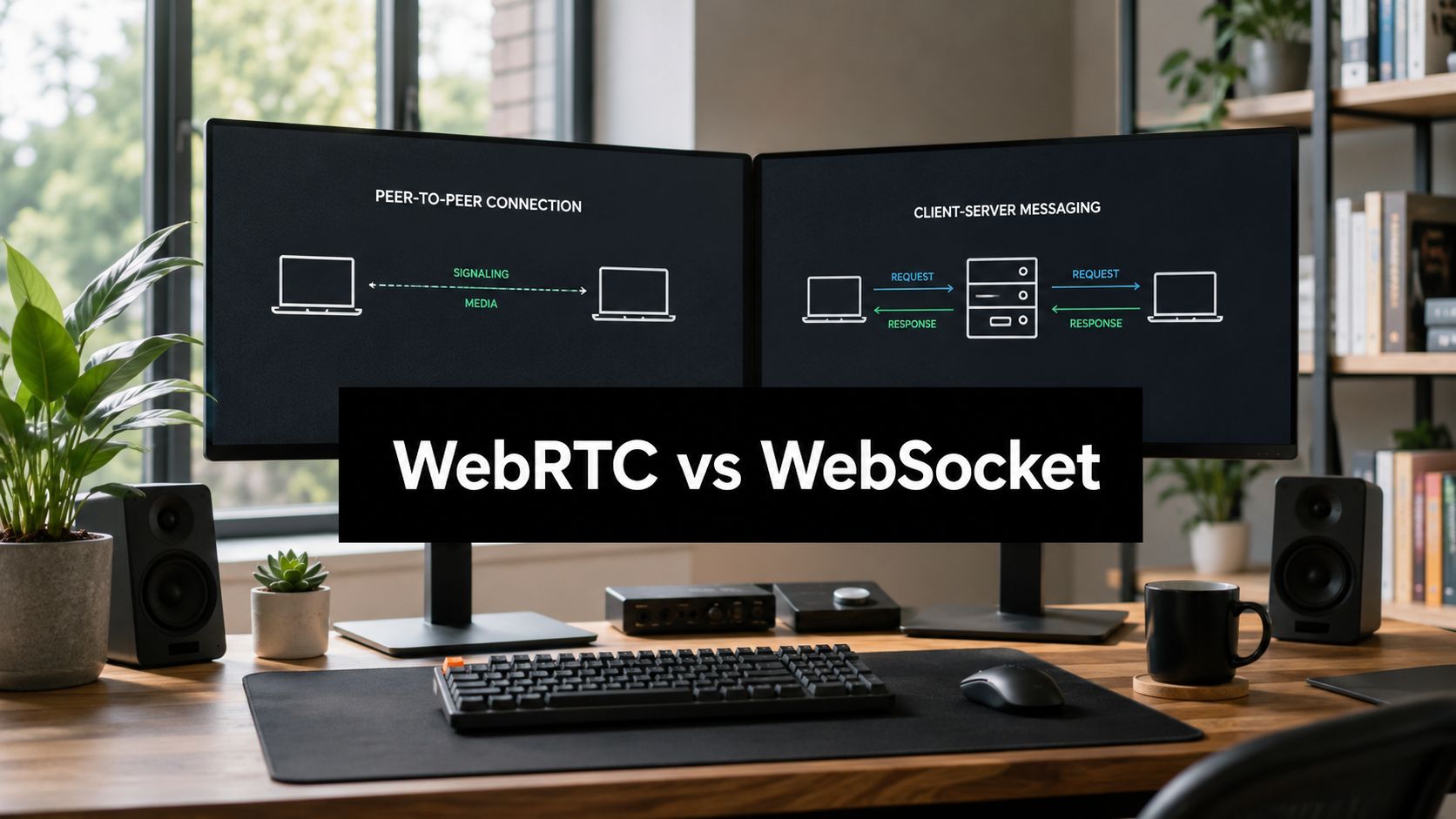
At a high level, WebSocket is a pipe. WebRTC is a communications stack.

What WebSocket is
WebSocket starts as HTTP, upgrades the connection, and then stays open so client and server can send messages in both directions without repeated request-response cycles. It was formally defined in RFC 6455 in 2011 and removes HTTP headers after the initial handshake, cutting bandwidth by up to 90% for frequent updates compared with polling, according to this WebSocket overview.
That matters because many real-time applications don't need a media engine. They need a stable messaging channel. Chat systems, live notifications, collaborative editing, and state propagation fit that model well.
Think of WebSocket as a dedicated lane between a browser and a service. The lane stays open, the server remains central, and every message passes through infrastructure you control.
What WebRTC is
WebRTC is broader. It enables direct real-time communication between endpoints for audio, video, and data. Its design centers on peer-to-peer exchange, especially for live media, where shaving off network hops matters.
That peer-to-peer goal creates a second layer of complexity. Browsers don't just “connect.” They have to discover how to reach each other across routers, NATs, and firewalls. That's where signaling and network traversal come in. If you need a clean primer on one of those traversal components, this explanation of what a STUN server does is a practical reference.
WebRTC isn't just “WebSocket, but faster.” It solves a different problem and carries a different setup burden because media delivery across consumer networks is hard.
The architectural split that matters
The foundational divide is simple:
- WebSocket is client-server
- WebRTC is peer-to-peer after setup, when network conditions allow
That one distinction drives most downstream engineering consequences:
- where bandwidth accumulates
- how failures surface
- whether the server is mandatory in the hot path
- how much synchronization logic the application has to build
If your team treats both as generic “real-time protocols,” you'll hide the most important design decision under the wrong abstraction.
Core Architectural and Protocol Differences
The protocol difference that matters most in practice is transport behavior. WebRTC and WebSocket aren't merely two APIs with different ergonomics. They sit on different assumptions about how data should move.

| Feature | WebRTC | WebSocket |
|---|---|---|
| Connection model | Peer-to-peer after signaling | Client-server |
| Primary role | Real-time audio, video, peer data | Real-time application messaging |
| Transport tendency | UDP-based media path | TCP-based message stream |
| Server role | Setup, traversal support, fallback infrastructure | Always in the path |
| Implementation complexity | Higher | Lower |
| Scalability shape | Media can bypass central relay in direct peer connections | Every message concentrates on server infrastructure |
Transport and delivery semantics
WebRTC's media delivery is built around UDP, which favors timeliness over perfect recovery. In live media, a late packet is often equivalent to a lost packet. The user cares more about hearing the next syllable on time than receiving the previous one after the moment has passed.
WebSocket runs on TCP. TCP guarantees ordered delivery and retransmission behavior that application teams rely on when message integrity matters. That's a strong default for stateful systems, but it's not ideal for conversational media where waiting for ordered recovery can make audio and video feel sluggish.
Connection model and infrastructure pressure
WebSocket is straightforward operationally because all traffic goes through your service. That's also its limitation. The server is not just coordinating the session. It is the session's data path.
WebRTC changes the shape of the system. Media can move directly between clients after signaling. For pure peer-to-peer applications, that architecture scales better than pushing all media through a centralized message broker because the stream doesn't automatically bottleneck at one relay point, as discussed in this breakdown of WebRTC signaling server architecture.
If the server must inspect, persist, or arbitrate every message, WebSocket aligns with the system model. If the server's main job is to help peers find each other and then get out of the way, WebRTC is the more natural fit.
Why WebRTC setup is harder
WebSocket setup is conceptually simple. Open a connection to a server and keep it alive.
WebRTC has to negotiate session details and solve network traversal. That means your architecture usually includes:
- Signaling to exchange offers, answers, and connection metadata
- STUN to help peers discover reachable addresses
- TURN when direct paths fail and relay becomes necessary
- ICE to evaluate candidate paths and select a workable route
Those moving parts aren't optional decoration. They exist because browsers live behind diverse network environments, and direct peer connectivity isn't guaranteed.
The hidden choice most teams miss
The choice isn't only protocol. It's where you want complexity to live.
With WebSocket, complexity tends to move into centralized backend scaling and message coordination. With WebRTC, complexity tends to move into connection establishment, NAT traversal, and media-aware session handling.
Neither is universally simpler. One is simpler for messaging systems. The other is simpler for real-time media systems, once you accept the setup machinery.
Performance Deep Dive Latency and Bandwidth
A product team ships a browser-based meeting app, sees acceptable average throughput in staging, and still gets complaints from users talking over each other on live calls. That gap usually comes from treating "real-time" as a single performance category. WebRTC and WebSocket behave differently under loss, jitter, and congestion, and those differences show up fastest in conversation.

Latency is an application architecture question
For chat, dashboards, collaborative state sync, and server-authoritative events, WebSocket latency is often good enough because the system values ordered delivery and centralized control. For live audio and video, the tolerance is lower. A conversational app is judged by turn-taking, interruption recovery, and whether participants can respond without hesitating.
That is why the protocol choice is rarely either-or in production systems. Most meeting platforms use WebSockets for signaling, presence, and control-plane events, then switch to WebRTC for the media plane. The two protocols solve different latency problems inside the same product.
Why media feels faster on WebRTC
WebRTC is built to protect timeliness first. It can drop late packets, adapt bitrate, and keep audio flowing even when the network is uneven. WebSocket runs over TCP, so lost packets must be retransmitted and delivered in order before later data is released to the application. That behavior is useful for correctness. It is often costly for speech and video, where an old packet can be less valuable than the next one.
The result is not just a lower number on a benchmark chart. It changes user behavior. If transport delay rises, people pause more, interrupt more often, and start compensating for the system. In a meeting product, that reduces perceived quality long before the connection fully fails.
A useful way to frame it is by transport semantics. Teams that need a refresher on how ordering, retransmission, and congestion handling affect user experience can review this summary of transport layer protocols.
Bandwidth concentration matters as much as raw bandwidth
Bandwidth planning is not only about how many megabits each participant sends. It is also about where traffic aggregates.
With a WebSocket design, application traffic stays pinned to the server path by definition. That is a good fit when the server must inspect every message, persist it, or broadcast it to many recipients. With WebRTC, media may flow directly between peers or through media infrastructure such as TURN relays and SFUs, depending on topology and network constraints. That can reduce avoidable backhaul on direct paths, but it also introduces a harder capacity-planning problem because relay usage spikes under restrictive NATs, corporate firewalls, and mobile networks.
This is the practical conclusion many teams miss. WebSocket can look simpler until media scale pushes bandwidth and packet timing issues into the application. WebRTC can look more complex up front, but that complexity exists to keep interactive media usable on imperfect networks.
CPU and debugging implications
CPU cost follows the same pattern. A system that carries media over a transport designed for generic message delivery often pushes more buffering, retry handling, and timing recovery into application code. WebRTC shifts more of that work into browser and media-stack primitives, which is one reason it is the default choice for live calling products.
When performance degrades, measure the network before blaming the protocol. These essential tools for network troubleshooting help isolate whether the issue is congestion, packet loss, relay fallback, or server path saturation.
Use WebSocket where correctness, ordering, and server coordination define the product. Use WebRTC where human conversation is the product. In most real systems, you need both.
Comparing Media Handling and Data Channels
A product team can get surprisingly far with a single persistent socket. Chat works. Presence works. Basic event streaming works. The design usually breaks at the point where users expect conversation quality, because audio and video are not just payloads. They are time-sensitive streams with loss, jitter, and synchronization requirements.
WebRTC is built around media behavior
WebRTC carries media with transport and control mechanisms designed for live audio and video. That includes RTP for packetized media, RTCP for feedback, jitter buffering, and codec negotiation. Browser implementations also expose features such as acoustic echo cancellation, noise suppression, and bandwidth adaptation. Those are not minor conveniences. They remove a large class of application-layer work that teams otherwise have to build and tune themselves.
For interactive multimodal systems, sync matters as much as throughput. Stream's analysis of audio-video sync trade-offs explains why native timestamps and clock coordination make WebRTC a better fit for lip-sync and conversational continuity than a generic message pipe.
That difference changes architecture. If the product is a meeting, call, interview, or telehealth session, media handling is a core system concern, not an edge feature.
WebSocket is generic by design
WebSocket gives you an ordered, reliable channel between client and server. That is exactly why it works well for signaling, state updates, chat messages, and server-authoritative workflows. The protocol does not model media clocks, packet loss recovery for real-time playout, or stream synchronization. If you send media over WebSocket, your application has to define those behaviors.
Some systems do that on purpose. Cloud rendering pipelines, AI transcription gateways, and recording services may choose WebSocket because every message must traverse infrastructure the server controls. The trade-off is that buffering, retransmission policy, and A/V alignment move into application code and server logic.
WebRTC data channels solve a different problem
WebRTC also carries non-media data through SCTP over DTLS. That often leads teams to ask whether WebSocket can be removed entirely. In practice, the answer depends on who needs to observe the data and what guarantees the application requires.
Ably's architectural comparison of WebRTC and WebSocket notes that WebRTC data channels can be configured for ordered or unordered delivery, with or without retransmissions. That flexibility is useful for game state, cursor positions, live annotations, and other peer data where freshness matters more than perfect recovery. It is a weaker fit for workflows where the backend must validate, persist, or sequence each event before clients act on it.
A simple rule helps:
- Use WebRTC media channels for voice and video, where late packets are often worse than lost packets.
- Use WebRTC data channels for peer-to-peer data that benefits from low latency and can tolerate application-specific delivery trade-offs.
- Use WebSocket for signaling and for server-visible state transitions, especially when auditability, authorization, or persistence is part of the requirement.
The hybrid pattern is not a compromise. It is usually the cleanest design. WebSocket establishes session state and keeps the server in control of coordination. WebRTC carries media, and sometimes fast peer data, on a path designed for live interaction.
The practical question is not whether both protocols can send bytes. It is whether the data needs media timing semantics, peer delivery semantics, or server-authoritative semantics.
Real-World Use Cases and Hybrid Architectures
In production systems, protocol choice usually follows the shape of the user interaction.
If the interaction is a server-governed stream of events, WebSocket is a natural fit. Presence updates, notification feeds, collaborative document operations, and live dashboards all benefit from a persistent channel where the backend remains authoritative. The server can inspect every message, apply business rules, and broadcast the result.
If the interaction is live human conversation, WebRTC maps more cleanly to the problem. Browser-based meetings, voice calls, and direct media exchange need a delivery path built around timing and responsiveness rather than strict ordered recovery.

Where hybrid architectures become mandatory
The important architectural reality is that many serious applications use both. The most nuanced version of the WebRTC vs WebSocket decision is not choosing one over the other. It's assigning each protocol the job it does best.
A common production pattern looks like this:
- WebSocket handles signaling. Browsers exchange session metadata, join events, participant presence, and setup messages through a persistent server connection.
- WebRTC handles media. Once peers have enough information to establish connectivity, audio and video move through the media path rather than through the same centralized messaging channel.
- Fallback logic stays server-aware. If direct peer connectivity fails because of NAT or firewall conditions, the system still needs a controlled way to recover.
That fallback point matters more than many diagrams admit. As noted earlier in the architectural comparison, hybrid designs are often necessary because WebSockets remain important for signaling and can still support fallback paths when direct media establishment runs into hostile network environments.
What this means in an enterprise conferencing stack
In a conferencing platform, signaling and media have different operational needs.
Signaling wants durability, predictable routing, and backend visibility. Media wants low delay, synchronization awareness, and a path that avoids unnecessary intermediaries. Combining those into one protocol usually means compromising one side of the system.
That's why hybrid architecture is less a clever pattern and more a practical separation of concerns. In enterprise deployments, products such as AONMeetings use browser-based real-time communication with a signaling layer because the application has to coordinate sessions and deliver live media at the same time. Those are different jobs.
Making the Right Choice for Your Project
Teams can make the right call by answering three questions.
Start with the user-visible failure
Ask what hurts more when things go wrong.
If users hate robotic turn-taking, broken lip-sync, or delayed speech, your critical path is media. Choose WebRTC first.
If users hate stale state, missing events, or inconsistent shared data, your critical path is message integrity. Choose WebSocket first.
Then decide where authority should live
Use WebSocket when the server must remain the source of truth. That includes moderation state, transactional workflows, collaborative edits, and any workflow where every update should pass through policy and persistence.
Use WebRTC when endpoints should exchange media directly after setup and the server's role is coordination rather than constant relay.
Finally, assume hybrid until proven otherwise
For meeting platforms, telehealth products, remote training tools, and browser collaboration suites, the default answer is often both.
- WebRTC for audio, video, and timing-sensitive exchange
- WebSocket for signaling, presence, chat, orchestration, and fallback control
That isn't architectural indecision. It's a cleaner system boundary.
The best design usually comes from refusing to force one protocol into the other's job. Use the message channel for control. Use the media channel for conversation. Your infrastructure will be easier to reason about, and your failure modes will line up with the user experience you're trying to protect.
If you're evaluating how to put that hybrid model into production, AONMeetings is a browser-based option that combines WebRTC-based conferencing with the signaling and session-control components enterprise teams need for secure, scalable collaboration.