Your sales lead is in Chicago. Your support manager is at home in Dallas. A founder is traveling, taking investor calls from an airport lounge. Customers still expect one polished business presence, not a patchwork of personal cell numbers, missed calls, and voicemail confusion.
That's the communications problem many companies are trying to solve right now. The old model assumed people sat near the same desk phone every day. Modern businesses don't work that way. Teams move, roles change, offices shrink, and customer conversations happen across laptops, mobile apps, and browsers.
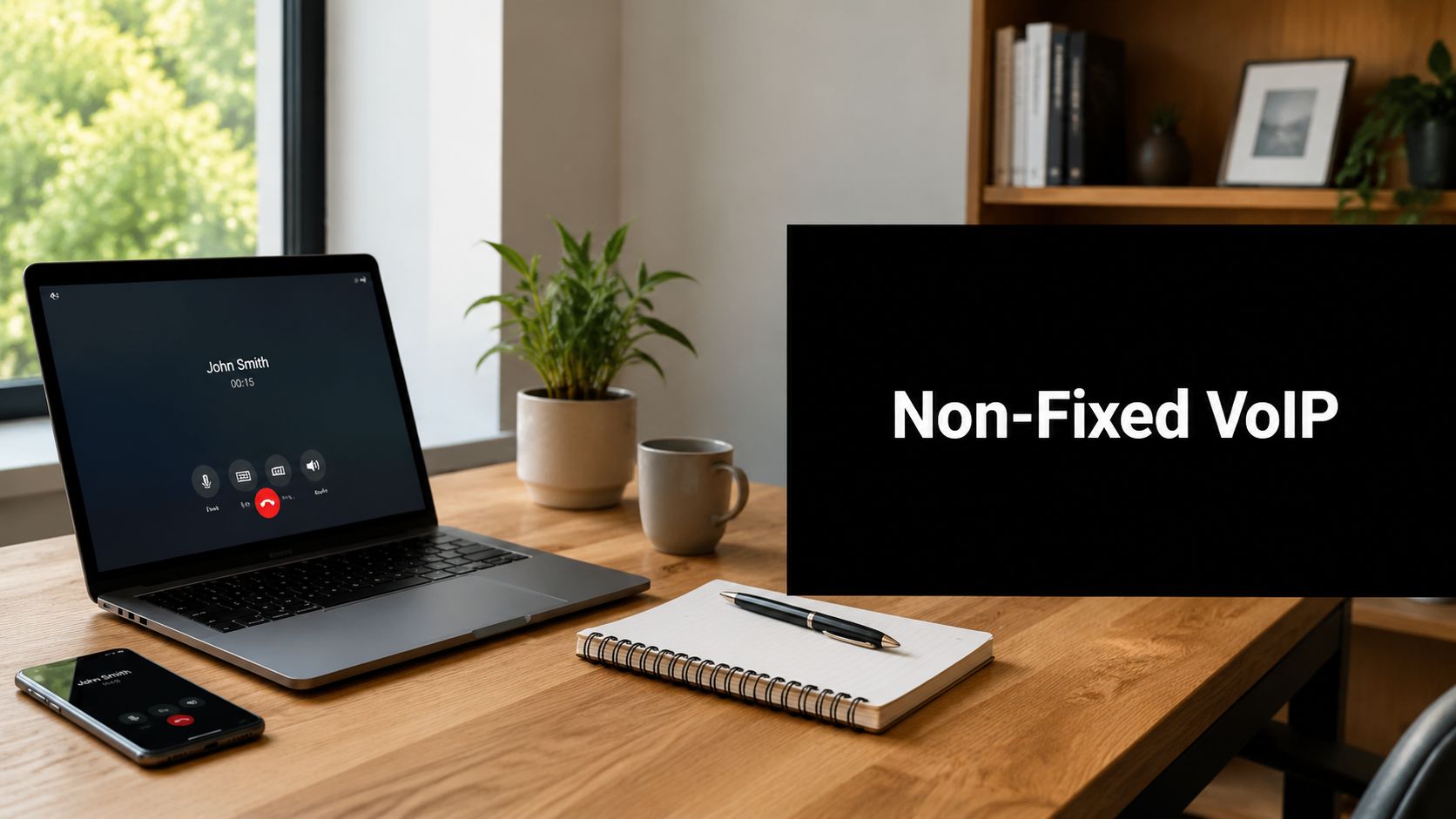
Non-Fixed VoIP sits at the center of that shift. It gives organizations a phone presence that isn't anchored to one building, while still letting calls flow through a structured business system. For remote teams, multi-location firms, and compliance-heavy organizations, that flexibility can be a strategic advantage. It can also create technical and regulatory questions that buyers need to understand before they deploy it.
The End of the Desk Phone Era
For years, business telephony followed the logic of the office floor plan. You leased lines, installed hardware, assigned extensions, and expected people to answer from a known location. That setup made sense when work happened in one place.
It breaks down fast when your company doesn't.
A small business might need a local number in one city, remote coverage in another, and the ability to transfer a call from a smartphone to a meeting platform without making the customer repeat themselves. A larger enterprise might need one voice system for recruiters, account managers, legal staff, and field employees who rarely set foot in headquarters.
That's why internet-based calling moved from “alternative” to standard infrastructure. The global VoIP market reached $176 billion in 2025 and is projected to reach $389 billion by 2034, reflecting a 10.4% CAGR, according to this VoIP market overview. The same source says U.S. interconnected VoIP subscriptions reached 64.5 million by mid-2024, compared with 18 million switched access lines. That gap tells you where business voice has already gone.
Practical rule: If your people work in more than one place, your phone system shouldn't depend on one place.
The strategic question isn't whether internet voice is real enough for business use. It is. The better question is which kind of internet voice matches your operating model.
Why the shift matters
Traditional phone systems were built around location. Modern communications are built around identity, access, and routing. That changes how companies think about phone numbers, call handling, compliance, and even customer trust.
If you need a baseline on how internet calling works before going deeper, this short explainer on what VoIP service is is useful context.
What business leaders are really buying
Most organizations aren't just buying dial tone. They're buying:
- Continuity: Calls reach the right person even when staff are remote or traveling.
- Flexibility: Admins can assign or reassign numbers without rebuilding office infrastructure.
- Consistency: Customers see one business identity instead of a maze of personal contact methods.
- Scalability: New teams can be added without treating every expansion like a construction project.
Non fixed VoIP is one of the clearest expressions of that shift.
Understanding Non-Fixed vs Fixed VoIP
The easiest way to understand the difference is this.
Fixed VoIP is like a street address. It points to a specific place.
Non-Fixed VoIP is like a P.O. box with forwarding rules. You still receive what's meant for you, but you aren't tied to one building to access it.
That analogy isn't perfect, but it helps. A fixed VoIP line is generally linked to a business or residential address. A non-fixed VoIP number is cloud-provisioned and not tied to a verified physical address. It routes calls over the internet and can be used by remote teams and organizations across different geographies, as explained in Voiso's overview of non-fixed VoIP numbers.

The core distinction
With fixed VoIP, the provider treats the number as belonging to a known physical location. That matters for operational reasons, especially where location-based services are involved.
With non fixed VoIP, the system treats the number as a cloud resource. The user, not the building, is the anchor point. A sales rep can answer from a laptop at home. A manager can log in while traveling. A distributed support team can share one business identity without sitting in one office.
That's why people often call non-fixed numbers virtual phone numbers.
Fixed VoIP vs Non-Fixed VoIP at a Glance
| Attribute | Fixed VoIP | Non-Fixed VoIP (Nomadic) |
|---|---|---|
| Location relationship | Linked to a specific registered location | Not tied to a verified physical address |
| Provisioning model | Address-based setup | Cloud-provisioned |
| User mobility | Best for one office or home location | Best for users who work from different places |
| Business fit | Stable, location-centered operations | Remote teams, multi-market businesses, flexible staffing |
| Emergency calling behavior | Better aligned to a known service address | Requires extra attention to location handling |
| Common description | Office or site-based VoIP | Virtual or nomadic VoIP |
Where buyers get confused
Some people hear “virtual number” and assume it means less professional. That's the wrong frame. The better frame is mobility versus location certainty.
A law office with one permanent location may prefer the predictability of fixed VoIP for its front desk lines. A distributed consulting firm may care more about routing calls to whichever partner is available. Neither approach is universally better. The fit depends on the way your business works.
For companies comparing setups in practical terms, this review of small business VoIP system options from IT Cloud Global can help clarify what features matter once you move from concept to vendor selection.
Non fixed VoIP isn't “internet calling without structure.” It's structured business telephony designed for organizations that don't want their phone system trapped inside one address.
Navigating Emergency Services and Regulations
This is the point where many buyers pause, and they should.
The same flexibility that makes non fixed VoIP attractive also creates a serious tradeoff. If a number lacks an essential link to a fixed service address, emergency systems can't assume where the caller is. That can affect routing, dispatch, and the speed at which first responders confirm location.
A provider-focused explanation from Dialpad's non-fixed VoIP guide notes that emergency services such as 911 may not work reliably without extra configuration because the system lacks a default registered address.

Why location becomes a problem
A desk phone in a fixed office tells a simple story. The line belongs to that office. If someone calls emergency services, the system has a known place to associate with the number.
A non fixed VoIP user could be anywhere with internet access. Today they might be in a branch office. Tomorrow they might be working from home. Next week they might be in a hotel. If the platform doesn't have accurate location handling, the emergency call process becomes less certain.
That's why compliance-sensitive organizations should treat emergency calling as a deployment requirement, not a side feature.
Questions to ask any provider
Before rollout, ask direct operational questions:
How is emergency calling configured for nomadic users?
You want a concrete answer, not marketing language.Can admins manage and update user locations?
If addresses change, the system should support that reality.What happens when a user calls from an unregistered location?
The answer reveals how mature the provider's safeguards are.How are mobile, browser, and softphone users handled?
Emergency behavior may differ by endpoint.What user training is required?
Technology alone won't solve a process problem.
A non fixed VoIP deployment is incomplete until emergency calling behavior is documented, tested, and understood by both admins and end users.
What regulated organizations should do
Healthcare groups, legal firms, financial organizations, schools, and public-facing businesses should formalize this in policy. At a minimum:
- Maintain address records: Keep current work locations for staff who place business calls.
- Set role-based rules: Front desk, clinical, legal intake, and mobile staff may need different calling policies.
- Test before launch: Don't assume the provider default matches your compliance needs.
- Train employees: Staff should know what to expect if they place an emergency call from a browser, mobile app, or laptop.
The most common mistake is thinking “internet phone” and “office phone” behave the same in every scenario. They don't. Non fixed VoIP can be safe and workable, but only when the organization handles location responsibility deliberately.
Key Security and Compliance Frameworks
Emergency calling is about physical safety. Security is about data, identity, and control.
Business leaders sometimes evaluate non fixed VoIP mainly on convenience. That's understandable, but incomplete. Once calls involve patient discussions, legal matters, financial conversations, or internal strategy, the phone system becomes part of your risk surface.
The three layers that matter most
The first layer is signaling security. This protects the setup and management of a call, including how sessions are initiated and controlled.
The second is media protection. This is about the voice content itself. If conversations contain sensitive information, the organization should understand how the provider protects audio in transit and, where relevant, in related recordings or stored artifacts.
The third is access control. Admin rights, user permissions, device management, and account recovery policies often matter as much as encryption. A well-encrypted platform can still create exposure if too many people can access call logs, recordings, transcripts, or routing settings.
Compliance isn't one-size-fits-all
A healthcare practice has different obligations than a recruiting agency. A law firm has different confidentiality expectations than a retail support team. The communication stack should reflect that.
For organizations handling regulated financial data, this guide to GLBA compliance is a good reference point for understanding how communications oversight connects to broader security monitoring and governance.
If your evaluation includes secure communications more broadly, it also helps to understand what end-to-end encryption means and where it fits into business collaboration tools.
What to verify before approval
Use a practical review lens:
- Encryption coverage: Ask what parts of the call flow are encrypted and under what conditions.
- Administrative controls: Review role-based permissions, user provisioning, and audit visibility.
- Data handling: Understand where call-related data is stored and who can access it.
- Policy alignment: Match platform settings to your industry rules, retention requirements, and internal workflows.
- Incident response: Ask how the provider handles misuse, account compromise, and support escalation.
Security for non fixed VoIP isn't a single feature. It's the combination of protected transport, disciplined access, and policies that fit your industry.
A small startup may accept a lighter governance model. A hospital group, law office, or financial firm usually can't. The right question isn't “Is this VoIP secure?” The right question is “Is this implementation secure enough for the data, users, and obligations involved?”
Practical Use Cases Across Industries
The value of non fixed VoIP becomes clearer when you stop thinking about “phone service” and start thinking about workflows.

Small business with a multi-city presence
A growing home services company wants to look local in several markets without opening a fully staffed office in each one. With non fixed VoIP, the business can manage customer-facing numbers through a centralized system while routing calls to the right dispatcher or sales rep wherever they're working.
The strategic benefit isn't just convenience. It's brand consistency. Customers dial what feels like a local business line, while the company handles calls through one operating model.
Remote-first software team
A software company hires talent across states or countries. Engineers, support staff, and account managers don't share one office, but leadership still wants a unified phone presence for prospects and customers.
In that setup, non fixed VoIP lets the company assign business numbers to roles and people rather than desks. A support lead can answer from a laptop. A sales rep can take the same business line on a phone app while traveling. Managers can reassign coverage without rewiring an office.
Healthcare and telehealth coordination
A healthcare organization may need staff to make and receive business calls from clinics, home offices, or remote care environments. The attraction of non fixed VoIP is clear. Staff mobility improves, and patient communication can follow the provider rather than the room.
But healthcare teams also need strict process discipline. They have to pair flexibility with security controls, emergency calling procedures, and policies around where sensitive conversations can happen.
Legal and advisory firms
Attorneys and advisors often work across court appearances, client offices, home offices, and travel schedules. They need to preserve professional identity without exposing personal mobile numbers.
Non fixed VoIP gives them that separation. A client sees the firm's business number, while the professional can answer from different approved devices. That helps confidentiality, continuity, and handoffs when assistants or colleagues need to cover communications.
For many firms, the biggest win is separation. Personal devices can still be used, but the business identity stays inside the business system.
Education and student support
Schools, training organizations, and student support teams often need reachable staff without requiring every administrator to sit in the same building all day. Advising, admissions, counseling intake, and departmental coordination all benefit from numbers that follow the role rather than the desk.
That flexibility is especially useful during seasonal shifts, hybrid operations, and distributed support models.
A Checklist for Implementing Non-Fixed VoIP
A successful rollout usually has less to do with buying the “best” platform and more to do with making disciplined decisions before launch.
Start with operating reality
Map how your people work.
Do they answer from one office, from home, from mobile devices, or from several environments in the same week? Which teams need direct inward numbers? Which groups need shared lines, queues, or front-door routing? If you skip this step, you'll end up forcing old assumptions onto a new system.
Create a short inventory that includes:
- User types: Front desk staff, sales reps, clinicians, attorneys, managers, field staff.
- Call patterns: Inbound support, outbound sales, appointment reminders, internal collaboration.
- Device mix: Browser, desktop, mobile app, physical handset, or a blend.
- Risk profile: Public-facing calls, sensitive conversations, regulated communications.
Vet providers with uncomfortable questions
Many evaluations stall because buyers compare feature lists instead of operating details.
Ask the provider how non fixed numbers are provisioned, how they handle emergency calling for mobile or browser users, what administrative controls are available, and what happens when an employee changes locations or leaves the company. If the answers are vague, your future support burden won't be.
Use a comparison framework, not a product demo glow. This guide for comparing VoIP service providers is a practical starting point.
Build policy before deployment
Technology should follow policy, not the other way around.
Define which staff can use personal devices, whether business calls can be recorded, how numbers are reassigned, how caller identity is managed, and who owns address updates for emergency configuration. In regulated industries, involve legal, compliance, or security reviewers before rollout rather than after an issue appears.
Design the full communication path
Phone calls rarely stay phone calls.
A sales inquiry may need to become a scheduled video meeting. A patient intake call may need secure follow-up. A support conversation may need screen sharing. That's why many organizations no longer treat voice as a standalone tool. They design a broader communications stack that includes calling, messaging, and browser-based meetings.
This visual shows how that kind of handoff fits into a modern workflow.

A browser-based platform can be useful here because it removes the friction of software installs for guests, clients, patients, or external partners. That matters when a voice conversation needs to escalate quickly into a secure face-to-face interaction.
Run a controlled rollout
Don't start with the whole company. Start with a contained group whose workflows represent the broader business.
Good pilot groups often include one admin-heavy function, one customer-facing team, and one mobile-heavy role. Watch how call routing works in practice. Test reassignment. Test escalation paths. Test onboarding and offboarding. Test what users do when they're away from their normal location.
Train for behavior, not just buttons
Users need more than a login and a quick demo.
They should know:
- Which number to use for business calls
- How to move between approved devices
- What to do if they're working from a new location
- How emergency calling works in their setup
- When to escalate from voice to a more secure meeting format
The cleanest deployment is the one employees can explain back to you in plain language. If they can't, the rollout isn't finished.
Is Non-Fixed VoIP Right for Your Business?
Non fixed VoIP makes the most sense when your organization values mobility, distributed work, faster provisioning, and a business identity that isn't trapped inside one office. It's a strong fit for remote teams, multi-location operations, mobile professionals, and companies that need to scale communications without rebuilding infrastructure every time roles change.
It's not a free pass to ignore operational discipline.
You need clear answers on emergency calling, user location management, security controls, access rights, and how sensitive communications move across your broader collaboration stack. For compliance-heavy industries, those questions matter as much as call quality or pricing.
The strategic upside is real. Non fixed VoIP lets companies align telephony with the way people work now. That means communication follows users, not desks. It also means leaders can build systems around workflows, not floor plans.
For many businesses, that's the core transition. They aren't replacing a phone line with another phone line. They're replacing a location-bound communications model with a flexible one that supports remote work, cross-functional collaboration, and more modern customer interactions.
The future of business communication will keep moving toward integrated, internet-based tools that combine voice, video, messaging, and access control. Non fixed VoIP is one of the clearest building blocks in that direction.
If you're evaluating a broader communications stack, AONMeetings is worth a look for browser-based video meetings, webinars, and secure collaboration. It fits organizations that want flexible communications without forcing participants to install software, and it's especially relevant for healthcare, legal, education, and business teams that need strong security controls alongside a modern user experience.