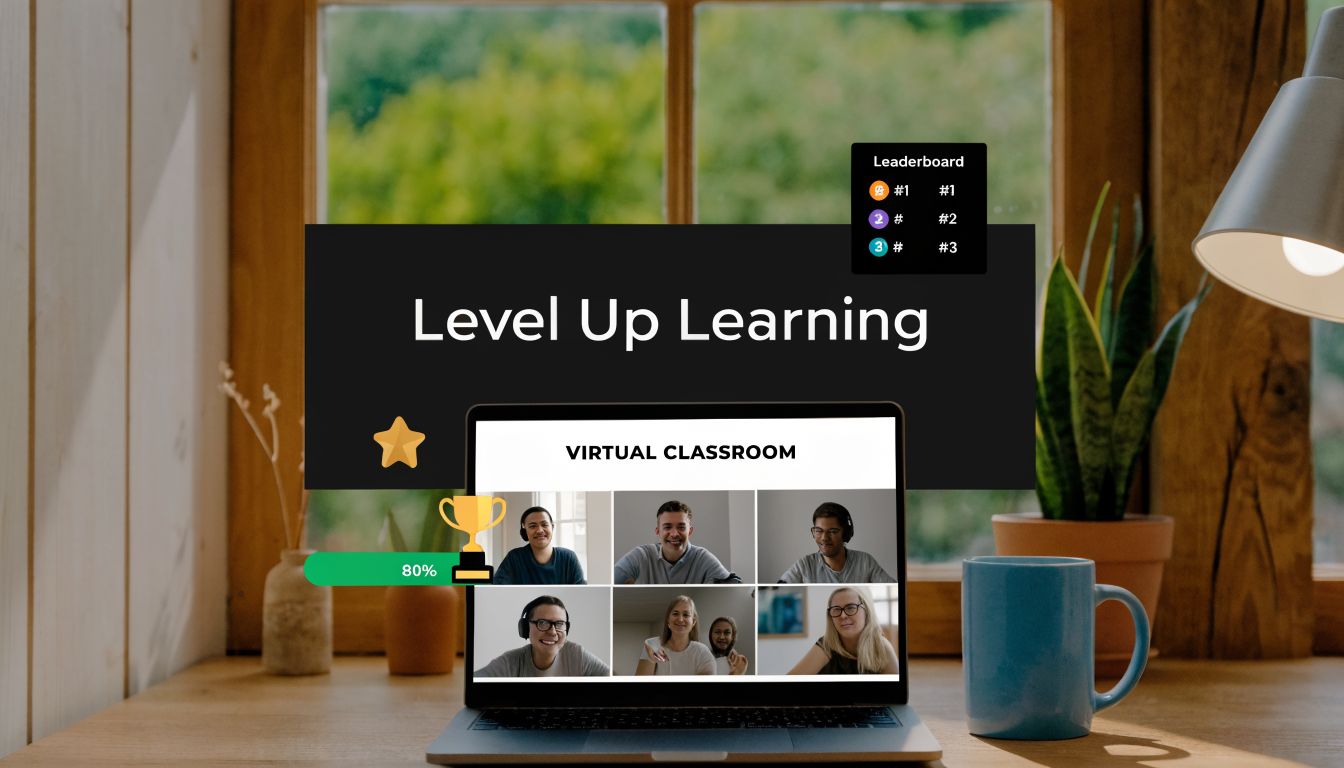
Gamified e-learning can reach a 90% completion rate, compared with 25% for non-gamified programs according to Wooclap’s roundup of e-learning statistics. That single comparison changes the conversation. Gamification e learning isn't a decorative layer. It's a design choice that can affect whether people finish training, remember it, and use it later.
Most discussions stop at badges, points, and leaderboards. That’s too narrow. In practice, the harder question is this: how do you make gamification work in live webinars, virtual workshops, and video-based classes where the instructor has one shot to hold attention in real time?
That’s where many teams struggle. They understand the theory, but they need a workable model for synchronous learning. They need to know which mechanics fit a live session, which ones distract, and how to design activity without turning a serious topic into a gimmick.
What Is Gamification in E-Learning and Why It Matters
The business case is no longer theoretical. The global EdTech gamification market is projected to grow sharply over the next decade, and 89% of educators report higher engagement with gamified tools according to Market.us coverage of the EdTech gamification market. For L&D leaders, that matters because engagement is not a side metric in digital learning. It affects attendance, participation, completion, and whether learners apply what they practiced after the session ends.
Gamification is not the same as game-based learning
A clear definition prevents poor design decisions.
Gamification adds game elements to a learning experience that is still a course, webinar, workshop, or training session. The content stays intact. What changes is the structure around it: progress markers, challenge, feedback, recognition, time-bound tasks, and visible signs of advancement.
Game-based learning teaches through an actual game or simulated game environment.
That distinction matters most in live learning. Many managers hear "gamification" and picture cartoon badges pasted onto serious training. In practice, synchronous gamification works more like good facilitation with stronger signals. It tells learners where they are, what to do next, and why the next action matters, especially in webinars and video sessions where attention can drift quickly.
The primary point is behavior, not entertainment
Good gamification is a behavior design tool. It helps instructors shape actions that support learning.
In e-learning, that often means helping people start on time, respond to prompts, contribute in chat, answer scenario questions, work through a case, or stay engaged long enough to complete a sequence of tasks. In a live virtual class, those small behaviors matter because they are the online equivalent of eye contact, note-taking, and discussion in a physical room.
A useful way to judge any game mechanic is simple: if it does not support a learning behavior you want to see, it does not belong.
That principle applies across age groups. If you're working in K-12 or family learning contexts, this explanation of how gamification aids child development is useful because it connects engagement mechanics to developmental needs rather than novelty.
Why this matters more in virtual learning
Virtual learning removes many of the cues instructors normally rely on. In a classroom, learners pick up momentum from nearby peers, room energy, and the instructor’s physical presence. In a webinar, those cues are weaker or missing, so the design has to carry more of the motivational load.
That is why gamification deserves special attention in synchronous formats, not just self-paced modules. A live poll can create immediate commitment. A team challenge in breakout rooms can turn passive attendees into contributors. A visible progress bar across a 60-minute workshop can reduce drop-off because learners can see the path, not just the clock.
For teams still defining delivery models, it helps to start with a shared understanding of virtual learning environments and formats before choosing which gamified elements fit a webinar, virtual workshop, or instructor-led online class.
Used well, gamification gives digital learning a structure that many live online sessions lack. It turns abstract goals like "keep people engaged" into concrete design choices that can be planned, facilitated, and improved.
The Science of Motivation How Gamification Boosts Learning
In a live online session, motivation is less about entertainment and more about attention management. Learners are making constant decisions in real time. Should I answer the prompt, stay quiet, check email, or wait for someone else to respond? Gamification helps instructors shape those moments so participation feels clear, achievable, and socially meaningful.

A useful way to understand this is through three learner needs that show up strongly in webinars, virtual workshops, and instructor-led video sessions.
- Autonomy: learners need room to choose how they contribute
- Competence: learners need evidence that they are making progress
- Relatedness: learners need to feel that their presence matters to other people in the session
These are familiar ideas in motivation research, but they become especially practical in synchronous learning because the instructor has only a short window to influence attention. In a self-paced module, a learner can pause and return later. In a live class, confusion and disengagement spread quickly. If the activity structure is weak, cameras go off, chat goes quiet, and breakout rooms produce very little.
Autonomy in a live session does not mean unlimited freedom. It works more like good facilitation in a workshop. People stay involved when they can choose between two case examples, pick a role in a team challenge, or decide whether to answer by chat, poll, or microphone. Small choices reduce the feeling of being talked at.
Competence depends on tight feedback loops. A learner who answers a poll, solves a timed scenario, or earns credit for a useful chat response gets immediate confirmation that effort led to an outcome. That matters in webinars because delayed feedback is weak feedback. If participants have to wait until a final quiz or post-session email to learn whether they understood the material, attention often fades long before then.
Relatedness is the piece many gamification discussions underplay. In live learning, social connection is not a bonus feature. It keeps energy in the room. Team scoreboards, shared progress toward a session goal, peer voting on ideas, and recognition for strong contributions all signal that participation is visible. The same principles behind why some virtual meetings feel more engaging than others apply here. People engage more when the session gives them a clear role in a shared activity.
This is one reason classroom-tested participation tactics still matter online. Educators looking at strategies for boosting student participation in class will recognize the pattern. Prompting, acknowledgment, low-risk contribution, and visible progress all help learners speak up. Gamification gives those patterns more structure in digital settings.
The practical lesson is straightforward. Game mechanics do not boost learning because points or badges have special power on their own. They work when they answer three questions quickly: What should I do now? How am I doing? Why should I stay involved for the next step?
That is why short challenge cycles work well in synchronous formats. A 60-minute webinar can be designed as a series of small wins: predict, respond, compare, discuss, apply. The rhythm is similar to good coaching. Learners act, get feedback, adjust, and try again while the content is still fresh.
Poorly designed gamification creates the opposite effect. If rewards feel random, learners stop trusting them. If competition is too public, quieter participants withdraw. If the challenge is too easy, the activity feels childish. If it is too hard, people wait for stronger peers to take over.
Strong motivational design keeps the difficulty within reach and makes progress visible. In practice, that usually means short activities, clear success criteria, feedback during the session, and social recognition that encourages contribution rather than embarrassment.
Gamification supports learning best in live digital environments when it helps learners feel oriented, capable, and connected while the session is happening, not after it ends.
Essential Gamification Mechanics and UX Patterns for Engagement
Many teams jump straight to tools. They ask whether they need badges, quizzes, or a leaderboard. A better starting point is the design stack behind those visible elements.

Think in three layers
A practical way to design gamification e learning is to separate dynamics, mechanics, and components.
- Dynamics are the big drivers. Progress, competition, collaboration, mastery, curiosity, status.
- Mechanics are the processes that produce those feelings. Challenges, rules, feedback loops, levels, timed activities, gaining access to content.
- Components are the visible pieces learners interact with. Points, badges, leaderboards, progress bars, avatars, quest cards.
This prevents a common design failure. Teams often install components without choosing the dynamic they want. They add a leaderboard because it seems standard, then discover it creates pressure in a course that really needed collaboration.
What the common mechanics are actually for
According to Redwerk’s discussion of gamification techniques and the FRAGGLE framework, a study integrating points, badges, and leaderboards found that learners achieved higher retention rates than with traditional methods. That gives us support for using familiar mechanics, but only when they match the learning goal.
Here’s a practical comparison.
| Mechanic | Primary Purpose | Best For | Consideration |
|---|---|---|---|
| Points | Show immediate feedback and effort | Short tasks, polls, quizzes, participation prompts | Points without meaning become noise |
| Badges | Mark achievement or milestone completion | Course completion, skill demonstration, streaks | Too many badges reduce perceived value |
| Leaderboards | Make performance visible | Sales training, optional competitions, team games | Public ranking can demotivate some learners |
| Progress bars | Show advancement toward completion | Multi-module courses, onboarding, certification paths | Must reflect real progress, not cosmetic activity |
| Quests or challenges | Organize learning into missions | Scenario work, live workshops, role-based training | Challenge wording must be clear and specific |
| Levels | Signal increasing difficulty or mastery | Progressive curricula, compliance pathways, skills labs | Poor sequencing makes levels feel arbitrary |
| Narrative | Add context and purpose | Simulations, onboarding, customer service, diplomacy exercises | Story should support the content, not overshadow it |
UX patterns that work in webinars and live classes
Synchronous learning adds a useful constraint. You can't rely on long-term automation alone. The interface and facilitation have to work together.
Good live-session UX patterns include:
- Visible session milestones: learners can see where they are in the experience
- Short interaction bursts: a poll, challenge, or prompt every few minutes
- Team scoring instead of individual ranking: this lowers pressure while preserving energy
- Recognition in multiple forms: chat shout-outs, badges, recap slides, or follow-up certificates
- Shared problem boards: whiteboards or collaborative documents where progress is public
If you're designing for active virtual classes, these tactics align well with practical methods for using polls and breakout rooms effectively in learning.
Use FRAGGLE to avoid random design
Redwerk also describes the FRAGGLE framework, which breaks implementation into four phases: Declaration, Creation, Execution, Learning. I like it because it forces discipline.
A simple application looks like this:
Declaration
Define the problem first. Are learners dropping out, staying silent, rushing through content, or failing to apply skills?Creation
Choose players, triggers, rewards, stages, and rules. At this stage, you determine whether your design needs collaboration, mastery, competition, or reflection.Execution
Run the activity and collect what learners do. Track participation patterns, missed challenges, common errors, and drop-off points.Learning
Review the data and redesign. If the leaderboard discouraged half the group, replace it. If a scenario task sparked discussion, expand it.
The best gamification plans don't start with rewards. They start with friction.
For instructors who want more ideas for boosting student participation in class, this roundup of student engagement strategies for elementary settings is useful because many of the participation principles scale surprisingly well into digital environments.
How to Implement Gamification in Your E-Learning Programs
What's often needed isn't more theory, but a build plan. The easiest way to approach gamification e learning is to separate asynchronous design from synchronous design because they solve different problems.

Workflow for asynchronous courses
In an LMS or self-paced course, the main challenge is persistence. Learners have to return on their own, track their own momentum, and complete modules without a live facilitator pushing them forward.
A strong implementation usually includes these moves.
Start with a learning map
Turn the course outline into a visible path. Modules become levels, milestones, or missions. Learners should know what they’ve completed and what becomes available next.
That map does two jobs. It reduces ambiguity, and it turns course progression into something people can monitor at a glance.
Rework assessments into challenge moments
Instead of one large test at the end, use smaller checkpoints. Each one should confirm a specific skill or concept.
You don't need to make every quiz playful. You do need to make it meaningful. A challenge should feel like an application step, not a decorative interruption.
Add recognition where it reinforces effort
Badges can work well for:
- Completion milestones
- Skill clusters
- Consistent participation
- High-quality discussion contributions
Use badges sparingly. If every click earns an award, learners stop noticing.
Workflow for live webinars and virtual workshops
Many organizations underuse gamification; in a live session, the goal isn't just course completion. It’s attention, participation, and recall in real time.
Here’s a workable pattern I’ve used in virtual instruction.
Open with a fast win
Start the session with a low-risk task that everyone can complete. A poll, a prediction question, or a quick scenario vote works well.
This creates early movement. It tells learners the session won't be passive, and it gives the facilitator a read on the room.
Turn content blocks into rounds
A useful webinar rhythm is:
- brief input
- challenge
- debrief
- next input
That can look like a mini lecture followed by a decision question, a breakout-room exercise, or a chat-based response sprint. The content feels lighter, but the learning is often deeper because participants use information immediately.
Use team play for complex topics
Individual competition can be energizing, but team-based play is often better for professional learning. It lowers social risk and creates discussion.
Examples include:
- Case-solving rounds: breakout groups recommend an action
- Evidence hunts: participants identify where a policy, regulation, or concept appears in a document
- Priority ranking tasks: teams decide which response should come first and defend it
- Live whiteboard builds: groups contribute steps in a process map
A browser-based platform like AONMeetings can support this type of live design with features such as polling, whiteboards, breakout rooms, webinars, and transcripts. The platform matters less than the activity structure, but those built-in tools make synchronous gamification easier to run without adding extra software.
Design test: If you removed the points and the activity still helps people think, discuss, or practice, the design is probably sound.
A concrete example for serious content
Suppose you're teaching compliance, healthcare procedure review, or legal issue spotting in a webinar. Don't force cartoon rewards into the experience. Use professional mechanics.
Try this pattern:
- Begin with a realistic scenario
- Ask participants to identify the first risk
- Award recognition for the strongest reasoning, not just speed
- Put small groups into breakout rooms to compare responses
- Return to plenary and reveal an expert model answer
- End with a recap challenge that asks learners to apply the rule in a new case
That structure keeps the seriousness of the content while adding momentum.
For instructors who want inspiration from diplomacy and simulation-based learning, this guide to student international relations games offers ideas that adapt well to live online role play and scenario work.
Designing Gamification for All Learners
Gamification has a reputation problem. Some people love it. Others have seen shallow implementations and assume it always trivializes learning. Both reactions are understandable.

Gamification can backfire in complex subjects
One of the most important cautions in this field comes from a Peterson’s discussion of research on gamification in education, which notes a systematic review of 37 studies and highlights that gamification may help more direct learning concepts while potentially detracting from more complicated, open-ended, and process-led experiences.
That finding matters. Not every learning problem needs points or a competitive frame.
When the subject depends on ambiguity, ethical judgment, layered reasoning, or long-form reflection, over-structuring the experience can flatten the very thinking you want learners to practice. A legal ethics seminar, a leadership conversation, or a healthcare case review may benefit from simulation and discussion, but not from constant scoring.
A better question is when to gamify lightly
Instead of asking whether to gamify a course, ask which parts of it benefit from stronger structure.
Use gamification more confidently when learners need:
- Frequent practice
- Immediate feedback
- Visible progress
- Repeated retrieval
- Participation prompts in live sessions
Use it more carefully when learners need:
- Nuanced interpretation
- Open-ended analysis
- Sensitive discussion
- Extended reflection
- Low-pressure participation
This is especially relevant in webinars. A simple poll-based challenge can sharpen attention. A public leaderboard during a difficult discussion may shut people down.
Inclusion should shape the mechanics
Another major gap concerns diverse learner profiles. As eSchool News notes in its discussion of gamification and inclusion in special education, current research still offers limited disaggregated guidance for neurodivergent learners in mainstream e-learning environments, even though adaptive and personalized gamified systems are gaining attention.
That doesn't mean you should avoid gamification. It means you should design it with humility.
Here are practical adjustments that help:
| Design choice | More inclusive approach |
|---|---|
| Public leaderboards | Use private progress views or team progress instead |
| Timed activities | Offer flexible pacing where speed isn't the only path to success |
| Dense visual reward systems | Keep interfaces simple and predictable |
| Audio-only instructions | Pair directions with text and visual cues |
| One type of participation | Allow chat, voice, poll, and collaborative board responses |
| Competitive framing only | Mix collaboration, mastery, and self-progress mechanics |
Some learners are energized by competition. Others interpret the same design as pressure. Inclusive gamification gives people more than one way to succeed.
Design principles worth keeping
A few rules hold up across settings:
- Prefer progress over pressure. Progress bars and milestone tracking often motivate without social exposure.
- Make rules obvious. Hidden expectations increase cognitive load.
- Reward quality, not noise. Don't incentivize constant clicking or superficial participation.
- Offer recovery paths. Learners should be able to rejoin after a missed question or weak round.
- Use competition as an option, not a default. Team formats and self-referenced goals are often safer choices.
Good gamification doesn't sort learners into winners and losers. It creates better conditions for practice, feedback, and persistence.
Measuring the Impact of Gamified E-Learning
If you can't show what changed, gamification will be dismissed as style. Measurement is what turns a creative design choice into a credible learning strategy.
Separate learning outcomes from engagement signals
Start by tracking two categories.
Learning metrics
These tell you whether learners understood, retained, or applied the content.
Useful measures include:
- Assessment performance: pre- and post-training comparisons
- Knowledge retention: follow-up quizzes or delayed checks
- Skill demonstration: scenario responses, observed practice, simulations
- Time to competency: how quickly learners reach expected performance
In some settings, a live session can generate better evidence than a self-paced module because facilitators can observe reasoning, not just answers.
Engagement metrics
These tell you whether learners interacted with the experience enough for learning to happen.
Good signals include:
- Completion patterns
- Attendance consistency
- Voluntary participation in chat or discussion
- Poll response rates
- Breakout room output quality
- Return participation in multi-session programs
Not every metric needs a number in your first evaluation cycle. Qualitative review matters too. Look at comments, transcripts, facilitator notes, and replay observations.
What to measure in live synchronous learning
Webinars and live classes need a different lens than LMS courses.
For live sessions, I’d focus on:
- whether participants respond early and continue responding
- whether the same few people dominate or participation broadens
- whether challenge activities improve recall later in the session
- whether post-session questions show transfer, not just recognition
- whether facilitators can identify confusion points from interaction data
A well-designed synchronous gamification model should produce more than energy. It should reveal where learners struggle, where discussion deepens understanding, and which prompts trigger usable thinking.
Build a simple review loop
You don't need a large analytics operation to improve design. Use a repeatable loop:
Set one target behavior
Example: increase participation during policy training webinars.Choose one or two mechanics
For example, scenario polling and team challenges.Collect evidence
Save poll results, breakout outputs, quiz responses, and participant feedback.Review friction points
Did learners understand the rules? Did the activity help or distract?Refine the next version
Keep what changed behavior. Remove what only added noise.
Measure whether learners did more meaningful work, not whether the interface looked more interactive.
Many programs quickly improve. The first version of gamification usually reveals more than it perfects. That's fine. Treat the design as something you tune, not something you launch once.
The Future of Engagement in Digital Education
The future of gamification e learning isn't about piling on more rewards. It’s about building more responsive learning environments.
That shift is already visible. Adaptive systems are starting to personalize challenge level, feedback, and pacing. Immersive environments are making simulation-based practice more practical. In live online learning, facilitators are getting better at turning polls, chat, breakout rooms, and collaborative boards into structured learning loops instead of isolated features.
The most important change is conceptual. Strong gamification doesn't begin with a badge library. It begins with a question about learner behavior. What do people avoid, misunderstand, forget, or hesitate to do? Once that friction is clear, game mechanics become design tools rather than decoration.
For educators and L&D managers, the opportunity is especially strong in synchronous learning. Webinars and video classes no longer have to be passive broadcast events. They can become environments where learners predict, decide, discuss, test, and reflect in real time.
That doesn't mean every session should feel competitive. It means every session can be designed with clearer feedback, stronger participation cues, and better visible progress.
Used well, gamification supports something very traditional: good teaching. It makes goals clearer, effort more visible, feedback faster, and practice more frequent. In digital education, those basics matter even more because attention is fragile and disengagement is easy.
The teams that get the best results won't be the ones using the most mechanics. They'll be the ones choosing the right mechanics for the right learners, in the right format, with the discipline to measure what improved.
If you're building live training, webinars, or virtual classrooms and want a browser-based platform that supports interactive delivery, AONMeetings is worth evaluating for features like polling, breakout rooms, whiteboards, webinars, recording, and transcripts that can support synchronous gamification design without extra installs.