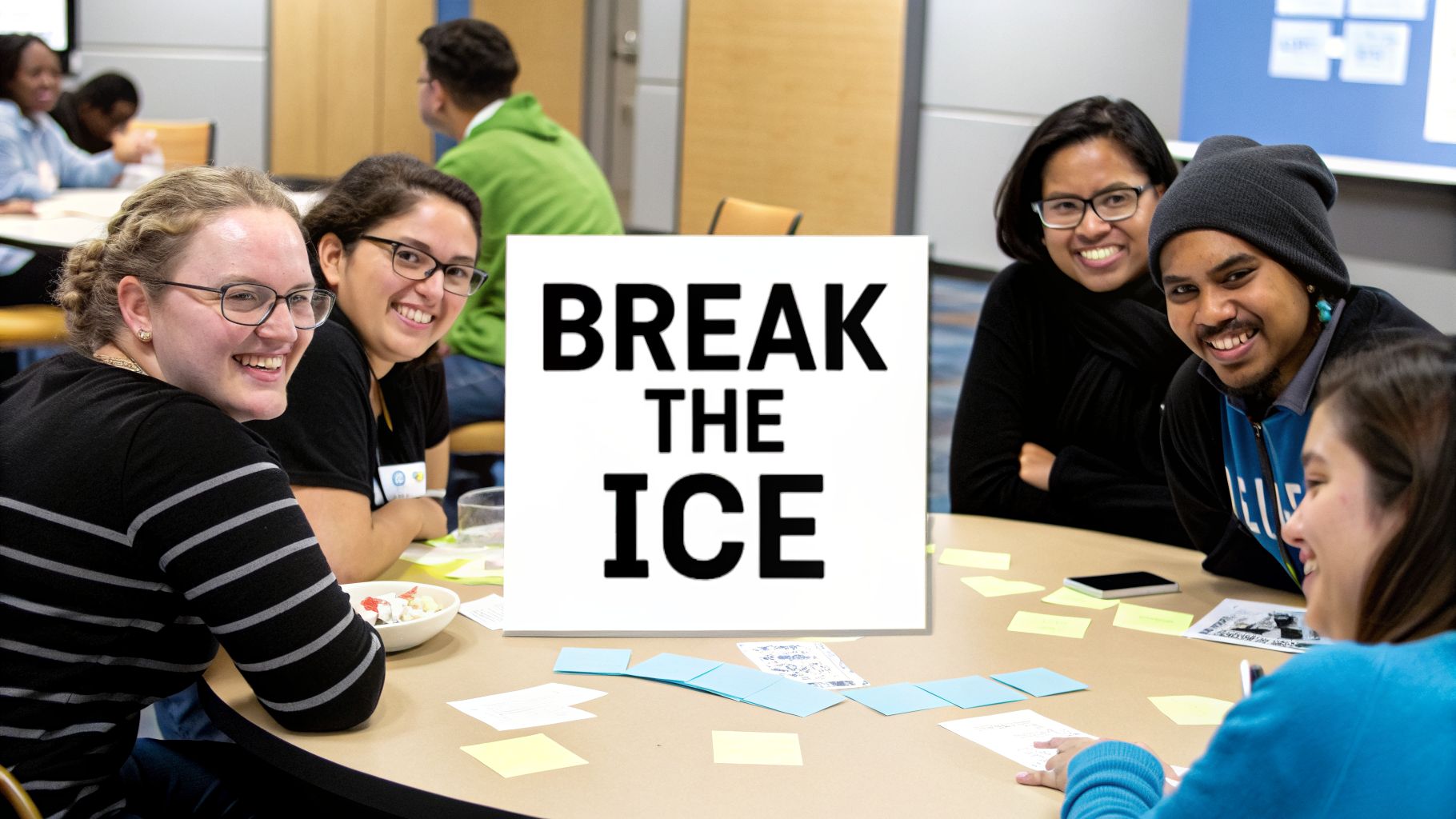
Starting a meeting with a new or small group can feel like navigating a minefield of polite but stilted small talk. The right activity does more than just fill the silence; it builds psychological safety, accelerates trust, and lays the groundwork for genuine collaboration. In today’s hybrid and remote work environments, creating these moments of connection is more critical than ever. This guide moves beyond generic advice to provide a curated list of powerful, field-tested break the ice games for small groups.
You will find a detailed breakdown for each game, including:
- Step-by-step instructions.
- Clear purpose and estimated time commitment.
- Accessibility and comfort level considerations.
- Specific adaptations for virtual meetings using AONMeetings features like polls, whiteboards, and breakout rooms.
These activities are designed to spark authentic conversations and build lasting rapport, turning initial awkwardness into productive energy. They are suitable for various professional settings, from onboarding new hires to kicking off a critical project. While the games here are tailored for professional groups, sometimes you need ideas for a more casual get-together. For a comprehensive list of ideas that are proven to get conversations flowing, check out these 10 fun icebreaker games for parties.
This collection will equip you with practical tools to foster a more connected team culture. Whether you're leading a session with colleagues you've known for years or meeting a team for the very first time, the right icebreaker sets a positive and inclusive tone, making every participant feel seen, heard, and ready to contribute.
1. Two Truths and a Lie
A true classic, "Two Truths and a Lie" is one of the most effective break the ice games for small groups because it masterfully blends storytelling with a fun guessing element. The concept is straightforward: each person prepares three "facts" about themselves. Two of these statements are true, and one is a plausible lie. One by one, participants share their three statements, and the rest of the group debates and votes on which one they believe is the lie.
The game's strength lies in its ability to reveal surprising and humanizing details about colleagues or group members in a structured, low-pressure format. It encourages active listening, critical thinking, and a healthy dose of creativity. It works exceptionally well for newly formed teams, training cohorts, or any group where building personal connections is a key objective.
Why It Works & How to Implement It
This activity is a favorite during corporate onboarding and interdepartmental meetings for a reason. It bypasses generic small talk and gets people sharing memorable anecdotes. A new hire might reveal they once won a hot-dog-eating contest or have climbed Mount Kilimanjaro, creating instant conversation starters that last well beyond the meeting.
Implementation Steps:
- Explain the Rules: Clearly state that each person will share three statements: two true and one false. The group's goal is to identify the lie.
- Provide Prep Time: Give everyone 3-5 minutes to brainstorm their statements. This prevents on-the-spot pressure and leads to more interesting facts.
- Share and Guess: Have one person share their three statements. After they finish, open the floor for a brief period of questioning or discussion before the group guesses.
- Reveal and Rotate: The speaker reveals the lie, often sharing the quick story behind the true statements. The next person then takes their turn.
Key Insight: The most successful lies are often mundane, while the most unbelievable truths create the best moments. Encourage participants to mix in ordinary-sounding lies with extraordinary-sounding truths to make the game more challenging and engaging.
Virtual Adaptation with AONMeetings
This game translates seamlessly to a virtual environment, making it perfect for remote or hybrid teams.
- Sharing: Participants can unmute themselves one at a time to share their statements. For those who are more introverted, the Chat feature is a great alternative for submitting statements in writing.
- Guessing: Use the Polls feature to run a quick, anonymous vote for which statement is the lie. This ensures everyone participates without feeling put on the spot.
- Discussion: For larger small groups (8-12 people), use Breakout Rooms to have smaller clusters discuss their guesses before a final group vote. This promotes more intimate conversation.
- Reactions: Encourage the use of Reactions (like a thinking face or clapping emoji) to keep the energy up and provide non-verbal feedback while someone is speaking.
2. Speed Networking (Speed Dating for Professionals)
Borrowing its structure from speed dating, "Speed Networking" is one of the most efficient break the ice games for small groups designed to foster a high volume of one-on-one connections in a short amount of time. The premise is simple: participants are paired up for brief, timed conversations (usually 2-3 minutes) before rotating to a new partner. This rapid-fire approach ensures that everyone gets a chance to interact with multiple people, breaking down initial barriers and moving beyond surface-level introductions.
It is an exceptional tool for corporate conferences, new hire onboarding, and interdepartmental mixers where the primary goal is to build a broad professional network quickly. The structured format removes the awkwardness of approaching new people and provides a level playing field for everyone to make meaningful first impressions.

Why It Works & How to Implement It
This activity is a staple at events hosted by organizations like LinkedIn and is used by law firms and medical conferences for a clear reason. It maximizes interaction, ensuring no one is left standing alone. By forcing participants to move beyond their existing cliques, it accelerates the formation of new professional relationships and uncovers potential collaborations that might otherwise have been missed.
Implementation Steps:
- Set the Stage: Explain the rules, the time limit for each conversation round, and how participants will rotate. Provide a few conversation starter prompts to help people dive in.
- Arrange the Space: For in-person events, arrange chairs in two rows facing each other or in small circles. One row or the outer circle will be the one to rotate.
- Start the Timer: Begin the first round. Use a clear audio or visual cue to signal when time is up. Announce a 30-second warning before the end of each round.
- Rotate and Repeat: Instruct one line of participants to move one spot down for the next round. Repeat the process until everyone has met a significant number of people.
Key Insight: The success of Speed Networking hinges on momentum. Provide industry-specific prompts to deepen the conversation quickly. For a corporate team, ask, "What's the most interesting project you're working on?" For healthcare professionals, try, "What recent development in your specialty excites you most?"
Virtual Adaptation with AONMeetings
Speed Networking is perfectly suited for remote events, replicating the experience with digital tools and ensuring your team can still network effectively in virtual environments.
- Pairing: Use the Breakout Rooms feature to automatically or manually assign participants into pairs. This is the core engine of virtual speed networking.
- Timing: Set a timer within the Breakout Rooms that automatically closes the rooms and brings everyone back to the main session when the time is up. This keeps the event on schedule.
- Discussion: Before starting, post the conversation prompts in the Chat for everyone to see and reference during their one-on-one discussions.
- Information Sharing: Create a shared document with participant names, roles, and LinkedIn profiles. Share the link in the chat so people can connect with their new contacts after the session. You can re-shuffle the breakout rooms several times to facilitate multiple rounds of networking.
3. Common Ground
"Common Ground" is a collaborative activity designed to quickly build rapport and highlight shared experiences within a group. It's one of the most effective break the ice games for small groups because it shifts the focus from individual presentation to collective discovery. The goal is for smaller clusters of 3-5 people to find a specific number of things they all have in common, ranging from obvious professional similarities to surprising personal connections.
This game excels at breaking down silos and fostering a sense of unity. By encouraging participants to look past surface-level differences, it builds empathy and creates a more inclusive environment. It is particularly powerful for cross-functional teams, new project groups, or any setting where strengthening interpersonal bonds is a primary goal. The visual element of mapping connections makes the experience more memorable and impactful.

Why It Works & How to Implement It
Companies like Google use variations of this activity to combat departmental silos, and healthcare systems find it invaluable for forming cohesive interdisciplinary teams. The process of finding commonalities naturally leads to storytelling and mutual understanding. A group might discover they all have a pet dog, have traveled to the same country, or share a favorite author, sparking conversations that build genuine connections.
Implementation Steps:
- Divide and Conquer: Split the main audience into small groups of 3-5 people. Explain that their objective is to find at least 10 things they all have in common.
- Set the Rules: Encourage them to start with obvious commonalities (e.g., "We all work in the marketing department") before digging deeper for more unique connections (e.g., "We all learned to play the piano as a child").
- Appoint a Timekeeper: Allocate a specific amount of time (10-15 minutes is usually sufficient) to keep the activity on track.
- Share Findings: Once time is up, ask each group to share one or two of their most surprising or interesting commonalities with the larger audience. This reinforces the sense of connection across the entire group.
Key Insight: The power of this activity comes from moving from the professional to the personal. Themed rounds can be effective. Start with a "Work Round" (shared projects, skills) and follow it with a "Life Round" (hobbies, travel, favorite foods) to encourage a well-rounded discovery process.
Virtual Adaptation with AONMeetings
This collaborative game is ideally suited for a virtual format, especially with tools designed for real-time interaction.
- Group Formation: Use Breakout Rooms to instantly divide participants into small, manageable groups for focused discussion.
- Visual Mapping: Instruct each group to use the shared Whiteboard feature as a digital canvas. They can create a mind map or a simple list to visually track the commonalities they discover in real-time.
- Time Management: The host can set a timer for the Breakout Rooms, which will automatically close the rooms and bring everyone back to the main session when time expires.
- Preserve Connections: Use the Screen Recording feature or take a screenshot of each group's whiteboard before closing the rooms. These connection maps can be shared after the meeting as a fun reminder of the team's shared identity.
4. Would You Rather
A universally popular format, "Would You Rather" is one of the most adaptable break the ice games for small groups. It operates on a simple premise: a facilitator poses a dilemma with two distinct choices, and participants must pick one and, more importantly, explain their reasoning. This lightweight game is excellent at revealing personality, values, and decision-making logic without feeling intrusive or overly personal.
The game's power comes from its simplicity and the conversations it sparks. Choices can range from the whimsical ("Would you rather have the ability to fly or be invisible?") to the professional ("Would you rather specialize deeply in one area or have broad knowledge across many?"). This makes it a perfect fit for startup teams, educational cohorts, and corporate culture-building initiatives where understanding how colleagues think is as important as what they know.
Why It Works & How to Implement It
"Would You Rather" bypasses awkward small talk by providing a clear, engaging topic for discussion. It's used everywhere from corporate team-building to healthcare shift meetings because it quickly builds camaraderie and humanizes professional relationships. A simple question can reveal a team member's preference for long-term strategy over immediate results, or a creative approach to problem-solving, all within a fun, low-stakes context.
Implementation Steps:
- Prepare Questions: Curate 8-12 questions in advance. Mix silly, thoughtful, and industry-specific options to keep the activity dynamic and relevant.
- Pose the Dilemma: The facilitator presents the first "Would you rather…?" question to the group. Keep the questions concise, ideally one sentence.
- Gather Choices: Ask for a show of hands or a quick verbal vote for each option. This provides a visual of the group's split.
- Invite Elaboration: Ask a few people from each side to briefly explain the "why" behind their choice. This is where the real connection happens. Rotate through the prepared questions.
Key Insight: The best questions are those without an obvious 'right' answer. They should spark friendly debate and encourage participants to think on their feet. Avoid divisive topics and focus on choices that reveal personality and preference.
Virtual Adaptation with AONMeetings
This icebreaker is exceptionally well-suited for virtual meetings, where its structure can direct conversation effectively.
- Voting: Use the Polls feature to present the question and have participants vote instantly. Sharing the results visually is a great way to kickstart the discussion.
- Discussion: After the poll, invite participants to unmute and share their reasoning. The Chat can also be used for people to type out their "why," which is a great option for more introverted team members.
- Targeted Conversation: For more in-depth topics, use Breakout Rooms. Split the group in two, with each room representing one of the choices, and ask them to discuss the collective reasoning before reporting back.
- Visual Engagement: Encourage participants to use Reactions to show agreement or surprise with others' explanations, keeping the atmosphere interactive and lively.
5. Show and Tell (Virtual Edition)
A nostalgic callback to elementary school, the virtual "Show and Tell" is one of the most powerful break the ice games for small groups in a remote setting. It taps into personal history and individual passions by having participants share a meaningful object via their camera. The concept is simple: each person selects an item from their physical environment, such as a family photo, a favorite book, an award, or a quirky desk gadget, and briefly explains its significance.
This game’s effectiveness comes from its ability to create genuine, authentic moments that humanize colleagues. Seeing a piece of someone's world fosters a sense of connection and understanding that goes far beyond their professional role. It’s especially impactful for remote-first companies and distributed teams where colleagues rarely, if ever, share a physical space.
Why It Works & How to Implement It
This activity is a staple in remote onboarding for companies like GitLab and Zapier because it instantly builds bridges between team members separated by geography. A developer might share a 3D-printed model from a personal project, or a marketer could show a souvenir from a memorable trip, revealing dimensions of their personality that enrich team dynamics. These small windows into each other's lives build trust and rapport.
Implementation Steps:
- Set the Context: Inform participants ahead of time about the activity so they can choose a meaningful object. Provide a clear theme, such as "an object that represents a hobby" or "something on your desk that makes you smile."
- Establish Time Limits: Give each person a strict 2-3 minute limit to share their object and story. This ensures the activity moves at a good pace and respects everyone's time.
- Share and Listen: Have individuals present one by one. Encourage the rest of the group to be active listeners and save questions for a brief Q&A after each person shares.
- Facilitate Interaction: After a person shares, the facilitator can ask a follow-up question like, "What's the story behind that?" to encourage a deeper explanation.
Key Insight: The power of this exercise lies in the story, not the object itself. Encourage participants to focus on the "why" behind their chosen item. A simple coffee mug becomes a compelling artifact when we learn it was a gift from a mentor who changed their career path.
Virtual Adaptation with AONMeetings
"Show and Tell" is built for the virtual world and is easily managed with the right tools.
- Sharing: Participants can hold their object up to their camera. For digital items, like a favorite photo or a piece of digital art, the Screen Share feature allows them to display it for the group.
- Managing Turns: The facilitator can use the Chat to create a speaking order, or participants can use the Raise Hand feature when they are ready to present.
- Timekeeping: The host can use a visual timer shared via Screen Share to help speakers stay within their allotted time in a friendly, non-disruptive way.
- Engagement: Encourage the audience to use Reactions (like a heart or clapping emoji) to show appreciation for each story. This maintains energy and provides positive feedback for the speaker.
6. Human Bingo
"Human Bingo" turns networking into an interactive quest, making it one of the most dynamic break the ice games for small groups. This activity moves beyond simple introductions by giving participants a mission: to find people who match specific descriptions on a bingo card. Each square contains a trait or experience, like "has traveled to more than five countries" or "speaks multiple languages," and players must mingle to get a signature for each square they fill.
The game's appeal comes from its structured yet free-flowing nature. It encourages participants to ask targeted, interesting questions rather than falling back on standard small talk. It’s perfect for corporate conferences, new student orientations, and training workshops where the goal is to get a large number of people to interact meaningfully in a short amount of time. The light competitive element of being the first to shout "Bingo!" adds a layer of excitement.
Why It Works & How to Implement It
Human Bingo is exceptional at breaking down cliques and encouraging cross-departmental interaction. Instead of just talking to the person next to them, participants have a clear reason to approach many different people. A legal firm might use it during a retreat with squares like "argued a case in federal court" or "is a member of the patent bar," sparking relevant professional conversations.
Implementation Steps:
- Create Custom Cards: Design bingo cards with a grid of traits and experiences relevant to your group. Mix professional facts ("has led a major project") with fun, personal ones ("collects vinyl records"). Randomize the square placement on each card.
- Explain the Rules: Clarify the objective: get a line (horizontal, vertical, or diagonal) by finding a different person for each square and having them sign it. Decide if you will also reward a "blackout" (full card).
- Set a Time Limit: Announce a time for the activity, typically 15-20 minutes, to create a sense of urgency and keep the energy high.
- Mingle and Sign: Let participants move around the room to find people who match the squares. The first person to complete a line shouts "Bingo!"
- Declare a Winner: Verify the winner's card and award a small prize or recognition. You can continue the game to find a "blackout" winner if time allows.
Key Insight: The magic of Human Bingo is in the card design. Ensure the squares are diverse and inclusive, avoiding items that might privilege a specific demographic or make people feel excluded. A well-designed card is a catalyst for discovering unexpected common ground.
Virtual Adaptation with AONMeetings
Human Bingo adapts surprisingly well to a virtual format, helping to combat the isolation of remote meetings. For more ideas on how to engage larger audiences, AONMeetings offers additional tips for engaging virtual icebreakers for large groups.
- Card Distribution: Email the bingo cards as PDFs ahead of time or share a link in the Chat at the start of the activity.
- Structured Mingling: Use Breakout Rooms as the primary tool for interaction. Send participants into small, randomized rooms for short bursts of time (e.g., 3-4 minutes). Rotate them through several different rooms to maximize interactions.
- Verification: Instead of signatures, participants can simply type the name of the person who matched the square. To "shout" bingo, they can use the Raise Hand feature or type "BINGO!" in the main chat.
- Keep It Interactive: Encourage participants to keep their cameras on and use Reactions to respond as others share fun facts during the breakout sessions.
7. Highs and Lows (or Rose, Thorn, Bud)
A deeply effective activity for building authentic connection, "Highs and Lows" is one of the most meaningful break the ice games for small groups because it creates space for structured vulnerability and empathy. Often known by its alternative name, "Rose, Thorn, Bud," the concept is simple: each person shares a positive experience (a high or rose), a challenge (a low or thorn), and optionally, something they are looking forward to (a bud).
This game’s power is in its ability to move beyond surface-level updates and foster genuine team support. By sharing both successes and struggles from a specific period, like the past week or a recent project, participants gain insight into each other’s realities. It’s particularly powerful for ongoing teams in high-stress fields like healthcare, law, or crisis response, as it provides a regular, safe outlet for reflection and mutual support.
Why It Works & How to Implement It
This exercise excels at building psychological safety and a supportive culture. For instance, agile software teams use variants in daily stand-ups to identify blockers and celebrate wins, while healthcare teams at end-of-shift huddles use it to decompress and process the day's events. The structure ensures that conversations are balanced, acknowledging both difficulties and moments of success.
Implementation Steps:
- Set the Stage: Explain the "High, Low, Bud" or "Rose, Thorn, Bud" framework. Establish clear confidentiality rules, ensuring everyone understands it is a safe space.
- Define the Timeframe: Specify the period for reflection, such as "this past week," "since our last meeting," or "during the project launch."
- Model Vulnerability: The facilitator or team lead should go first to set the tone, sharing an authentic and appropriate example.
- Go Round-Robin: Move through the group, giving each person 2-3 minutes to share. Make it clear that passing is perfectly acceptable if someone isn't comfortable sharing.
Key Insight: The consistency of this ritual is what builds lasting trust. Integrating it into the start or end of regular weekly meetings transforms it from a one-off icebreaker into a foundational element of your team's culture.
Virtual Adaptation with AONMeetings
"Highs and Lows" is an exceptional tool for fostering connection on remote teams, where emotional cues can be easily missed. AONMeetings makes it simple to facilitate.
- Sharing: Participants can unmute to share in a round-robin format. The Raise Hand feature helps manage the speaking order smoothly.
- Asynchronous Option: For those who prefer to reflect before speaking, use the Chat to have everyone post their "high, low, bud" simultaneously. This can be less intimidating and gives everyone time to read and react.
- Building Support: Encourage the use of Reactions (like a heart or support emoji) to show empathy as colleagues share their challenges. This non-verbal feedback is crucial for virtual team engagement.
- Deeper Dives: If a significant challenge is shared that warrants more discussion, the host can use Breakout Rooms to create a space for a smaller group to offer support without derailing the main meeting.
7 Small-Group Icebreakers: Quick Comparison
| Activity | Implementation complexity | Resource requirements | Expected outcomes | Ideal use cases | Key advantages |
|---|---|---|---|---|---|
| Two Truths and a Lie | Low — minimal facilitation | Video/chat only; optional timer | Rapid rapport, memorable personal details | Remote onboarding, small teams, classrooms | Low-pressure, adaptable, no materials |
| Speed Networking (Speed Dating for Professionals) | Medium–High — coordination and timing needed | Breakout rooms, timer, facilitator, participant list | Many short connections; follow-up opportunities | Conferences, large onboardings, professional networking | Efficient, structured, scalable connections |
| Common Ground | Medium — small-group facilitation and synthesis | Whiteboard/collaboration tool, facilitator, timekeeper | Increased trust, documented commonalities | Cross-department teams, team formation, diversity work | Builds psychological safety and empathy |
| Would You Rather | Low — prepare questions and run polls | Poll tool, curated question set | High engagement; reveals values and preferences | Culture-building, large webinars, classrooms | Scalable, low-stakes, quick insights (polls) |
| Show and Tell (Virtual Edition) | Low–Medium — scheduling and tech comfort | Camera/screen share, recording, participant prep | Humanizing connections; memorable impressions | Remote-first teams, orientations, distributed staff | Highly personal, fosters empathy and retention |
| Human Bingo | Medium — design and logistics upfront | Custom bingo cards, breakout rooms, facilitator, prizes | Active mingling, broad peer interaction | Large conferences, orientations, all-hands | Gamified engagement that forces conversation |
| Highs and Lows (Rose/Thorn/Bud) | Medium — requires skilled facilitation | Facilitator, timekeeper, confidentiality norms | Deeper support, morale insight, ongoing cohesion | Ongoing teams, high-stress environments, weekly check-ins | Promotes vulnerability, reflection, leader insight |
Turn Connections into Collaboration
Moving beyond initial introductions is the first step in building a high-functioning team. The collection of break the ice games for small groups we've explored serves a purpose that extends far beyond a few minutes of fun at the start of a meeting. These activities are strategic tools designed to dismantle barriers, foster psychological safety, and lay a foundation of mutual understanding. From the simple storytelling of "Two Truths and a Lie" to the reflective nature of "Highs and Lows," each game is a structured opportunity for genuine human connection.
The real power of these exercises is unlocked when they are chosen with intention. A fast-paced game like "Speed Networking" might be perfect for a new project kickoff, while a more thoughtful activity like "Common Ground" can help a long-standing team find new points of alignment. The key is to match the activity to your group's specific context, goals, and comfort levels. By doing so, you are not just passing time; you are actively engineering an environment where people feel seen, heard, and valued.
From Icebreakers to Actionable Insights
The energy and goodwill generated by a successful icebreaker should not be left to dissipate. The most effective leaders channel this positive momentum directly into the work at hand. The insights gained are more than just trivia; they are windows into your colleagues' personalities, communication styles, and even their current states of mind.
Consider these practical applications:
- Post-"Common Ground" Follow-up: Did you discover that several team members share a passion for data analytics or a specific hobby? This shared interest can become the basis for a special interest group, a mentorship opportunity, or simply a new way to relate to one another in future conversations.
- Insights from "Would You Rather": The choices people make, even in a hypothetical scenario, can reveal their problem-solving approaches. A person who consistently chooses the practical, logical path might be a great resource for process optimization, while someone who favors creative, out-of-the-box solutions could be a valuable contributor during brainstorming sessions.
- Takeaways from "Show and Tell": When a team member shares an object that represents a personal achievement or a deeply held value, it creates a powerful moment of vulnerability and trust. Acknowledging this later ("Thanks for sharing that story about your marathon medal, it was really inspiring") reinforces that you were listening and that their contribution mattered.
This deliberate approach transforms icebreakers from a checklist item into a continuous cycle of connection, insight, and application. To further enhance team bonding and streamline social interactions, consider exploring dedicated platforms like the saucial app that can facilitate connection building within your group.
Making Connection a Core Business Strategy
Ultimately, the goal is to create a culture where these moments of connection are not confined to a five-minute game. The spirit of curiosity, empathy, and open communication cultivated during these activities should become the default mode of operation for your team. When people feel comfortable being themselves, they are more likely to share bold ideas, provide constructive feedback, and collaborate effectively to solve complex problems.
The break the ice games for small groups featured in this guide are your starting point. Experiment with them, adapt them to your specific needs, and observe what resonates most with your team. Pay attention to the laughter, the "me too!" moments, and the quiet nods of understanding. These are the building blocks of trust. By investing in these small, intentional acts of connection, you are making a direct and powerful investment in your team's long-term success, productivity, and overall well-being. The relationships you build today will become the resilient foundation for whatever challenges and opportunities tomorrow brings.
Ready to bring these games to life in your virtual meetings? AONMeetings provides all the integrated tools you need, from breakout rooms and interactive whiteboards to polls and chat. Turn your next virtual meeting into an engaging experience by exploring the features at AONMeetings today.