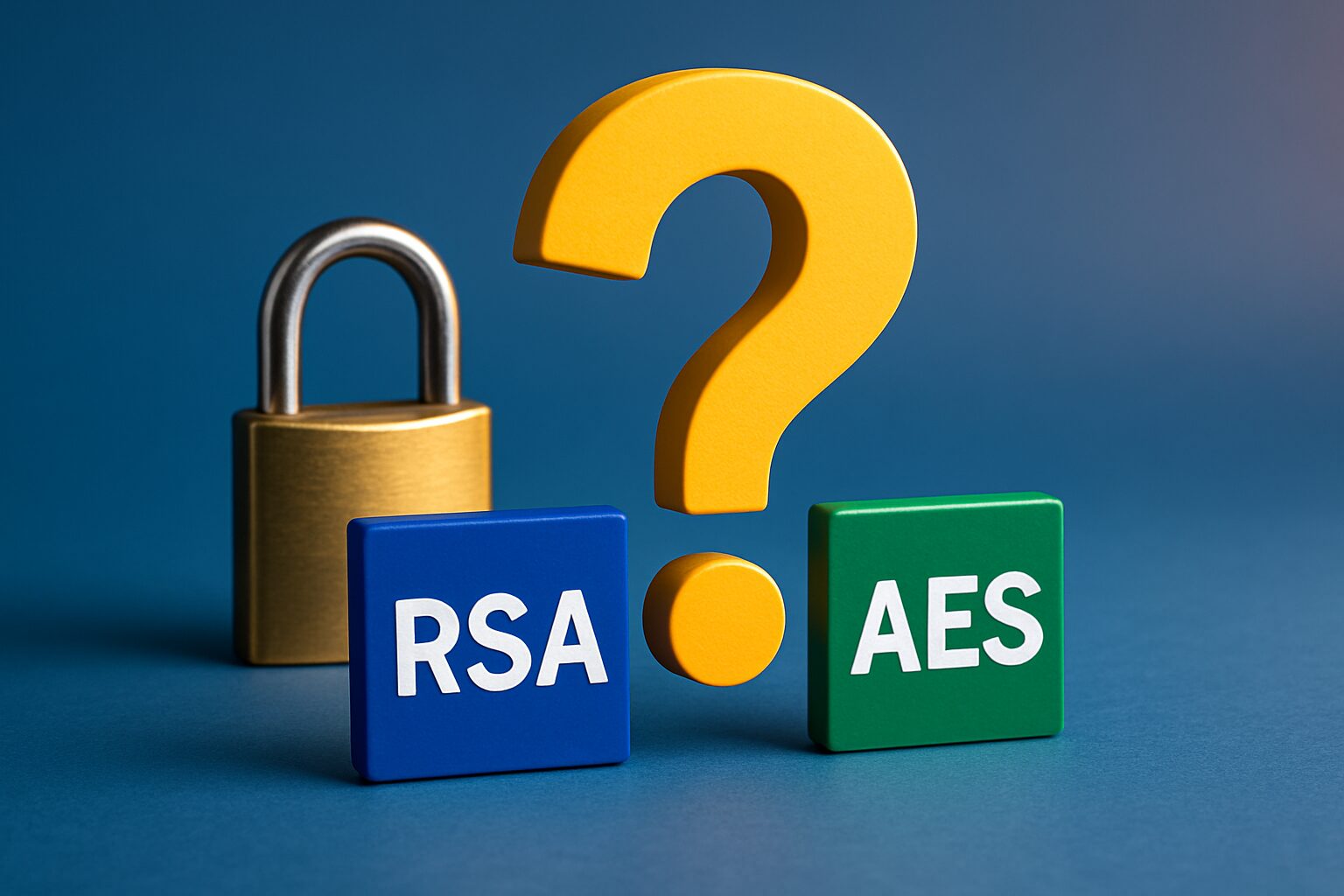
Ask ten security engineers which is better, RSA or AES, and you will quickly learn that the real question is about roles, not winners, because each algorithm was designed for a distinct job in the cryptographic toolbox and excels only when used in that job. In practice, rsa cryptography, formally RSA [Rivest–Shamir–Adleman], and AES [Advanced Encryption Standard] serve different but complementary purposes: one proves identity and enables secret exchange over untrusted networks using public and private keys, while the other locks down bulk data with lightning-fast, hardware-accelerated symmetric operations. That distinction matters to every organization streaming voice and video, signing contracts, or exchanging patient records, because choosing the wrong tool increases cost, weakens privacy, and frustrates users, especially on mobile devices where battery and bandwidth are precious and latency directly shapes perceived call quality. It also matters to modern video platforms such as AONMeetings, where security must not drag down quality, and where high-definition media rides across the open internet hundreds or thousands of times a day, demanding strong encryption, careful key management, and frictionless, 100 percent browser-based experiences with no downloads.
Before we compare them, anchor the decision in what you need to achieve: confidentiality, integrity, authentication, and availability, because cryptography is a means to an end and that end is trustworthy communication. Are you trying to encrypt a gigabit video stream in real time, verify a digital signature on a court filing, or exchange a session key during a telehealth visit, and do you also need to satisfy compliance requirements and simple user onboarding. Because RSA [Rivest–Shamir–Adleman] and AES [Advanced Encryption Standard] answer those tasks differently, your choice should balance speed, security level, regulatory obligations such as HIPAA [Health Insurance Portability and Accountability Act], and the user experience demanded by clients and employees, including the practical reality that web browsers and phones must perform the work efficiently. This is the approach AONMeetings follows with its HD Video & Audio Quality powered by WebRTC [Web Real-Time Communication], 100 percent browser-based meetings with no downloads, unlimited webinars in every plan, and AI-powered summaries and live streaming, all wrapped in advanced encryption that respects HIPAA [Health Insurance Portability and Accountability Act] considerations and makes high-stakes collaboration feel effortless and fast.
RSA vs AES: The Short Answer
If you want a one-line verdict, start here: RSA [Rivest–Shamir–Adleman] is best for establishing trust and sharing keys, and AES [Advanced Encryption Standard] is best for protecting data at speed once those keys exist, which is why modern systems use both. Think of RSA [Rivest–Shamir–Adleman] as the tamper-evident seal and identity badge that lets two strangers agree on a secret in public, and think of AES [Advanced Encryption Standard] as the vault that then locks the conversation, files, or video frames with minimal delay. Because asymmetric math involves large integers and costly exponentiation, RSA [Rivest–Shamir–Adleman] is slower and used sparingly, whereas AES [Advanced Encryption Standard] uses compact rounds and benefits from hardware acceleration on most servers and laptops, delivering multi-gigabit performance for streaming, backups, and file protection. Consequently, the reliable pattern across browsers, messaging apps, and conferencing platforms is a hybrid handshake that authenticates with certificates and digital signatures, derives ephemeral session keys, and then encrypts the live traffic using AES [Advanced Encryption Standard] in an authenticated mode such as GCM [Galois/Counter Mode] for both confidentiality and integrity in one pass.
| Attribute | RSA [Rivest–Shamir–Adleman] | AES [Advanced Encryption Standard] |
|---|---|---|
| Type | Asymmetric (public and private keys) | Symmetric (one shared secret key) |
| Primary Use | Key exchange, digital signatures, certificates | Bulk data encryption for speed and low latency |
| Typical Key Sizes | 2048 to 4096 bits | 128, 192, or 256 bits |
| Performance | Slow, used sparingly | Fast, hardware-accelerated on many CPUs [Central Processing Units] |
| Security Foundation | Integer factorization hardness | Block cipher design strength and key length |
| Common Protocols | TLS [Transport Layer Security], S/MIME [Secure/Multipurpose Internet Mail Extensions], code signing | TLS [Transport Layer Security], SRTP [Secure Real-time Transport Protocol], disk and database encryption |
| Not Ideal For | Encrypting large media streams | Digital signatures or certificate chains |
Where rsa cryptography Fits: Key Exchange, Identity, and Trust
RSA [Rivest–Shamir–Adleman] shines when two parties must authenticate each other and agree on a secret in public, which is why browsers validate X.509 [Public Key Certificate Standard] certificates, verify server identities signed by a CA [Certificate Authority], and then run a handshake that either uses RSA [Rivest–Shamir–Adleman] or an elliptic alternative to set up session keys. In legal e-signatures, software updates, and court filings, RSA [Rivest–Shamir–Adleman] signatures confirm who created a document and that it was not altered, and that assurance comes from the impracticality of forging a signature without the private key. In conferencing, the login page, API [Application Programming Interface] calls, and signaling layers rely on TLS [Transport Layer Security] with certificates to prevent impostors, block downgrade attacks, and stop man-in-the-middle interception before any audio or video flows. AONMeetings builds on these well-understood patterns, integrating certificate-based trust, modern ciphers, and secure key management to make sure that only the right hosts and attendees join a meeting and that every negotiation for keys happens over authenticated, encrypted channels that preserve confidentiality and inform your audit trail.
Watch This Helpful Video
To help you better understand rsa cryptography, we’ve included this informative video from Eddie Woo. It provides valuable insights and visual demonstrations that complement the written content.
- Use OAEP [Optimal Asymmetric Encryption Padding] for RSA [Rivest–Shamir–Adleman] encryption and PSS [Probabilistic Signature Scheme] for signatures to resist adaptive chosen-ciphertext attacks.
- Choose at least 2048-bit keys today; consider 3072-bit for long-term assurance aligned with NIST [National Institute of Standards and Technology] guidance.
- Prefer ephemeral ECDHE [Elliptic Curve Diffie–Hellman Ephemeral] for key agreement to achieve PFS [Perfect Forward Secrecy], reducing the blast radius if a server key is ever exposed.
- Rely on a strong PKI [Public Key Infrastructure], rotate keys on schedule, and validate certificate chains and revocation status rigorously.
Why AES [Advanced Encryption Standard] Protects Most Data in Motion and at Rest
![Illustration for Why AES [Advanced Encryption Standard] Protects Most Data in Motion and at Rest related to rsa cryptography](https://i0.wp.com/admanager-ai.s3.us-east-1.amazonaws.com/seopro-blog-inline-images/f155ce80-ef55-44bd-82f3-e4174de9c1cf.png?w=640&ssl=1)
AES [Advanced Encryption Standard] is the workhorse for encrypting data because symmetric operations are compact, parallelizable, and accelerated on commodity hardware, making them ideal for live voice and video, large file transfers, and databases at scale. Modern authenticated modes such as AES-GCM [Advanced Encryption Standard in Galois/Counter Mode] deliver confidentiality and integrity together by combining counter-mode encryption with a fast polynomial authenticator, which helps detect tampering and prevents bit-flip attacks that older modes like CBC [Cipher Block Chaining] with ad hoc MACs [Message Authentication Codes] might miss. In real-time media stacks such as SRTP [Secure Real-time Transport Protocol], the cipher must keep up with frame rates and jitter budgets, and AES [Advanced Encryption Standard] excels here, sustaining strong protection with minimal added delay so that calls feel natural and responsive. For AONMeetings, that performance efficiency translates directly into HD Video & Audio Quality powered by WebRTC [Web Real-Time Communication], because the encryption overhead remains low, the loss recovery stays tight, and the platform can prioritize clarity, continuity, and accessibility across healthcare consults, classes, depositions, and cross-team standups.
- Prefer AEAD [Authenticated Encryption with Associated Data] modes such as AES-GCM [Advanced Encryption Standard in Galois/Counter Mode] or AES-CCM [Advanced Encryption Standard in Counter with CBC-MAC], avoiding ECB [Electronic Codebook] entirely.
- Pick AES-256 [Advanced Encryption Standard with 256-bit keys] for very long-term data; AES-128 [Advanced Encryption Standard with 128-bit keys] is still robust for most real-time traffic and often faster.
- Use hardware support such as AES-NI [Advanced Encryption Standard New Instructions] where available to cut CPU [Central Processing Unit] cost and reduce tail latency.
- Authenticate every packet or record to stop silent corruption and active tampering, then monitor for anomalies at the application level too.
Hybrid Designs Power Modern Apps and Calls
Real systems combine asymmetric and symmetric methods so you do not have to choose between trust and throughput, and this is visible in TLS 1.3 [Transport Layer Security version 1.3], messaging apps, and WebRTC [Web Real-Time Communication] media stacks. A typical flow authenticates the server with a certificate chain, performs an ephemeral ECDHE [Elliptic Curve Diffie–Hellman Ephemeral] key agreement (or historically RSA [Rivest–Shamir–Adleman] key transport), derives fresh session keys, and then switches to AES-GCM [Advanced Encryption Standard in Galois/Counter Mode] for the actual stream, achieving PFS [Perfect Forward Secrecy] and integrity with minimal handshake latency. In WebRTC [Web Real-Time Communication], DTLS [Datagram Transport Layer Security] is widely used to negotiate keys that protect SRTP [Secure Real-time Transport Protocol] media, and that design lets browsers interoperate securely without plugins, software installs, or device drivers, an accessibility imperative for large organizations. AONMeetings adopts this standards-first approach to keep user experiences clean and secure: sessions run in the browser, no downloads are required, webinar capacity is included in every plan, and encryption and HIPAA [Health Insurance Portability and Accountability Act] safeguards are woven into the pipeline so clinicians, educators, attorneys, and corporate teams can collaborate with confidence while maintaining excellent call quality.
- Authenticate: validate the server certificate and hostname via PKI [Public Key Infrastructure] to block impostors.
- Agree on keys: use ECDHE [Elliptic Curve Diffie–Hellman Ephemeral] for ephemeral secrets and PFS [Perfect Forward Secrecy].
- Derive traffic secrets: feed the handshake outputs into a KDF [Key Derivation Function] that produces distinct keys for encryption and authentication.
- Encrypt at speed: protect audio, video, and data channels using AES-GCM [Advanced Encryption Standard in Galois/Counter Mode] to minimize latency while checking integrity.
Performance, Key Sizes, and Security Equivalence

It is natural to ask whether RSA-4096 [Rivest–Shamir–Adleman with 4096-bit keys] is “stronger” than AES-256 [Advanced Encryption Standard with 256-bit keys], but these numbers describe very different mathematics, so equivalence is approximate and depends on assumptions and attack models. NIST [National Institute of Standards and Technology] guidance provides a helpful mapping between asymmetric and symmetric security levels under classical computing, indicating that RSA-3072 [Rivest–Shamir–Adleman with 3072-bit keys] roughly aligns with AES-128 [Advanced Encryption Standard with 128-bit keys] assurance, while achieving parity with AES-256 [Advanced Encryption Standard with 256-bit keys] would require extraordinarily large RSA [Rivest–Shamir–Adleman] keys that are impractical for most real-time systems. Performance matters as much as raw strength, because a hand-wavy jump to massive keys can slow logins, inflate CPU [Central Processing Unit] costs, and add seconds of page delay, which degrades user experience and threatens adoption. Planning ahead should also include a roadmap for PQC [Post-Quantum Cryptography], since Shor’s algorithm [Quantum Integer Factoring] threatens RSA [Rivest–Shamir–Adleman]/ECC [Elliptic Curve Cryptography] while Grover’s algorithm [Quantum Search] gives a quadratic speedup against symmetric ciphers, a risk that is mitigated by longer AES [Advanced Encryption Standard] keys and hybrid handshakes that add a PQC [Post-Quantum Cryptography] key encapsulation mechanism.
| Target Security Level | Approximate RSA [Rivest–Shamir–Adleman] Key Size | Comparable AES [Advanced Encryption Standard] Strength |
|---|---|---|
| ~112-bit security | RSA-2048 [Rivest–Shamir–Adleman with 2048-bit keys] | AES-112 to AES-128 [Advanced Encryption Standard with 112 to 128-bit keys] |
| ~128-bit security | RSA-3072 [Rivest–Shamir–Adleman with 3072-bit keys] | AES-128 [Advanced Encryption Standard with 128-bit keys] |
| ~192-bit security | RSA-7680 [Rivest–Shamir–Adleman with 7680-bit keys] | AES-192 [Advanced Encryption Standard with 192-bit keys] |
| ~256-bit security | RSA-15360 [Rivest–Shamir–Adleman with 15360-bit keys] | AES-256 [Advanced Encryption Standard with 256-bit keys] |
Note: The table gives common equivalence guidance under classical computing assumptions; real-world choices should consider performance budgets, hardware support, and protocol constraints.
A Practical Framework to Choose the Right Tool
Choosing wisely starts with mapping your workload, regulations, and user expectations, and then picking algorithms and modes that meet those needs with safety margins and operational headroom. For live conferencing, use asymmetric cryptography such as RSA [Rivest–Shamir–Adleman] or ECDHE [Elliptic Curve Diffie–Hellman Ephemeral] to authenticate and agree on ephemeral keys, then put AES-GCM [Advanced Encryption Standard in Galois/Counter Mode] to work on the media and data channels, and you will preserve quality while enforcing integrity. For stored assets, encrypt databases and archives with AES [Advanced Encryption Standard], manage keys centrally, and require per-tenant separation and rotation to satisfy internal policy and external rules such as HIPAA [Health Insurance Portability and Accountability Act], FERPA [Family Educational Rights and Privacy Act], and GDPR [General Data Protection Regulation]. AONMeetings solves the practical puzzle many teams face by offering a fully browser-based platform with no extra fees for webinars and advanced security measures such as encryption and HIPAA [Health Insurance Portability and Accountability Act] compliance, ensuring a seamless user experience and peace of mind for organizations of all sizes, and by pairing that operational simplicity with AI-powered summaries and live streaming for better reach and recall.
| Use Case | Recommended Choice | Why | Example in AONMeetings |
|---|---|---|---|
| Live video meetings | ECDHE [Elliptic Curve Diffie–Hellman Ephemeral] + AES-GCM [Advanced Encryption Standard in Galois/Counter Mode] | PFS [Perfect Forward Secrecy] with high-throughput, low-latency protection | WebRTC [Web Real-Time Communication] media protected end to end while preserving HD quality |
| File transfers and recordings | AES-256 [Advanced Encryption Standard with 256-bit keys] at rest | Strong symmetric security and efficient bulk processing | Encrypted storage with policy-based key rotation and auditing |
| User login and API [Application Programming Interface] calls | TLS 1.3 [Transport Layer Security version 1.3] with certificates | Server authentication and encrypted control channels | Secure meeting creation, invites, and admin actions in the browser |
| Digital signatures | RSA-PSS [Rivest–Shamir–Adleman Probabilistic Signature Scheme] or ECDSA [Elliptic Curve Digital Signature Algorithm] | Non-repudiation and tamper detection for critical artifacts | Integrity checks on releases, policies, or exported reports |
- Adopt FIPS 140-3 [Federal Information Processing Standards 140-3] validated libraries for cryptographic operations and prefer constant-time implementations.
- Centralize secrets in an HSM [Hardware Security Module] or a hardened key management service and enforce rotation, revocation, and least privilege.
- Monitor for misconfigurations, reject weak ciphers and outdated protocol versions, and test regularly with automated scanners and staged chaos drills.
- Educate teams and clients so that secure behavior is the default, not an afterthought, and document controls for audits and risk reviews.
So, which is better, RSA or AES? Neither replaces the other, because RSA [Rivest–Shamir–Adleman] provides identity and safe key setup while AES [Advanced Encryption Standard] protects the actual data, and your systems are safest and fastest when both are used as designed.
The right combination gives you trust without slowdown and privacy without friction.
In the next 12 months, expect broader deployment of hybrid classical plus PQC [Post-Quantum Cryptography] handshakes and continued dominance of AES-GCM [Advanced Encryption Standard in Galois/Counter Mode] for real-time media, tightening defenses with little user impact.
How will you tune your stack to capture the benefits of rsa cryptography while keeping performance, compliance, and user delight front and center?
Additional Resources
Explore these authoritative resources to dive deeper into rsa cryptography.
Elevate Secure Collaboration with AONMeetings
AONMeetings’ HD Video & Audio powered by WebRTC [Web Real-Time Communication] helps professionals, teams, and businesses collaborate in any browser with HIPAA-compliant encryption and no webinar fees across healthcare, education, legal, and corporate.