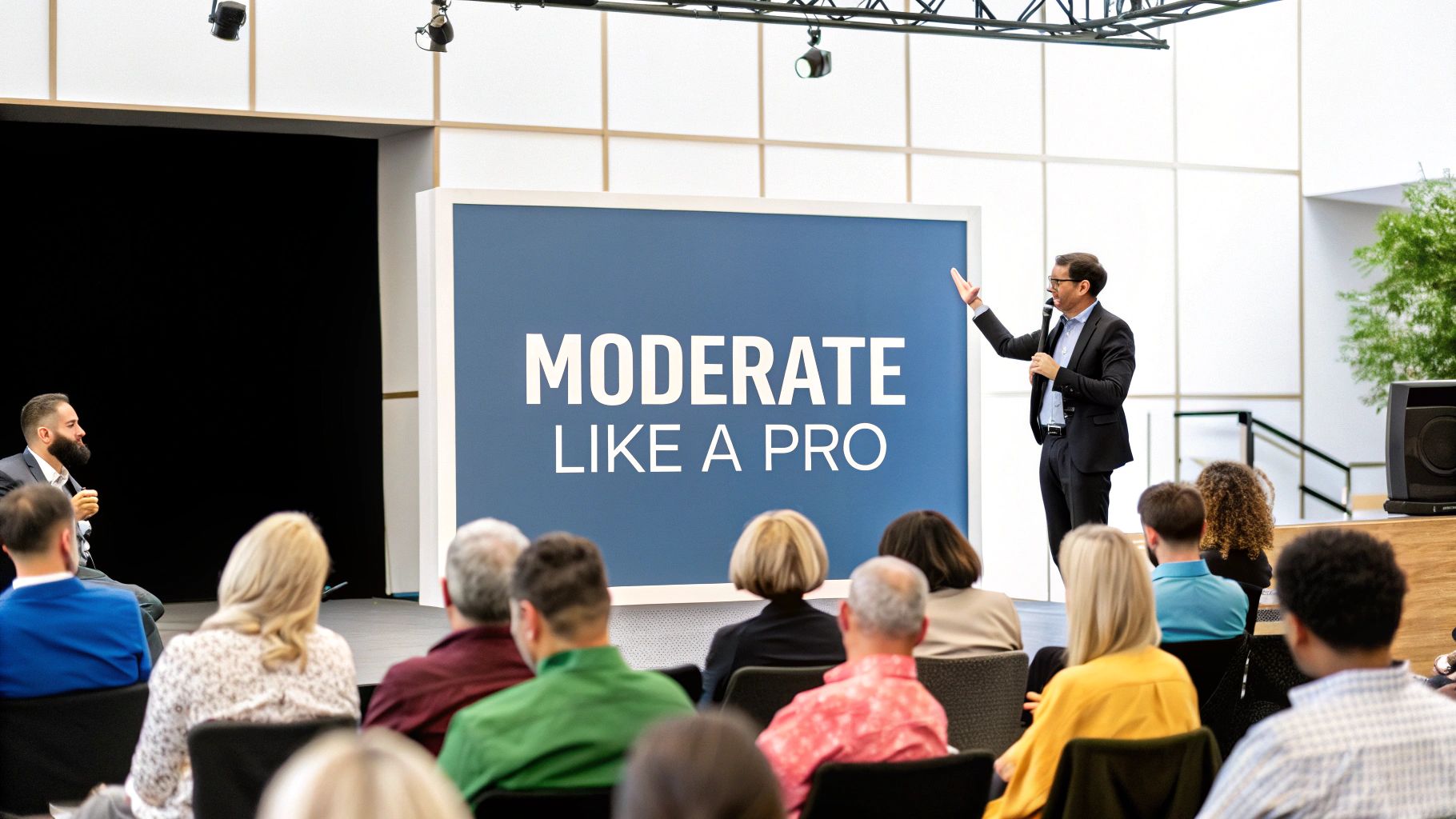
Moderating a panel discussion is less about asking questions and more about steering a great conversation. The magic lies in doing your homework—thorough preparation, getting your panelists on the same page, and framing questions that ignite a real dialogue. That's how you deliver a session that actually gives the audience something valuable to take away.
Laying the Groundwork for a Flawless Panel
The fate of your panel is sealed long before anyone grabs a microphone. A moderator’s job isn't just to keep time; you're the architect of the entire conversation. Think of yourself as the director, not just the host. Mastering this role means understanding how your piece fits into the larger puzzle of planning an event successfully.
This proactive mindset is what separates a forgettable panel from one that people talk about afterward. I’ve seen it time and again: the best moderators are active drivers of the discussion, not passive observers. They dive deep into the topic and truly get what makes each panelist tick.
Research Beyond the Bio
Your first mission is to become a mini-expert on both the topic and the people you'll be guiding. Don't stop at their official bios—that's just the surface. You need to dig deeper to find out what really makes them interesting.
- Check Out Their Recent Work: Read their latest articles, watch a recent talk on YouTube, or listen to a podcast they were on. This gives you a snapshot of what's on their mind right now.
- Scan Their Socials: A quick look at their LinkedIn or X (formerly Twitter) feed tells you what they're passionate about and the conversations they're already having. This is gold for finding potential points of friendly debate.
- Find the Connections (and Gaps): Map out where your panelists will likely agree, where they might differ, and how their expertise complements one another. The most electric moments happen in these intersections.
This isn't just about knowing what they know, but how they think. You’re looking for the conversational glue that will hold everything together.
The infographic below breaks this whole prep process down into a simple, three-stage workflow.

This flow—Research, Align, Questions—is your roadmap. Each step logically builds on the last, helping you create a panel that feels cohesive and thoughtfully planned.
Aligning Panelists with a Pre-Call
A pre-panel call is an absolute must. Seriously, don't skip it. This quick virtual meeting, usually a week or two out, is your best shot at setting expectations and building a bit of rapport. It's not a rehearsal; think of it as a strategy session.
Before you get started, it helps to have a solid grasp of the basics. If you need a refresher, check out this guide on what a panel is and how it works.
To make your prep even smoother, use this checklist to track your progress and make sure nothing falls through the cracks.
Your Pre-Panel Prep Checklist
A little organization goes a long way. This checklist breaks down the essential actions you need to take before the panel begins, ensuring you and your speakers are perfectly aligned and ready to go.
| Phase | Key Action | Why It Matters |
|---|---|---|
| Research | Dive into panelists' recent work, talks, and social media activity. | Uncovers current perspectives and potential points for dynamic conversation, moving beyond static bios. |
| Theme Definition | Solidify 3-4 core themes or "big ideas" for the discussion. | Gives the panel a clear narrative arc and prevents the conversation from becoming scattered or unfocused. |
| Pre-Call | Schedule and run a 30-minute alignment call with all panelists. | Builds rapport, sets expectations on format and flow, and creates a sense of a "team" effort. |
| Question Crafting | Draft 8-10 open-ended questions tied to your core themes. | Ensures you have a solid foundation to guide the discussion, even if you go off-script. |
| Logistics Check | Confirm all technical and logistical details (mic setup, virtual links, timing). | Prevents day-of surprises and technical glitches that can derail an otherwise great panel. |
| Final Briefing | Send a final confirmation email 24-48 hours before the event. | Provides a final reminder of the key details and shows your panelists that you're organized and on top of things. |
Following these steps methodically transforms your role from a simple time-keeper to a true conversation architect, setting the stage for a session that feels both professional and engaging.
The goal of the pre-call is to create a sense of psychological safety. When panelists feel comfortable with you and each other, they are more likely to be candid, open, and engaging on stage.
During the call, you’ll walk them through the session's main themes, explain the format, and cover any logistical need-to-knows. This is also your chance to get their buy-in on the conversational journey you have in mind. By the time you hang up, everyone should feel like they're on the same team, primed to create a fantastic experience for the audience. No surprises, just a shared goal.
Assembling Your Panel for Dynamic Conversation

A great panel isn't just a collection of impressive résumés; it’s about crafting chemistry. The goal is to bring together a group whose expertise and personalities will ignite a conversation that’s not just enlightening, but genuinely interesting for your audience. The real magic happens when you balance different viewpoints to create a truly well-rounded dialogue.
Forget credentials for a moment and focus on communication style. I've seen brilliant experts with groundbreaking ideas fall flat because they couldn't articulate them clearly. They're far less valuable than someone who can make complex topics feel accessible and exciting. Your job is to find people who not only know their stuff but actually enjoy talking about it.
Finding the Right Mix of Voices
Diversity of thought is the engine that drives a memorable panel. You want panelists who will challenge each other respectfully, build on each other's points, and give the audience a multi-faceted view of the topic. The last thing you want is an echo chamber where everyone just nods in agreement.
When you're vetting potential speakers, here are a few things I always look for:
- Complementary Expertise: Look for people whose knowledge areas overlap just enough for a cohesive conversation but differ enough to bring unique angles to the table.
- Engaging Communicators: Are they natural storytellers? Can they explain things clearly and concisely? A quick YouTube search for their past speaking gigs can be incredibly revealing.
- A Collaborative Spirit: The best panelists are phenomenal listeners. They engage with others' ideas instead of just waiting for their turn to talk.
It's also worth considering how well they've cultivated their public voice. Strong personal branding strategies often mean a panelist is more practiced at communicating their unique perspective with authority.
Striking the Perfect Balance in Numbers
When it comes to how many people to put on stage, more is definitely not merrier. A crowded panel almost always leads to a shallow, rushed conversation where nobody gets enough time to dig into the details. The trick is finding the number that allows for varied perspectives without descending into chaos.
My experience has shown that the sweet spot is a group of 4 to 5 expert panelists. This size is big enough for lively interaction but small enough for a moderator to manage effectively.
This number ensures you can give each expert adequate airtime while keeping the energy high. Any fewer than four and you risk losing that dynamic range. Any more than five, and deep, meaningful engagement becomes nearly impossible. By carefully curating both who is on your panel and how many of them there are, you're setting the stage for a truly compelling discussion.
Guiding the Conversation on Stage
After all the prep work, it’s showtime. This is the moment you shift from planner to conductor, steering the live discussion with a steady hand. Your presence on stage—whether physical or virtual—is what turns a series of talking points into a dynamic, valuable conversation for everyone in the room.
Those first five minutes are everything. You have to grab the audience’s attention, put your panelists at ease, and establish yourself as a friendly but firm guide. A great opening isn’t just a laundry list of names and titles; it’s a story about why this topic, with these specific people, is so critical right now.
Kicking Things Off with Impact
Ditch the dry, by-the-book introductions. Kick things off with a compelling statistic, a provocative question, or a short, relevant story that immediately frames why this discussion matters. Your goal is to make the audience lean in, feeling like they're about to witness an important conversation.
Once you have their attention, introduce your panelists with genuine enthusiasm. Share a quick, interesting tidbit you picked up during your research—something that goes beyond their job title. It humanizes them and helps build an instant rapport with the audience.
A great moderator doesn't just introduce speakers; they introduce ideas. Your opening should feel like the first chapter of a story, setting the scene and introducing the key characters who will drive the narrative forward.
This is also the time to lay down the ground rules, but keep it light and conversational. Let the audience know the format—for example, that you’ll save questions for the last 15 minutes. This also sends a subtle signal to the panelists that you're keeping an eye on the clock to make sure everyone gets a word in.
The Art of Active Listening and Pivoting
Your list of prepared questions is your roadmap, but the real magic happens in the spontaneous moments. Active listening is your single most powerful tool. Don't just wait for a panelist to stop talking so you can fire off the next question. Listen intently to what they’re saying and how they’re saying it.
That’s how you spot the openings for brilliant follow-ups.
- Listen for Keywords: Did a panelist drop a specific term, project, or idea that needs a bit more unpacking?
- Notice Connections: Did one speaker's comment directly relate to—or even contradict—what someone else said earlier?
- Sense Enthusiasm: Does a panelist seem particularly fired up about a certain point? Give them room to expand on it.
Your ability to ask thoughtful questions is crucial, and it helps to have a solid framework. For a deeper dive, check out our guide on how to develop panel questions for impactful presentations. Weaving these follow-ups into the conversation makes the whole thing feel more organic and less like a scripted performance.
Managing Time and Challenging Situations
Let's be honest: keeping the clock and managing different personalities is one of the toughest parts of moderating. You're the audience's advocate, responsible for keeping the conversation on track and making sure everyone gets a chance to contribute. It’s a delicate dance between being assertive and being polite.
Things don’t always go according to plan, but a little foresight goes a long way. Here are some of the most common hiccups you might face and a simple game plan for each.
Common Panel Challenges and How to Solve Them
| Challenge | Moderator's Action Plan |
|---|---|
| The Mic Hog | Politely interject with a bridging phrase. "That's a powerful point, Maria. John, I'd love to get your perspective on that." |
| The Silent Panelist | Directly invite them into the conversation. "Sarah, you have deep experience in this area. What are your thoughts?" |
| Off-Topic Tangents | Gently steer the conversation back. "That's an interesting tangent, but in the interest of time, let's bring it back to our core theme of…" |
| Awkward Silence | Have a "softball" or universal question ready to go that any panelist can answer, giving everyone a moment to reset. |
Confidence in these moments comes from preparation. When you anticipate these potential bumps in the road, you can respond with poise and keep the panel professional, engaging, and respectful of everyone’s time.
Turning Your Audience into Active Participants

The difference between a good panel and a great one often comes down to one thing: turning it from a monologue into a genuine dialogue. As a moderator, your job isn't just about guiding the experts on stage. It’s about breaking down that invisible wall between the stage and the seats, making everyone feel like they're part of the same conversation.
This starts by treating the Q&A as an integral part of the show, not just something you tack on at the end if there's time. Whether you’re running a mic through a packed auditorium or managing a flood of questions in a virtual chat, the goal is to make participation feel natural and seamless.
Orchestrating an Effective Q&A
Let's be honest, the phrase "any questions?" is usually met with crickets. You can’t just hope for participation; you need a strategy to draw it out. A well-run Q&A doesn't just fill time—it can unearth brilliant insights and deliver huge value to your attendees.
Here are a few ways I’ve seen work wonders to get the ball rolling:
- Front-load the questions: Ask attendees for their questions during the registration process. This gives you a stash of high-quality, thoughtful queries to kick things off and gives you a peek into what the audience really wants to know.
- Use technology to your advantage: For any virtual or hybrid event, moderated Q&A apps are a must. Tools like Slido (or the features built into your event platform) let attendees submit and upvote questions. It's a beautifully democratic way to see which topics are generating the most buzz.
- Set the expectation early: Announce the Q&A time upfront. A simple, "We'll be sure to save the last 15 minutes for your questions" lets people know what's coming and gives them time to organize their thoughts.
Once the questions start rolling in, your role shifts from facilitator to synthesizer. Look for patterns. If you see three similar questions about funding, don’t ask them one by one. Group them.
Try something like, “It looks like a lot of you are curious about the financial side of this. Panelists, can you talk a bit about how you approach budgeting for these kinds of projects?”
This technique respects everyone's time and prompts a richer, more comprehensive answer from your panel. The impact of panel events on audience engagement is directly tied to how much you make attendees feel heard. We actually did a deep dive on this, and you can read more about analyzing the impact of panel events on audience engagement and insights.
A great moderator doesn't just read a question verbatim. They reframe it to spark a better conversation. If a question is too specific, broaden it for the whole audience. If it’s a bit pointed, soften the tone to encourage a constructive response.
Going Beyond the Standard Q&A
While a solid Q&A is non-negotiable, it's not your only tool for engagement. Sprinkling in other interactive moments can keep the energy high and prevent that mid-session slump.
Live polls are fantastic for this. They're a quick and easy way to take the room's temperature on an issue. The real-time results can even give you a great jumping-off point for a whole new line of discussion.
You can also pull the conversation onto social media. Encourage attendees to share takeaways or ask questions using a specific event hashtag. This not only boosts engagement in the room but also expands the discussion to a wider digital audience, giving your event a life of its own long after it's over.
Ending Strong and Extending the Conversation

How you close your panel is just as important as how you kick it off. I’ve seen it happen too many times: a fantastic, high-energy discussion just… peters out. A weak ending can completely undo all the great momentum you’ve built, leaving the audience feeling like the conversation simply ran out of steam.
Those final few moments are your last, best chance to crystallize the key insights and leave a powerful impression. The goal isn't just to stop talking; it's to provide a sense of closure and a clear path forward. This is where you consciously shift from facilitator to synthesizer, distilling an hour of rich, sometimes complex, conversation into a few takeaways that actually stick.
Crafting a Memorable Summary
Resist the temptation to just say, "Well, that's all the time we have." That's a surefire way to make the last hour feel forgettable. Instead, always reserve the final three to five minutes for a deliberate, thoughtful wrap-up. As a moderator, you should be listening for the core themes that bubbled up throughout the discussion and be ready to weave them into a cohesive final narrative.
A simple yet incredibly effective technique I’ve used is the "What, So What, Now What" framework:
- What: Briefly hit the 2-3 biggest ideas that surfaced. For example, "We heard from Sarah about the critical importance of clean data, and from David on the human element of building a strong, trusting team culture."
- So What: Quickly explain why these ideas matter to the people in the room. "What this really tells us is that technical prowess and human connection must go hand-in-hand for any real, sustainable success."
- Now What: Give them a clear, actionable takeaway. "As a next step, maybe you can go back and evaluate one single process in your own team where you can better integrate these two powerful elements."
The final summary is your last opportunity to reinforce the value of the session. A great closing doesn't just recap the facts; it makes the audience feel smart and empowered. It connects the dots for them one last time.
Extending the Conversation Beyond the Stage
The end of the panel doesn’t have to be the end of the conversation. In fact, what you do next is crucial when you consider how little information attendees typically retain. Some research suggests audiences may only remember about 10% of what was said just two days later. This makes post-event reinforcement essential if you want your panel to have a real impact. You can read more about leveraging panel discussion highlights to boost retention.
Here are a few practical ways to extend the value long after the lights go down:
- Announce a Follow-Up: Let the audience know exactly where they can continue the discussion. This could be a specific LinkedIn thread you create, a dedicated Slack channel for the event, or simply by following and using the official event hashtag.
- Create Shareable Content: Work with the event organizers to turn the best moments into shareable assets. Think quote cards for social media, a short highlights video, or a summary blog post that captures the key themes. This is gold for both attendees and people who couldn't make it.
- Provide a Clear Call to Action: End with a single, unambiguous action. It might be downloading a resource the panelists mentioned, visiting a specific website, or encouraging them to connect with the panelists on LinkedIn.
By ending with purpose and creating clear pathways for continued engagement, you transform a one-time event into a lasting resource that keeps delivering value long after the applause fades.
Answering Your Top Moderation Questions
Even the most experienced moderators get thrown a curveball now and then. Knowing how to steer a panel discussion isn't just about the plan; it's about being ready for anything. Let's tackle some of the most common questions that pop up, whether you’re stepping onto the stage for the first time or the fiftieth.
How Do You Handle a Panelist Who Talks Too Much?
Ah, the classic runaway train. This is probably the most common moderation challenge, and your best tool is a polite but firm interjection that keeps the conversation moving for everyone. The trick is to avoid an abrupt, awkward cutoff. Instead, you want to use a bridging phrase that acknowledges their point while gracefully redirecting traffic.
For instance, you could jump in with, "That's a fantastic point, and it connects perfectly to a question I have for Maria…" This validates what they said but smoothly hands the baton to someone else. Another go-to line is, "Thank you, John. In the interest of time, I'd love to bring Sarah in here for her take on that." This frames your interruption as a time management necessity, which is exactly what your job is.
Think of yourself as a graceful traffic cop. Your job isn't to police any single speaker but to keep the conversation flowing smoothly for the entire audience. Sometimes, a simple, pre-agreed hand signal for time can work wonders without saying a word.
Should My Questions Be Scripted or Spontaneous?
The only right answer here is both. You should absolutely walk in with a list of 8-10 well-researched, open-ended questions. This is your safety net, the structural backbone of the entire discussion. It guarantees you have a clear path forward and won't be left scrambling if the conversation hits a lull.
That said, the most memorable and insightful moments on a panel almost always come from spontaneous follow-ups. You have to listen—really listen—to what your panelists are saying. When someone drops a particularly interesting or controversial comment, don't be afraid to deviate. A simple, "Could you expand on that a little?" can unearth a true gem. Your prepared questions are the roadmap, not a rigid, turn-by-turn script.
How Should I Prepare Differently for a Virtual Panel?
While the core principles of great moderation don't change, the execution for a virtual panel demands a different focus. Your number one priority is, without a doubt, the technology. A mandatory tech check with every single panelist on the exact platform you'll be using is completely non-negotiable.
Here’s where your energy should go:
- Tech Is Everything: Make sure everyone has a stable connection, decent lighting, and clear audio. A fuzzy mic or a grainy camera can tank an otherwise great discussion.
- Plan for Digital Engagement: Don't just hope for engagement; build it in. Actively plan to use the platform's features like polls, Q&A boxes, and the live chat to pull the remote audience into the conversation.
- Manage Screen Energy: You don't have physical presence to rely on, so you have to be more direct. Call on panelists by name to avoid those awkward silences where everyone waits for someone else to speak.
For in-person events, you're more focused on stage presence and managing the physical energy of the room. But in either scenario, a thorough pre-panel call to get everyone on the same page is absolutely essential.
Ready to host flawless virtual panels with tools that make moderation a breeze? AONMeetings offers a browser-based platform with live polling, moderated Q&A, and recording capabilities built right in. Learn more about AONMeetings.