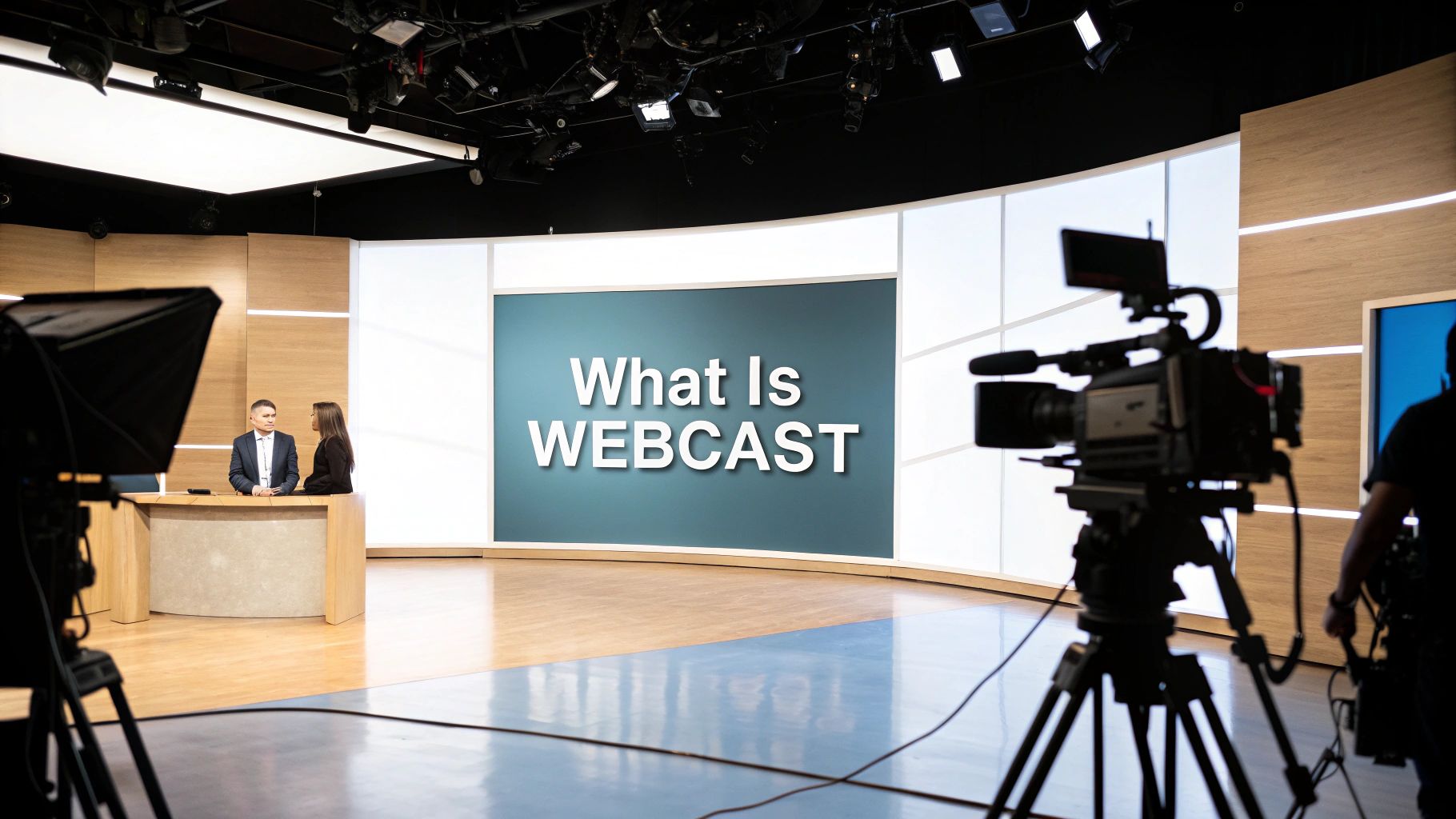
At its core, a webcast is a live video broadcast sent out over the internet, designed to reach a large audience spread out across different locations. Think of it like a private television broadcast for your organization. It's a powerful one-way communication tool where a presenter, or a small group, can speak to many viewers at once.
Unlike a typical video meeting, a webcast is built for scale and control, not for back-and-forth collaboration. It’s the perfect setup when the message is the main event.
What Is a Webcast, Really?
Imagine you’re renting out a massive digital auditorium. A webcast lets you fill that space with hundreds, or even thousands, of people in real-time to hear what you have to say. This one-to-many model is exactly what you need for a CEO's company-wide town hall, a major product launch, or a keynote speech for a virtual conference.
The demand for this kind of live streaming has exploded alongside better internet access. Companies have jumped on board, realizing they can connect with a global audience while cutting event costs by a massive 30-50% compared to flying everyone out for an in-person event. It's a fascinating part of broadcasting's evolution from old-school radio to today's digital streams.
This is a world away from traditional TV or radio, which depends on expensive satellite or cable networks. Webcasting just needs the internet, making it a far more accessible and affordable option for just about any organization.
To make the difference crystal clear, let's break it down.
Webcast vs Traditional Broadcasting At a Glance
The table below gives you a quick snapshot of how modern webcasting stacks up against the old guard of TV and radio.
| Feature | Webcast (Internet) | Traditional Broadcast (TV/Radio) |
|---|---|---|
| Delivery Medium | Internet via streaming platforms | Radio waves, satellite, or cable |
| Audience Reach | Global, limited only by internet access | Regional or national, limited by broadcast range |
| Interactivity | Limited (Q&A, polls, chat) | Typically none (passive viewing/listening) |
| Accessibility | Available on computers, mobile devices | Requires a television or radio receiver |
| Cost to Produce | Generally lower, highly scalable | High initial and ongoing costs |
As you can see, webcasting offers a level of flexibility, reach, and cost-effectiveness that traditional methods just can't match. It puts the power of broadcasting directly into the hands of organizations, without the massive infrastructure costs of the past.
How Webcasting Technology Powers Your Stream
Ever wonder what happens in that magical space between your camera and your audience's screens? It’s not quite smoke and mirrors, but it’s a slick process that relies on a few key technologies working in perfect harmony to create a seamless live experience. It all kicks off with your camera and microphone, which capture the raw video and audio.
This raw feed gets passed to a crucial piece of the puzzle: an encoder. Think of an encoder as a digital shipping expert. It takes your huge, uncompressed video and audio files and skillfully packages them down, compressing them into a much smaller size that’s ready for a trip across the internet. This step is non-negotiable for smooth streaming.
From there, the neatly compressed data travels to a streaming platform like AONMeetings, which acts as the central distribution hub. This kind of webcasting technology is the powerful engine behind many of the top-tier virtual event platforms, giving them the muscle needed for large-scale online events and broadcasts.
The Final Delivery to Your Audience
Once your stream hits the platform, it doesn't just beam out directly to every single viewer from one spot. Instead, it gets a major assist from a Content Delivery Network (CDN). The best way to picture a CDN is as a global network of local warehouses, all strategically placed around the world.
Your streaming platform sends your broadcast out to all these warehouses. When someone tunes in, they get the stream from the server that’s physically closest to them. This simple but brilliant setup slashes lag and buffering, making sure everyone gets a crisp, stable picture, no matter where they are on the map.
A webcast’s success really hangs on this end-to-end process. By efficiently compressing, distributing, and delivering the stream, the technology makes sure you can put on a professional and reliable broadcast for thousands of viewers at once.
This visual breaks down the simple yet powerful flow from a single presenter to a global audience.

The infographic really drives home the core idea of a webcast: using the internet to connect one presenter to a massive, widespread audience. A few different protocols handle this data transfer behind the scenes. Digging into the differences between them can give you an even deeper appreciation for how this technology works. You can learn more here: https://aonmeetings.com/rtmp-vs-rtsp/
The Evolution from Niche Broadcast to Global Tool
Webcasting didn't just show up one day. Its journey started back in the dial-up days of the 1990s, when early internet video was more of a pixelated, stuttering science experiment for tech junkies than a serious business tool. For companies, broadcasting online was a neat idea, but slow connections and clunky software made it totally impractical.
The real change started when the technology got smarter. Better compression standards were a total game-changer, making it possible to send higher-quality video without completely overwhelming the primitive internet connections of the time. This one advancement turned streaming from a cool novelty into a real, workable medium.
From Flash to Flawless Streaming
For years, streaming platforms were stuck on Flash players, which were notoriously buggy and always needed plugins. The big turning point came when the entire industry shifted to HTML5 video. This technology is built right into modern web browsers, so there’s no extra software to download, creating a much more stable and universal viewing experience on any device, from a desktop PC to your phone.
That transition was a massive part of the webcast's evolution. A key milestone was the introduction of the MPEG-4 compression standard back in 1998, which finally made decent-quality online video and audio a reality. A decade or so later, the move away from Flash to HTML5 between 2011 and 2016 locked in the reliable, smooth streaming experience we all expect today. You can get the full story on these advancements in online video.
Think about it: better compression plus universal browser support is the magic formula that paved the way for high-definition, massive-scale webcasts. It took the simple idea of broadcasting and made it truly global and dependable.
Today's webcasting technology is the culmination of decades of hard work and innovation. What started as a niche concept for hobbyists has become an absolutely essential tool for global business communication, marketing, and training. It’s a direct line from a simple idea to a powerhouse platform.
Powerful Ways Businesses Use Webcasting

Knowing the tech is one thing, but seeing it drive real business results is where the true power of webcasting shines. A webcast isn’t just another streaming tool; it’s a strategic asset for high-impact communication, capable of reaching across entire organizations and global markets.
From tightening internal alignment to launching a product with a bang, its applications are as broad as they are effective. Smart companies use webcasts to connect with global teams, generate high-quality leads, and broadcast critical information with the polish and professionalism it deserves.
Corporate Communications and Training
One of the most immediate uses for webcasting is inside the company walls. Picture a CEO delivering a quarterly update to thousands of employees spread across multiple continents. A webcast ensures everyone gets the same message at the same time, creating a powerful sense of unity and transparency. No more "he said, she said."
It's also a game-changer for training and development at scale. A single expert can deliver a world-class training session to an entire workforce, slashing the huge costs tied to travel and venue rentals. More importantly, it guarantees everyone receives consistent, high-quality information.
By centralizing communication, a webcast eliminates inconsistencies and empowers leaders to speak directly to their entire organization, no matter where employees are located.
Marketing and Lead Generation
On the marketing front, webcasts are a genuine powerhouse for building a brand and winning new customers. A major product launch, for instance, can generate massive market buzz by reaching customers, partners, and the press all at once with a slick, engaging presentation.
Webinars, which are just a more interactive type of webcast, are especially potent for lead generation. Hosting an expert-led session on a topic your audience is hungry for instantly positions your brand as a thought leader. In fact, understanding why webinars are essential for modern businesses is the key to building a robust marketing funnel that attracts genuinely interested prospects looking for solutions.
High-impact marketing and communication use cases include:
- Major Product Launches: Create an exciting, live event feel to generate buzz and media coverage.
- Investor Relations Calls: Share financial results and company updates with stakeholders in a secure, professional format.
- Expert-Led Webinars: Attract and qualify leads by offering valuable educational content.
- Global All-Hands Meetings: Connect a distributed workforce with consistent and direct leadership communication.
What Are the Real Business Benefits of a Webcast?
Beyond simply getting your message out, a webcast brings some serious, measurable advantages to the table that traditional events just can't touch. The most obvious win is its incredible scalability. Think about it: whether you're presenting to 100 people or 10,000, the core effort and cost are pretty much the same. Suddenly, geographical borders just disappear.
This kind of reach naturally leads to some pretty dramatic cost savings. When you go digital, you sidestep the hefty price tags that come with physical events. There’s no venue to book, no travel and hotel bills for your speakers, and no complicated on-site logistics to manage. A webcast neatly replaces all those budget killers with one efficient digital platform.
From Engagement to Actionable Data
But here's where it gets really powerful. One of the biggest perks of a webcast is the treasure trove of data it gives you. At an in-person event, it's tough to truly know who was paying attention. Webcasting platforms, on the other hand, deliver deep analytics. You can see exactly who showed up, how long they stayed, what content they clicked on, and which resources they downloaded.
This kind of data is gold for sharpening your communication and marketing efforts. It's no surprise that in the corporate world, over 75% of large enterprises have made webcasting a regular part of their communications, boosting employee engagement by up to 40%. On top of that, interactive features like a live chat have been shown to increase how much an audience retains by at least 30%—a clear sign of just how effective they are. You can find more insights on how webcasting has shaped corporate communications.
The real beauty of a webcast is that its value doesn't evaporate when the live event ends. By making a recording available on-demand, you give your content an indefinite shelf life, letting it continue to generate leads and provide value long after you've signed off.
When you combine that kind of reach, cost-efficiency, actionable data, and long-term value, the webcast becomes an essential tool for any modern organization that wants to communicate effectively and actually see a return on its investment.
How to Keep Your Webcasts Secure and Compliant

When you're handling sensitive information, webcast security isn't just another feature on a list—it's an absolute must. Protecting your broadcast from prying eyes is critical, especially when the conversation turns to private financial data, proprietary strategies, or confidential patient information.
Think of end-to-end encryption as a digital armored truck for your content. It scrambles the video and audio the moment it leaves your camera and keeps it that way until it reaches your intended viewers. This makes it completely unreadable to anyone who might try to intercept it along the way. Honestly, this should be the baseline for any professional webcast you run.
Controlling Access to Your Webcast
Beyond encryption, the next layer of defense is all about managing who gets through the virtual door. You need tools that give you precise, granular control over your audience.
- Password Protection: This is the simplest way to create a private event. Only people with the correct password can get in.
- Domain Restrictions: This feature is perfect for internal all-hands meetings. It limits access to viewers with specific email domains, so you can set it to only allow users with an "@yourcompany.com" email address to join.
- Single Sign-On (SSO): For corporate environments, SSO integration is a game-changer. It lets employees use their existing company login credentials, which is not only more secure but also a lot more convenient for everyone involved.
If you’re in a regulated industry like healthcare, compliance with standards like HIPAA is non-negotiable. Enterprise-grade platforms like AONMeetings are built from the ground up to meet these tough demands, giving you the secure framework you need to protect sensitive data and enjoy complete peace of mind.
Answering Your Top Webcasting Questions
If you're diving into the world of live streaming, you probably have a few questions. That's completely normal. Getting these common points cleared up is the first step toward choosing the right tool and hosting a sharp, professional event that hits the mark every time.
One of the biggest head-scratchers for people is the difference between a webcast and a webinar. They sound alike, and they both involve streaming, but they’re built for entirely different jobs. Think of a webcast as a one-to-many broadcast, designed for a huge audience that’s mostly there to watch and listen—kind of like a live TV show translated for the web. It's your digital auditorium.
Webcast vs. Webinar
A webinar, on the other hand, is designed for smaller, more intimate groups where two-way communication is the goal. It's much more like a digital classroom, packed with features that encourage the audience to jump in and participate. If you’re stuck trying to figure out which one fits your needs, we have a detailed guide that breaks it all down in our comparison of a webcast vs webinar.
Another question we hear a lot is about interactivity. Can a webcast actually be interactive? The answer is yes, but it’s a more controlled kind of interaction. You can absolutely engage your audience with tools like moderated Q&A sessions, live polls, and dedicated chat boxes. This allows for audience input without derailing the presenter's flow. Unlike a typical meeting, attendees can't just turn on their own audio or video.
Finally, there’s the question of internet speed. For viewers, a stable connection of about 5 Mbps is usually plenty to get a smooth, HD stream. For the person doing the broadcasting, however, the stakes are higher. We strongly recommend a reliable, wired connection with at least 10 Mbps upload speed to ensure you’re sending out a high-quality, buffer-free broadcast to everyone watching.
Ready to host professional, secure, and scalable webcasts? AONMeetings gives you a browser-based platform with all the tools you need to connect with your audience, from HD streaming to detailed analytics. Start broadcasting with confidence at https://aonmeetings.com.