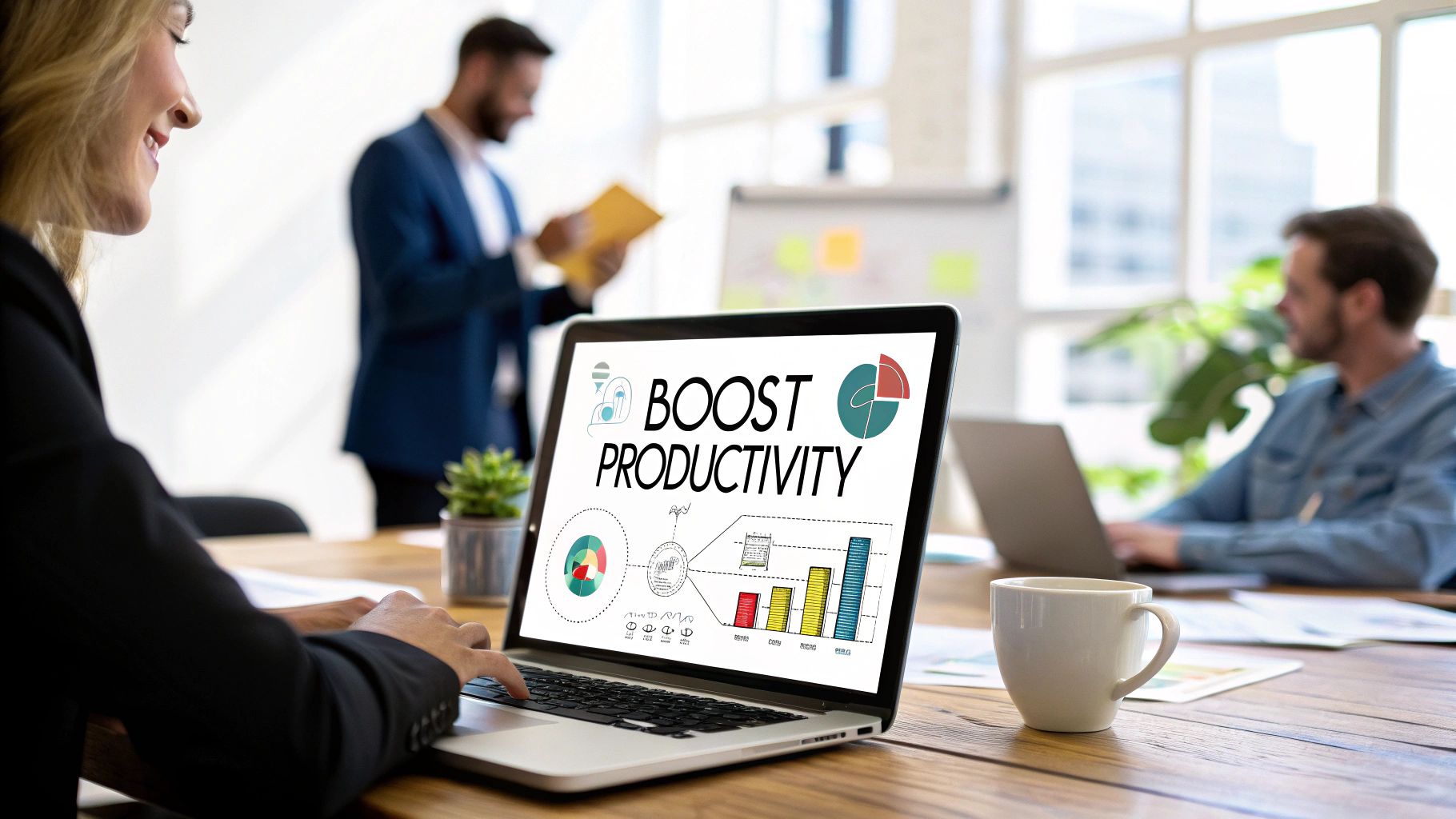
Boosting team productivity isn't about cracking a whip or demanding longer hours. It's a much more nuanced game—a strategic mix of smarter workflows, the right tech, and a culture where people genuinely want to do great work. Nail these three, and you can transform a team from just busy to truly effective.
The Modern Productivity Puzzle: Unlocking Your Team's Potential

In too many offices, there’s a dangerous myth that activity equals achievement. Teams are drowning in a sea of emails, back-to-back meetings, and task lists that never end, yet they struggle to make real, meaningful progress. This gap between effort and actual results is the heart of the modern productivity puzzle.
The problem usually runs deeper than just clunky processes. It’s often a cocktail of digital friction, fuzzy priorities, and a quiet, creeping lack of genuine engagement that grinds things to a halt.
Understanding the Engagement Gap
The data on this is pretty stark. Globally, only 21% of workers felt truly engaged in their jobs in 2024. That's not just a feel-good metric; it translates into a massive economic drain. Some estimates pin the cost of this disengagement at billions in lost productivity worldwide. Tackling this isn't a "nice-to-have" for morale—it's a core business strategy that can directly impact your bottom line. You can dive deeper into these employee productivity statistics and their impact over at ArchieApp.co.
A productive team doesn’t happen by chance. It’s the result of deliberate leadership that aligns individuals, fosters collaboration, and cultivates a culture of excellence.
This guide is designed to cut through the fluff and give you a clear roadmap. We’ll break down actionable strategies that address this puzzle by focusing on the three pillars that truly move the needle on team performance. For another great perspective, you can find more insights on how to improve team productivity.
The Three Pillars of Team Productivity
To get real, lasting results, you need a balanced approach. It’s about building a framework that addresses how work gets done, the tools you use, and the human environment where it all happens. Think of it as a three-legged stool—if one leg is wobbly, the whole thing falls over.
Let's break down this framework into what I call the three pillars of team productivity.
The Three Pillars of Team Productivity
| Pillar | Key Objective | Primary Benefit |
|---|---|---|
| Optimized Workflows | Eliminate bottlenecks and create clear, repeatable systems. | Reduced friction, less wasted effort, and consistent output. |
| Smart Technology | Choose and integrate the right tools to automate and inform. | Minimized mundane work, freeing up time for high-value tasks. |
| Engaged Culture | Foster psychological safety, ownership, and clear communication. | Empowered individuals who innovate and perform at their best. |
By methodically improving each of these areas, you're not just patching problems—you're building a resilient, high-performing team that's ready to take on whatever comes next. It’s a holistic approach that creates a sustainable engine for growth, not just a temporary burst of activity.
Redefining Workflows for Peak Efficiency
Generic advice like "work harder" doesn't actually boost team productivity. The real gains come from working smarter, and that means taking a hard look at the very systems your team relies on every single day. The goal is to build structured, repeatable processes that cut down on friction and eliminate confusion, giving your team the freedom and confidence to get things done on their own.
Think about it: vague or undocumented workflows are where time goes to die. When your people have to constantly ask for directions or reinvent the wheel for tasks they do all the time, you lose all momentum. The fix is to create crystal-clear Standard Operating Procedures (SOPs) for anything you find yourself doing more than once. This isn't about creating soul-crushing bureaucracy; it's about building a shared playbook everyone can run with.
For example, a customer support team might map out an SOP for handling refund requests. That document would walk through every single step, from the first customer email to processing the refund and sending the confirmation. This kind of clarity means every customer gets the same great service, and new hires can get up to speed in a fraction of the time.
Uncovering Hidden Bottlenecks
Even with great SOPs, inefficiencies have a way of hiding in plain sight. To find them, you have to dig deeper than the surface-level symptoms. One of my favorite methods for this is the ‘Five Whys’ technique. It’s a deceptively simple but incredibly powerful way to follow a problem right back to its root.
Let's say a marketing team is always missing the deadline for its weekly newsletter.
- 1. Why are we missing the deadline? “Because the final graphics are always late.”
- 2. Why are the graphics late? “Because the designer is waiting for the copy to be approved.”
- 3. Why is copy approval so slow? “Because the marketing manager is too swamped to review it.”
- 4. Why is the manager so swamped? “Because she keeps getting pulled into last-minute meetings.”
- 5. Why are there so many last-minute meetings? “Because our campaign planning is totally reactive instead of proactive.”
Boom. The real issue isn't a slow designer—it's a broken planning process. By asking "why" just a few times, the team can stop pointing fingers and start fixing the actual problem, like implementing a proper content calendar.
A great workflow doesn’t just tell people what to do; it removes the obstacles that prevent them from doing it. It’s about designing a system where the path of least resistance is also the path of greatest efficiency.
Getting these issues out in the open requires honest dialogue before they grow into major roadblocks.

This really gets at the heart of it. You need to build a culture where people feel safe enough to have those casual, "hey, this isn't working" conversations. That's how you create the continuous feedback loop you need to keep refining how your team gets things done.
Implementing Agile Principles for Flexibility
For dynamic, project-based work, rigid, step-by-step processes can completely fall apart. This is where you can borrow some game-changing principles from the Agile methodology, even if you're not a tech team. Agile is all about breaking massive projects into smaller, more manageable cycles known as sprints.
Take a software team building a new feature. Instead of a six-month marathon where you only find out if you succeeded at the very end, they work in focused, two-week sprints.
Example Agile Sprint for a Development Team
| Sprint Goal | Key Tasks | Outcome |
|---|---|---|
| User Login | Build secure authentication; design UI; test for bugs. | A functional, testable login page is ready for feedback. |
| Dashboard V1 | Develop core widgets; connect to data API. | A basic but usable dashboard is complete. |
| Reporting Feature | Create export-to-CSV function; add date filters. | Users can now download their basic activity data. |
This iterative rhythm lets the team adapt to feedback and pivot quickly without derailing the whole project. A marketing team could use this exact model for a product launch, with sprints dedicated to audience research, then content creation, then ad campaigns. Each sprint delivers a tangible result, which keeps momentum high and allows for constant improvement.
By building systems that are both clear and flexible, you shift your team from a reactive, fire-fighting mode into one of proactive, efficient execution.
Measuring What Matters: Shifting from Presence to Performance

For decades, productivity was a simple, if flawed, equation: presence equaled performance. The manager who saw you at your desk first thing in the morning and last thing at night assumed you were getting the most done. It’s an old-school mindset that isn't just ineffective—it's actively damaging to morale and genuine output.
To truly boost team productivity, we have to stop measuring time and start measuring what actually matters: results. It's a fundamental shift from tracking hours clocked to evaluating the tangible outcomes your team produces. It’s all about impact, not just activity.
Moving Beyond Busywork to Outcomes
The first step is a big one. You need to redefine what success actually looks like for your team. Instead of asking, "Did everyone work a full eight hours?" the better question is, "Did we achieve our most important goals this week?" This simple change moves the conversation from micromanagement to meaningful progress.
So, what should you track? Focus on metrics that directly reflect the value your team creates.
- Project Milestones Achieved: How consistently is the team hitting key project deadlines and completing major phases of work?
- Customer Satisfaction Scores (CSAT): For any client-facing team, this is a powerful, non-negotiable indicator of quality and effectiveness.
- Tasks Completed and Quality: It's fine to measure the number of tasks finished, but always pair it with a quality benchmark. Rushed, sloppy work isn't productive.
- Lead-to-Close Ratio: For a sales team, this outcome-based metric is far more telling than the number of calls made.
When you focus on these kinds of results, you empower your team with autonomy. You give them the freedom to figure out how to best do their work, as long as they deliver on the agreed-upon outcomes. This approach is especially critical for hybrid and remote teams where old-school "visibility" is a relic of the past. If you're finding it tough to keep your distributed team on the same page, check out our guide on how to engage remote employees for some fresh ideas.
A Practical Framework for Setting Goals
Adopting outcome-based metrics is much easier when you have a clear system for setting goals. One of the most effective frameworks I’ve seen in action is OKRs (Objectives and Key Results). It’s a simple yet powerful way to get the entire team aligned around what’s most important.
- Objectives are the ambitious, qualitative goals you want to achieve. They answer the question, “What do we want to accomplish?” An objective should be inspiring, like "Launch the Most Successful Product in Company History."
- Key Results are the specific, measurable milestones that tell you if you've achieved your objective. They answer, "How will we know we got there?" For the objective above, key results might be "Achieve 10,000 new sign-ups in Q1" or "Secure press coverage in 5 major industry publications."
OKRs provide the perfect balance of big-picture inspiration and concrete, measurable progress. They give every team member a clear line of sight from their daily tasks to the company's highest priorities.
Defending Against Distractions
Even with the best goals, modern work is a minefield of interruptions. Constant notifications, context switching, and those "just a quick question" pings can demolish focus and torpedo productivity.
Research confirms what we all feel. While we seem to be working more efficiently in shorter workdays, that progress is fragile. The average worker is interrupted roughly every three minutes and needs an average of 23 minutes to fully refocus. That's a staggering amount of lost time. Managing distractions isn't a "nice-to-have"—it's critical.
To counter this, you have to be deliberate about creating space for focused work.
- Implement 'Deep Work' Blocks: Encourage your team to block off 2-3 hour chunks of time in their calendars for uninterrupted, focused work. During these blocks, notifications are off, and non-urgent meetings are politely declined.
- Establish Communication Norms: Create a simple guide for when to use different tools. For instance, Slack is for quick, non-urgent questions, while a phone call is for genuine emergencies. This stops every minor query from becoming a major distraction.
- Promote Asynchronous Communication: Normalize the idea that an immediate response isn't always required. This simple cultural shift empowers team members to check messages on their own schedule, protecting their flow state.
By measuring what matters, setting clear goals, and fiercely protecting your team's focus, you move your team's culture away from performative busyness and toward genuine, sustainable high performance.
Choosing the Right Technology Stack for Your Team
Let's be honest: picking the right technology isn't about chasing the latest shiny app. It's about intentionally building a digital environment where your team can actually get work done. The wrong tools create what I call "digital friction"—those invisible hurdles like clunky interfaces and constant login issues that add frustration to an already busy day.
The right tools, on the other hand, act as a force multiplier. They automate the grunt work and free up your team to focus on the strategic, high-impact tasks that really matter.
This isn’t a minor inconvenience; it's a massive productivity bottleneck. A recent study found that a staggering 95% of companies said technical issues like slow software were directly hurting their team's output. In stark contrast, the most productive teams are 242% more likely to use AI, which helps them reclaim an average of 3.6 hours every week by automating repetitive tasks. The data paints a clear picture: a thoughtfully chosen tech stack is no longer a "nice-to-have." It’s fundamental.
You can dig into more of these findings over at smbguide.com. Ultimately, the best technology just fades into the background, making work easier without becoming another chore to manage.
Core Software Categories for Every Team
While every team's specific needs will differ, a solid tech stack is almost always built on a few core pillars. Think of these as the foundation for modern work, addressing coordination, communication, and automation.
- Project Management Tools: Platforms like Asana, Trello, or Monday.com are the central nervous system for your team's projects. They create a single source of truth for who is doing what and by when, preventing tasks from slipping through the cracks.
- Communication Hubs: It's hard to imagine work without tools like Slack or Microsoft Teams. They get conversations out of chaotic email threads and allow for quick, asynchronous updates that protect everyone’s focus.
- Automation and Integration: This is where the real magic happens. Tools like Zapier act as the glue between your other apps. For instance, you could set up a workflow where a new lead in your CRM automatically creates a task in Asana and pings the relevant person in Slack. No more manual data entry.
The Rise of Smart Automation and AI
Artificial intelligence has officially moved from a sci-fi concept to a practical, everyday tool for boosting team productivity. Its true power lies in its ability to take on the low-value, repetitive work that eats up a surprising amount of your team’s day.
Here are a few practical ways to think about integrating AI:
- Kickstart Content Creation: Generative AI can whip up a first draft of almost anything—reports, emails, social media posts, you name it. This gives your team a solid starting point to refine, slashing the time it takes to get from a blank page to a finished product.
- Summarize Everything: AI assistants can instantly digest long documents, meeting transcripts, or lengthy email chains. Team members can get up to speed in minutes instead of wading through pages of text. We've seen this firsthand with tools like AONMeetings, which provides AI-generated transcripts to make meeting follow-ups completely painless.
- Automate Scheduling: The endless back-and-forth of finding a meeting time is a universal time-waster. AI-powered schedulers can handle that entire process, freeing up calendars across the board.
The goal of AI in the workplace isn't to replace people, but to augment their intelligence. By offloading routine cognitive tasks to AI, you free up your team's mental bandwidth for the stuff that really requires human ingenuity: strategic thinking, creative problem-solving, and innovation.
A Checklist for Evaluating New Tools
Before you let any new software into your ecosystem, run it through a quick evaluation. It's easy to get distracted by "shiny object syndrome," so you have to be ruthlessly practical.
Your Software Evaluation Checklist
| Criteria | Key Question to Ask | Why It Matters |
|---|---|---|
| User-Friendliness | Is the interface intuitive? Can someone figure it out without a massive user manual? | If a tool is a pain to use, your team just won't adopt it. It becomes shelfware—a total waste of money. |
| Integration Power | Does it play nicely with the tools we already rely on, like Slack or Google Drive? | A tool that operates in a silo creates more work, not less. You need a cohesive digital ecosystem, not a collection of isolated apps. |
| Scalability | Will this tool grow with us? Or will we hit a wall and face a painful migration in a year? | Think ahead. Choosing a tool that can't scale is just kicking a much bigger problem down the road. |
| Real-World Value | Does this actually solve a specific, painful problem for our team right now? | Every tool should have a clear purpose and a measurable impact. If it's just a "nice-to-have," it's probably a "don't-need." |
And don't forget that hardware is part of your stack, too. Simple upgrades can have an outsized impact. For instance, understanding the top benefits of dual monitors for productivity can be a game-changer for individual and team output.
A well-chosen tech stack streamlines everything your team does, reduces friction, and gives them the support they need to truly excel.
Fostering a Culture of Psychological Safety and Engagement
Let's be honest: productivity isn't just about slick workflows and fancy software. At its core, it's a deeply human thing. You can have the most buttoned-up processes in the world, but if your team operates in a culture of fear, you’ll never see their best work. To unlock real productivity, you have to start with an environment where people feel safe, respected, and genuinely empowered.
This is the whole idea behind psychological safety. It’s that shared feeling on a team that it's okay to take risks. It means people aren't afraid to speak up, pitch a wild idea, admit they messed up, or question the way things have always been done. Without it, you get silence. You get stagnation.
The financial cost of this is staggering. Studies have shown that disengaged employees cost companies trillions in lost productivity. This isn't a fluffy, feel-good concept; it's a hard number that hits the bottom line. A culture of safety is the engine that actually drives high-performing teams.
Building Trust Through Open Communication
You can't build trust in a single team-building retreat. It's forged over time through consistent, honest, and respectful communication. Leaders have to be the ones to go first, modeling the exact behaviors they want to see from everyone else.
This means pushing beyond the typical "what's your status?" updates. It’s about creating real space for people to voice concerns, suggest something that sounds a little crazy, or even show a bit of vulnerability. That kind of openness doesn't just happen; it has to be deliberately cultivated.
"A productive team doesn’t happen by chance. It’s the result of deliberate leadership that aligns individuals, fosters collaboration, and cultivates a culture of excellence where people feel safe to contribute fully."
Especially with remote and hybrid teams, a simple communication charter can work wonders. Just defining when to use Slack versus email can cut down on a surprising amount of stress and miscommunication. For a deeper dive, check out these virtual collaboration tips to boost team productivity.
How to Give and Receive Feedback Effectively
Feedback is the lifeblood of growth, but it can turn toxic fast if the environment isn't safe. The goal is to build a culture where feedback feels like a gift, not an attack. That requires a structured and empathetic approach from everyone.
When you're giving feedback:
- Be Specific and Actionable. Don't just say, "Your report was confusing." Try this instead: "I had a hard time following the data in the second section. Maybe we could add a summary chart to make the key trends pop?"
- Focus on Behavior, Not Personality. The feedback should always be about the work or a specific action, never a judgment of someone's character.
- Deliver It Privately and Promptly. A quick one-on-one chat is infinitely more effective than calling someone out in a group or letting an issue fester for weeks.
And when you're on the receiving end? The most important thing is to listen to understand, not to immediately get defensive. Thank the person, ask questions to clarify, and give yourself a moment to process it before you respond.
From Failure to Fuel: A Scenario
The way a leader reacts to a mistake can single-handedly define a team's culture. Imagine a new marketing campaign completely bombs, missing every single target.
-
The Fear-Based Response: The manager calls an emergency meeting, demanding to know who's to blame. The people responsible are publicly shamed. What’s the result? The team will be terrified to take another risk. Ever. Creativity shrivels up, and people start hiding problems instead of solving them.
-
The Safety-Based Response: The manager brings the team together for a blameless post-mortem. The question isn't who failed, but why the campaign failed. The group digs into flawed assumptions, gaps in the process, and market misreads—all as a collective learning opportunity.
The second approach completely reframes failure. It's no longer a career-killer; it's a valuable data point. This is how you build a true learning organization where mistakes become the fuel for smarter decisions and future productivity. It sends a powerful signal that innovation isn't just allowed—it's encouraged, even when the outcome isn't a home run.
Putting It All Together: Your Team's Productivity Playbook
Boosting your team's productivity isn't a project with a start and end date. It's really a commitment to constantly refining how everyone works together. We've covered the big strategies, but now it’s time to turn those ideas into a focused, real-world plan.
The first step? A brutally honest audit of where you are right now. Where is the most friction in your day-to-day operations? Maybe your workflows are clunky and undocumented, leaving everyone to guess their way through tasks. Are you still measuring outdated metrics like hours clocked instead of tangible results? Or is your tech stack causing more headaches than it solves? You can't chart a course for where you're going until you know exactly where you stand.
Once you have that clear picture, don't try to boil the ocean. Just pick one or two key areas to tackle first.
A Checklist for Immediate Action
- Clarify One Core Workflow: Zero in on a single recurring process that constantly causes confusion or delays. Work with your team to create a dead-simple Standard Operating Procedure (SOP) for it. When you eliminate ambiguity, you empower people to act confidently.
- Switch to Meaningful Metrics: It's time to stop tracking busy-work and start focusing on results. A simple framework like OKRs can be a game-changer, getting everyone aligned on what truly moves the needle for the business.
- Tune Up Your Tech Stack: Look at your tools. Are they truly integrated and saving people time? Pay special attention to your communication platforms, because messy practices there can derail everyone's focus. For example, knowing how to run productive virtual meetings is a massive leverage point, and our guide has practical tips to get you there.
The real goal here is to build a system where the path of least resistance is also the path of greatest productivity. That sweet spot happens when crystal-clear processes are backed by the right tools and a culture of genuine trust.
Finally, you have to weave these new habits into the very fabric of your team's culture. Building psychological safety—where people feel secure enough to give honest feedback, ask "dumb" questions, and take calculated risks—is the bedrock of any high-performing team. Lead the way, celebrate the small wins, and be the most consistent champion of these new, more productive habits.
Still Have Questions?
Even with the best strategies in place, improving team productivity often brings up new questions. That’s perfectly normal. Let's dig into a couple of the most common hurdles managers run into when they start putting these ideas into practice.
How Can I Measure Productivity for Creative Roles?
This is a big one. Measuring productivity for designers, writers, or strategists can feel like trying to nail Jell-O to a wall. Their output isn't as clean-cut as sales calls made or widgets produced. The trick is to stop thinking about raw output and start focusing on impact and process.
Instead of getting bogged down in timesheets, shift your focus to things like:
- Milestone Completion: Are they hitting their deadlines for key project phases? Think first drafts, user research, or wireframe delivery. Consistent progress is a great sign.
- Quality of Output: Use feedback loops and revision rates as your guide. If their work is high-quality and needs minimal rework, that's a huge productivity win.
- Contribution to Goals: This is where the magic happens. How did their work directly push a larger goal forward? For instance, did a designer's new landing page actually improve conversion rates? This ties their creative genius to real business results.
Don’t fall into the trap of measuring creative work by the pound. One brilliant idea is infinitely more valuable than ten mediocre ones. The goal is to track progress and impact, not just activity.
How Do I Get My Team to Buy Into New Processes?
Nobody likes having change forced on them. If your team feels like you're just dropping new rules from on high, they'll resist. The secret to getting genuine buy-in is to make them part of the solution, not just subjects of the change.
Always start with the "why." Frame the new process as a fix for a shared headache. Something like, "I know we've all been burned out by last-minute scrambles. Let's try this new planning system to make our deadlines feel less like a fire drill."
Then, get them involved in building it. Ask for their feedback on new tools or workflows. When people have a hand in creating the system they'll be using, they develop a sense of ownership. That feeling is the difference between begrudging compliance and enthusiastic adoption.
Ready to take the friction out of your virtual meetings? AONMeetings gives you a seamless, browser-based solution with AI-powered transcripts, screen sharing, and top-notch security—all built to make your team’s collaboration time more productive. Discover how AONMeetings can upgrade your team's communication.